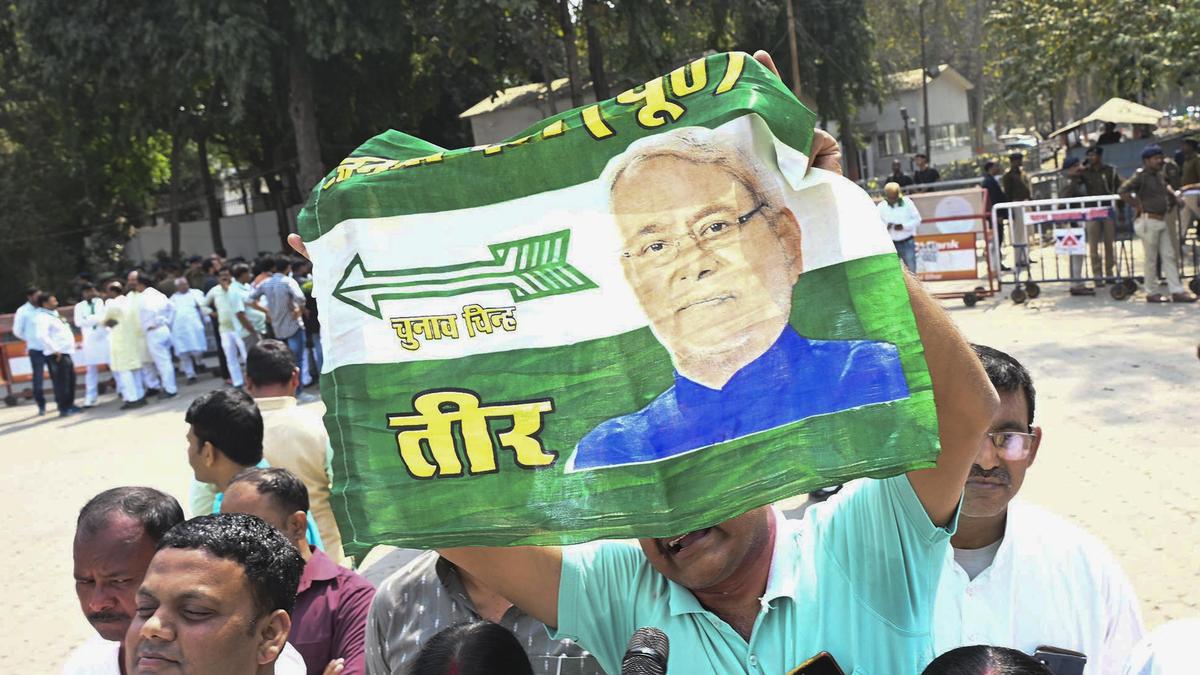
JD(U) workers outside the residence of Bihar Chief Minister Nitish Kumar after he announced that he will be contesting the Rajya Sabha polls, bringing the curtain down on his tenure as the longest-serving CM of state, in Patna, on March 5, 2026.
| Photo Credit: PTI
A comment circulating online encapsulates the political developments in Bihar perfectly – “it took a global war for a regime change in Iran to effect one in Bihar.”
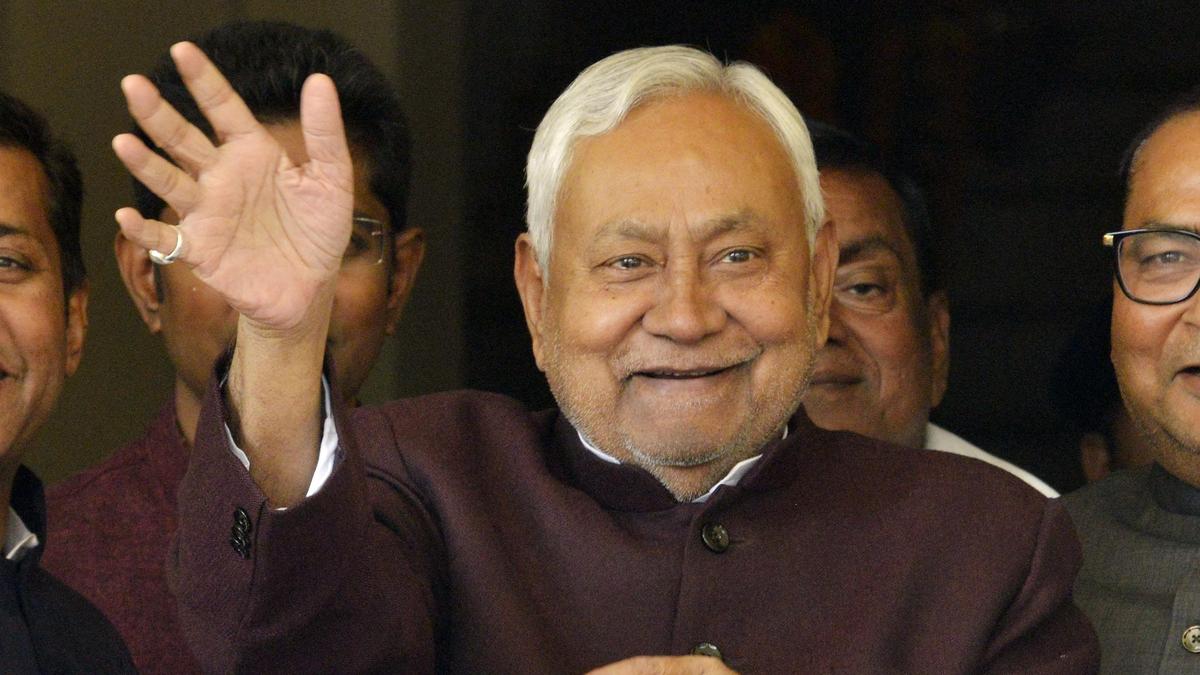
Nitish Kumar, the State’s longest serving chief minister, is going to the Rajya Sabha, vacating the post for National Democratic Alliance ally, Bharatiya Janata Party (BJP), which finally gets to hold the top spot.
The relationship between the Janata Dal(U) and the BJP through the years — from the time when the JD(U) was Samata Party to now — has been full of twists and turns, with one constant factor: Nitish Kumar as the chief ministerial face.
This constancy of the alliance’s face, since 2000, when the Samata Party got fewer seats than the BJP, but saw Mr. Kumar being projected as chief minister for a brief period of seven days in a short lived claim, to 2025, when, again, the BJP won more seats than the JD(U), was a product of the political field of Bihar but also the image and persona of Mr. Kumar.
Nitish Kumar’s special place in Bihar
Mr. Kumar managed to carve out a strong base from the larger Mandal umbrella of Extremely Backward Classes (EBC), Mahadalits, some sections of the Pasmanda or backward Muslims, and women voters. It was a reinterpretation of social justice politics and the capture of regional sub nationalism of Bihari pride, of a renewal of the State after the “Jungle Raj” of the RJD years that made him valuable to the BJP as well, which was considered a party of largely upper caste Hindu communities.
With the advent of Prime Minister Narendra Modi, hailing as he does from a backward community, may have modified some of that image for the BJP in Bihar, but as the party discovered in 2015, the caste arithmetic did not add up for it in the absence of Mr. Kumar.
That is perhaps why, in every Assembly poll since, even if the JD(U) won fewer seats than the BJP, Mr. Kumar would be the chief ministerial face. Even in 2025, with reports of Mr. Kumar’s ill health doing the rounds, the BJP had insisted that he would be the chief minister.
When situation changed after Bihar Assembly elections
It is a different matter that after the results were out. BJP’s senior leaders sent firm messages that a succession plan in the JD(U) was needed to be put in place, and the chief minister’s position should be ceded to the BJP.
Mr. Kumar’s reported ill health had led to questions being raised over succession plans in the party, with his son Nishant Kumar now being groomed to enter the JD(U). There are apprehensions that a Nitish-less JD(U) in Bihar will be like a swagger less junior partner of the BJP or may even lose its ground in the State.
But what it demonstrates more starkly is the end of an era in Bihar politics, where the heirs of Ram Manohar Lohia and Jayprakash Narayan – Mr. Kumar and RJD supremo Lalu Prasad held sway. The generation that participated in the anti-Emergency movement and ushered in the heydays of socialist politics is making its final bows from the stage.
What we are likely to see in Bihar is another churning.
Bihar as a State has always been at the forefront of presaging political forces that later hold sway in the rest of the country, from anti-Congressism in the 1960s and 1970s to Mandal and post-Mandal politics, to the cultivation of a new women’s vote bank, and as it sees the exit of Nitish Kumar as chief minister, it will be interesting to see what and who takes his place.
Published – March 05, 2026 12:54 pm IST