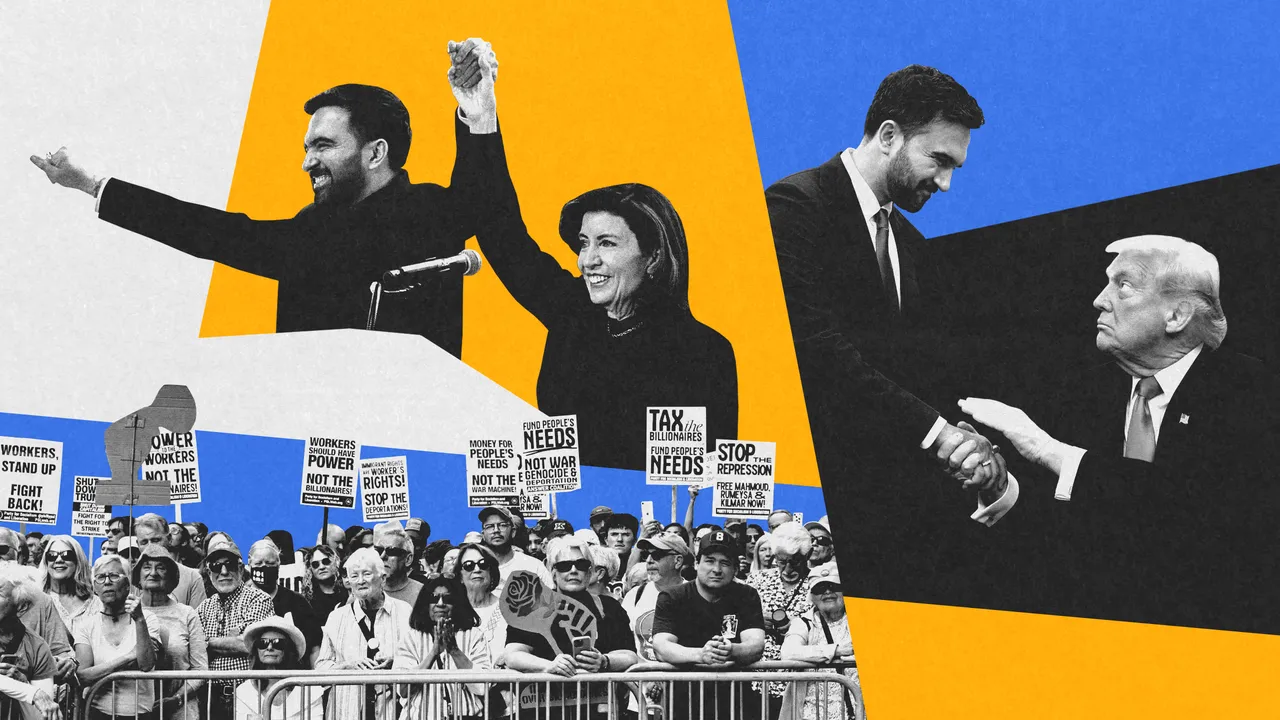
The day before the Mayor flew to D.C., he had skipped a “Tax the Rich” rally in Albany. Organized by the New York City Democratic Socialists of America (which Mamdani has called his political home) and Our Time for an Affordable NYC (an independent organizing group dedicated to advancing Mamdani’s agenda), the event was co-sponsored by almost two dozen other advocacy groups and unions, and billed as an Albany takeover: there were speeches, singing, a march, and a delegation from New Yorkers United for Child Care with kids in tow. The goal was to push the state government—and especially the Governor—to support legislation raising taxes on corporations and the wealthy. Hochul “needs to understand that it’s her fight, too,” Phara Souffrant Forrest, a State Assembly member who represents, among other areas, Fort Greene and Clinton Hill in Brooklyn, told me. “There’s so much room for the executive and the legislature to work together.” Forrest, who is a member of the D.S.A.’s “Socialists in Office” caucus, has introduced the Fair Share Act, which would allow a two-per-cent income tax on city residents who earn more than a million dollars a year.
“I’ve been told that the Governor is not very happy with us,” Gustavo Gordillo, a co-chair of the N.Y.C.-D.S.A., said from the rally stage, with a note of pride. He went on to riff about witnessing the wealth of the Tisch family (of which Mamdani’s police commissioner, Jessica Tisch, is a scion) during his days as a gallery assistant. “Alice Tisch had paid two hundred and fifty thousand dollars for that sculpture,” he recalled, of a work owned by the commissioner’s aunt. This was, presumably, the sort of scene that the Mayor had been inclined to avoid.
His choice not to attend was reportedly a gesture toward maintaining good relations with the Governor, but it presented a challenge for his comrades: a headlining mayor might have made it easier to get New Yorkers onto predawn, post-blizzard buses outside Barclays Center that Wednesday morning. His absence also left an opening for someone to serve as the event’s public face and master of ceremonies.
That role had been accepted by the City Council member Chi Ossé—although, by his own account, somewhat reluctantly. “It took multiple asks,” he told me on Tuesday afternoon. “I really do not love going up to Albany,” he said. “It’s cold. It’s far away.” Getting there would require a 5:45 a.m. departure. “But this is for a good cause,” he added. Ossé has emerged as a bit of a foil for Mamdani—he is another young left-wing upstart with an aptitude for explainer videos—though his choices have seemed to lack the strategic discipline and focus that defined Mamdani’s mayoral campaign. (Late last year, Ossé sought the D.S.A.’s endorsement for a longshot primary challenge to the House Minority Leader, Hakeem Jefferies, and Mamdani took time out from his mayoral transition to make the case to D.S.A. members against endorsing him.) In Albany, Ossé filmed a video, rife with quick cuts, of himself walking around briskly in a dark suit and talking about the Fair Share Act.
Still, his ambivalence about the day’s trek may have been representative. The organizers had chosen a rally venue that could accommodate forty-three hundred attendees, but the turnout on Wednesday was a bit under two thousand, Divya Sundaram, the deputy director of Our Time, said. She called the event “proof of concept” for her group’s push to organize New Yorkers beyond Election Day. “We would have loved to have the Mayor there,” she told me after the rally. “And also, you know, this is the tension of organizing from the outside, independently of the administration. Sometimes, we have to lead.” Hochul, as it happened, missed the rally, too; she was in New York City.
Mamdani deviated sharply from his general strategy of playing nice at a February press conference where he proposed his preliminary budget. In the event that the Governor does not deliver a tax increase, as few expect her to, Mamdani said that he would ask the City Council to increase property taxes, a prospect that was greeted with general horror and incredulity—“a non-starter,” in the words of the City Council speaker, Julie Menin. According to Mamdani, taxing the rich and taxing property owners represented the “two paths to bridge the city’s inherited budget gap,” even if the latter would place the burden on “the backs of working- and middle-class New Yorkers” (as the rueful Mayor put it).