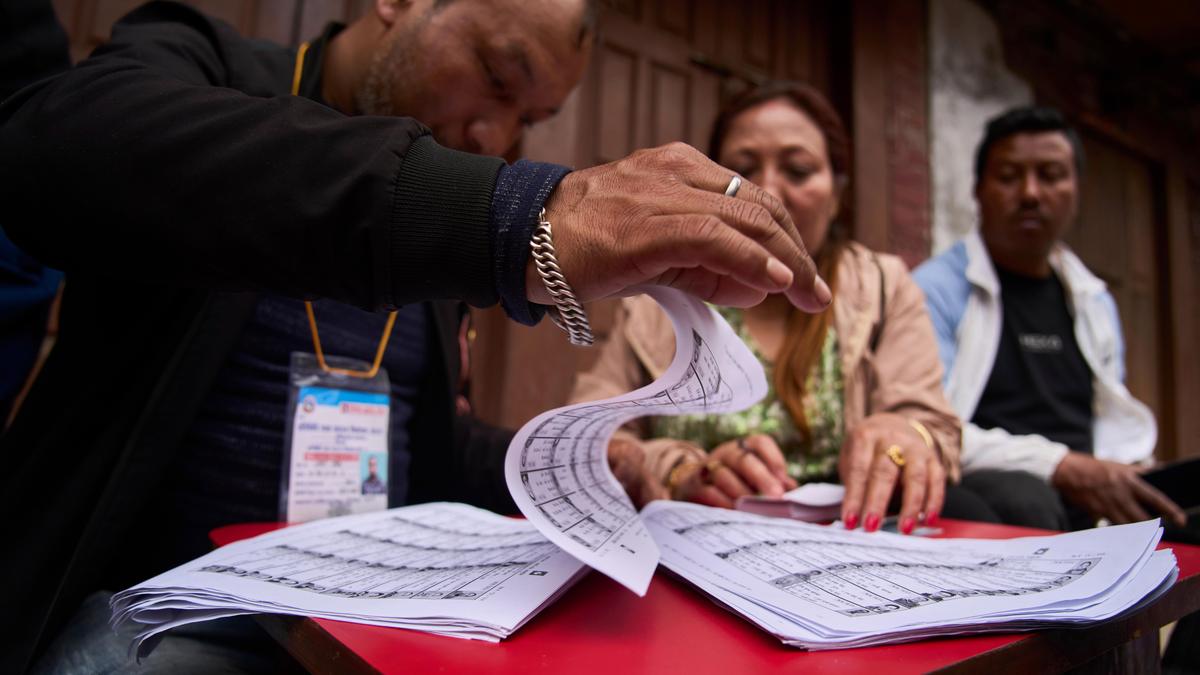
An Election Commission representative helps a voter find their name on the list to cast their vote at the polling station for the parliamentary election in Bhaktapur, Nepal, Thursday, March 5, 2026.
| Photo Credit: AP
Vote counting is underway in Nepal following Thursday’s (March 6, 2026) election, first since last September’s protests, with early trends showing the Rastriya Swatantra Party (RSP) in the lead.
According to Election Commission data, the RSP is ahead in 47 constituencies.
RSP chief Rabi Lamichhane is leading in Chitwan-2 with 6,700 votes, while CPN-UML’s Asmini Ghimire trails with 2,321 votes.
Similarly, RSP senior leader Balendra Shah, the party’s prime ministerial candidate, is ahead in Jhapa-5 with 10,190 votes, leaving former Prime Minister K.P. Sharma Oli behind at 4,087 votes.
The RSP, a relatively new party founded about four years ago by Mr. Lamichhane, a former TV host, saw a massive groundswell ahead of the March 5 election, fuelled by public frustration with established parties like the UML and Nepali Congress.
RSP’s Ranju Neupane is leading in Kathmandu-1 with 15,455 votes, while her closest rival Prabal Thapa trails at 6,364 votes.
The polls were triggered by youth-led protests demanding an end to corruption, clean governance, and accountability — issues the RSP has championed since its founding.
Meanwhile, the Nepali Congress and the UML are leading in six and four constituencies, respectively.
The Election Commission said on Thursday (March 6, 2026) that preliminary estimates suggest a 60% voter turnout. More than 18.9 million people were eligible to vote, with around one million added to the rolls since last September’s protests, out of a population of roughly 30 million.
Last year’s protests claimed 77 lives, including 19 killed in police firing on the first day, September 8, 2025, which led to the fall of the Oli government.
Published – March 06, 2026 08:19 am IST