
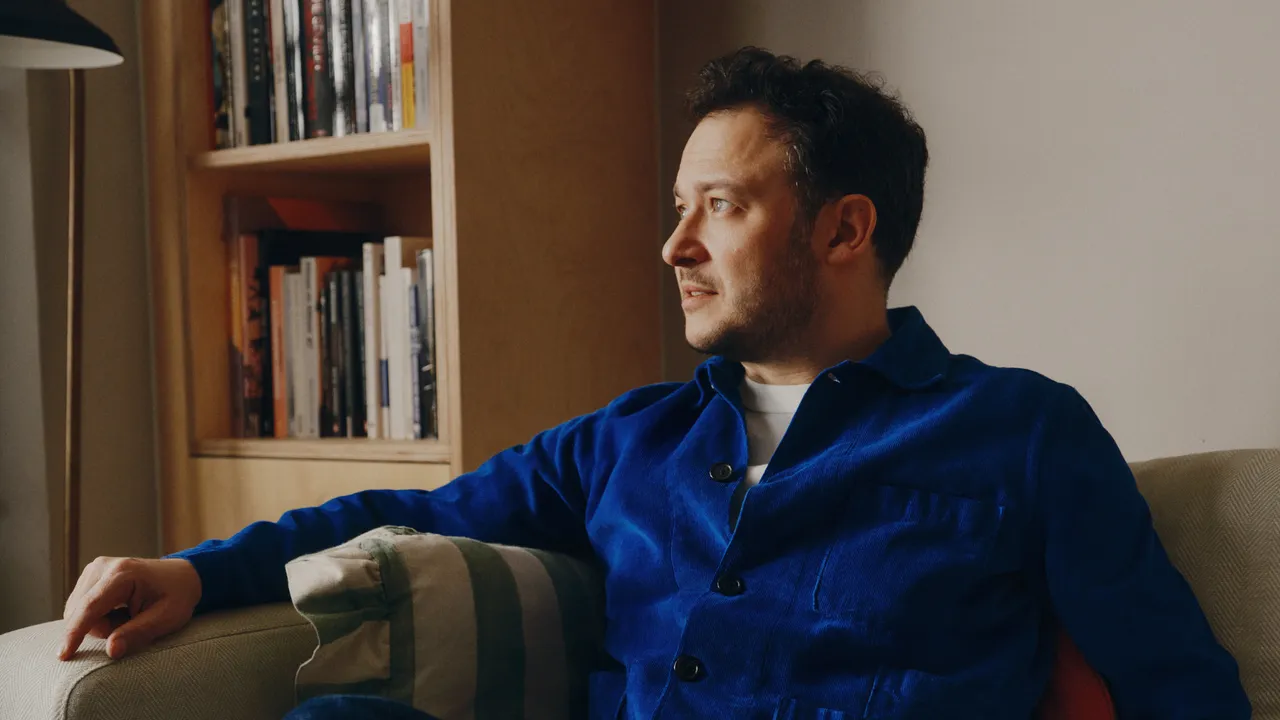
“Was it up when you were writing the play?” I asked.
“It was in my eye line,” he said.
At the entrance, an attendant asked to see our tickets. “I’m the author,” Rosenblatt said. His words didn’t seem to register. He added, “The playwright. I wrote the play. I’m just going to listen from the back.”
The attendant’s brow furrowed. “Come with me,” he said. We followed as he forged a path through the throng until he spotted the house manager. “He says he wrote the play,” the attendant said, nodding in our direction. The manager smiled at us over the attendant’s shoulder and waved us in.
We entered at the foot of the proscenium. “Too close, too overwhelming,” Rosenblatt said, moving up the aisle toward the ochre curtains at the back of the stalls, his preferred spot. The lights dimmed. The audience drew itself to attention. Rosenblatt whispered, “The beginning of Act II is quite fun. There are a couple of good jokes. So, when I’m back here, I can feel how lively the show’s been tonight.” What distinguished this night’s audience was the particular quality of its focus. There was no restlessness, no coughing. The audience was braced, ready to listen.
The play imagines the arrival at Dahl’s Buckinghamshire home of Tom Maschler and Jessie Stone, emissaries from Dahl’s English and American publishing houses, both of whom are Jewish, soon after the publication of his antisemitic review and just prior to the launch of his novel “The Witches.” To the publishers, who have made a big investment in Dahl, the visit is an exercise in disaster management. To Dahl, it’s an opportunity to poke the bear. To the audience, the ensuing debate works as a kind of Roman candle, the play’s lacerating wit shooting sparks of light over an array of divisive issues that are hard, in these heartbreaking days, to speak or hear about—Palestine and Israel, Jewish identity, political correctness, antisemitism, malignant narcissism. Rosenblatt’s script trades in paradox, not polemics; it is at once uncomfortable and thrilling. Among “Giant” ’s many astonishments—of thought, characterization, construction—the most surprising, perhaps, is that it is the first play that Rosenblatt ever wrote.
Rosenblatt paced. Act II begins with the offstage sound of a toilet flushing. Dahl, who suffered from lifelong back pain after crashing his plane as an R.A.F. fighter pilot in the Second World War, enters. “Narrow escape. . . . Battle adrenaline meant I held it in,” he says, and then proceeds to dump on the other characters with withering ironies. Beyond the physical resemblance, Lithgow conveys Dahl’s soigné swagger, the shellac of his English public-school privilege. Dahl, like his fictional witches, is “dangerous because he doesn’t look dangerous.” Although his fiancée, Felicity Crosland, or Liccy, begs him not to, Dahl draws his jejune young housekeeper, Hallie, into his mess. He asks if her upcoming holiday includes a visit to Israel: