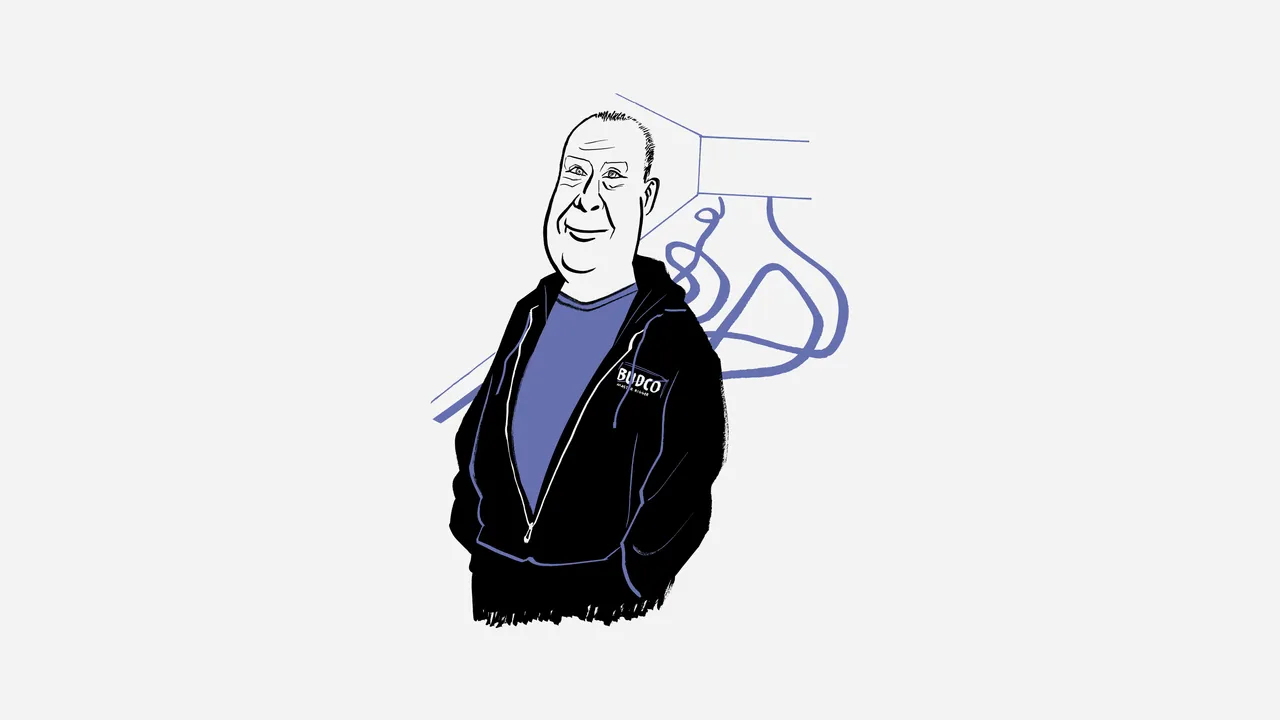
At a Gagosian gallery in Chelsea the other day, the master rigger Joe Vilardi, a gray-haired Long Islander in a hoodie that said “Budco Enterprises,” surveyed the final steps of the installation of Michael Heizer’s new exhibition, “Negative Sculpture.” The show features “Convoluted Line A” and “Convoluted Line B” (2024), two eighty-seven-and-a-half-foot curved steel troughs that wend through the gallery’s floor like a figure skater’s tracks on ice.
Budco, of Hauppauge, New York, moves things like generators and HVAC systems—“anything big and heavy, basically,” Vilardi said—but its specialty is large-scale art. Because Heizer’s sculptures occupy negative space—they go into the ground—an elevated false floor was made for them to sit in. The pieces are for sale, and could, like much of Heizer’s work, be displayed outside, amid grass or dirt. At the gallery, workers were distributing crushed red granite in a one-inch layer across the base of each sculpture. “This is the icing on the cake,” Vilardi said: gravel.
Planning for the art works’ move began in 2024. “We went to Heizer’s ranch, where they were fabricated,” Vilardi said. Heizer, who is eighty-one and now resides mostly in New York, was long based in rural Nevada. (His magnum opus, the mile-plus-long “City,” in Garden Valley, took fifty years and some forty million dollars to make.) Vilardi has worked with Heizer for three decades; their first in-person meeting was on the ranch. “When I drove in, Michael walked out to the car, and he was carrying a slab of beef,” Vilardi recalled, extending his arms in front of him. “He goes, ‘You must be Joe.’ I said, ‘Yes, I am.’ He says, ‘Come on with me—we’re going to throw this on the smoker.’ ” They did, and ate it for dinner. “It was cattle he raised,” Vilardi said. “I think it was called beefalo—buffalo and cow. It was delicious.” (It was, in fact, Red Angus.) The most recent Heizer exhibit that Vilardi moved to Gagosian before this one involved five large rocks paired with tilted steel slabs, each work weighing more than twenty-six tons. “Never a dull moment with Michael,” Vilardi said.
Vilardi grew up on Long Island and began working for his cousin’s rigging company, pre-Budco, in his teens. One of their clients was the sculptor Richard Serra, conjurer of gargantuan things, who would change the course of Vilardi’s career. “We kind of grew together,” Vilardi said. Serra connected Vilardi to the broader art world—if his crew could handle a twenty-ton Corten-steel swerve, one imagines, they could handle anything. “I used to tell my guys, ‘We’re moving this huge piece of steel, but we have to treat it like glass,’ ” Vilardi said. “We’re not even supposed to touch it.”
He has since worked with a Who’s Who of colossal sculpture: Heizer and Serra, but also Simone Leigh, Jeff Koons, MOMA. The biggest and heaviest stuff can involve cranes, hydraulic gantries, barges, and police escorts. In comparison, the “Convoluted Line” sculptures, totalling more than eighteen tons, were a breeze. Budco trucked the pieces from Nevada to Long Island, and then to Gagosian, where they were moved with a “big forklift” and special reinforced steel dollies. “This is a pretty simple project for us—relatively small and easy to handle,” Vilardi said. “The only challenging part was the layout, making sure we get the measurements proper so it’s centered in the room the way Michael wanted it. And then alignment, where all the sections come together—you want that to look smooth and flush,” which takes “a little bit of welding and bolting.”