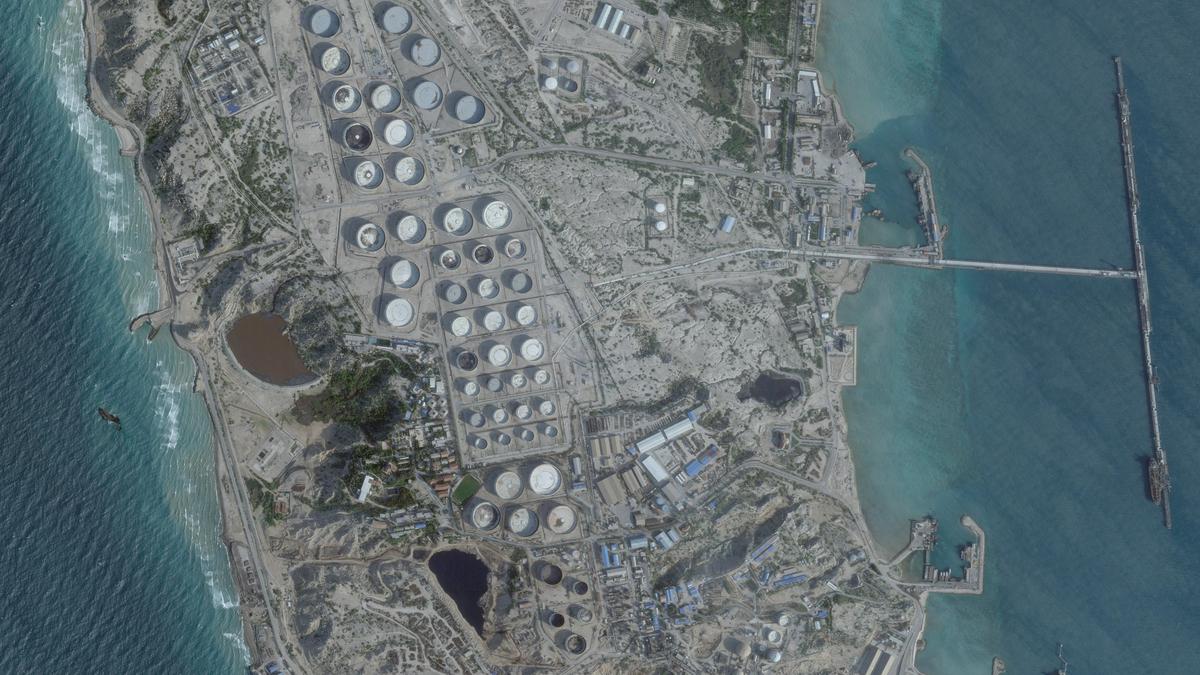
A satellite image shows an oil terminal at Kharg Island. Photo: Planet Labs PBC/Handout via REUTERS
A U.S. attack has “totally obliterated every military target” on Kharg Island, Iran’s crown jewel in the Persian Gulf, said President Donald Trump in a social media post on March 14. Trump described the attack as “one of the most powerful bombing raids in the history of the Middle East”. The attack came after Mr. Trump’s earlier warning to Iran not to shut the Strait of Hormuz, a critical maritime checkpoint connecting the Gulf with the Arabian Sea. The strait remains effectively closed.
As the U.S.–Israel war on Iran enters its second week, Kharg Island is now at the centre of the conflict. The tiny coral outpost in the Gulf sits at the centre of Iran’s oil export network. The attack on the island now raises the risk of choking Iran’s economic lifeline and triggering wider global disruptions.
Iran-Israel war LIVE updates
Kharg Island is no ordinary speck of land. Barely 8 km long and covering about 20 sq. km, it rises from the northern Persian Gulf as a small island, about 25–30 km off Iran’s mainland coast. It sits in the turquoise waters of the Gulf. The landscape is dominated not by nature but by industry: massive storage tanks, sprawling jetties and an airstrip cutting across the island. Super tankers dock here daily to load millions of barrels of crude piped in from Iran’s inland oil fields.
‘Forbidden island’
Jalal Al-e-Ahmad, the celebrated 20th century Iranian writer and philosopher, once described Kharg as the “orphan pearl” of the Persian Gulf. Today, many Iranians term it the “forbidden Island” because of the tight military restrictions surrounding it. Guarded by the Islamic Revolutionary Guard Corps (IRGC), entry is limited to those with official clearance.
Despite the secrecy, the island has a long and layered history. Kharg has long been part of regional trade networks. Ancient records from around the 10th century describe it as a stop for pearl divers and traders travelling between India and Basra, Iraq. Dutch merchants fortified the island in the 18th century before being driven out, and the British briefly occupied it in the 19th.
Unlike most of Iran’s coastline, where shallow waters make it difficult for large tankers to dock, Kharg has deep waters and long jetties that allow multiple ships to load oil at the same time. Its oil terminal was built in the late 1950s with help from the American company Amoco, after modern supertankers proved too large for many of Iran’s ports.
Export hub
The island soon became Iran’s main export hub for two key reasons. It could be connected by pipeline to the major oil fields of south-western Iran, and its deep-water location meant it was one of the few places where the new generation of supertankers could dock easily. By the 1970s, Kharg was already capable of loading several supertankers at once. After the 1979 Iranian Revolution, the facilities were nationalised. During the Iran–Iraq War in 1980, Saddam Hussain’s forces repeatedly bombed the island’s oil terminal, but Iran rebuilt it and kept exports flowing.
Its modern importance, however, comes from oil.
Up to 90% of Iran’s crude exports pass through the Kharg Island terminal. Oil from Iran’s largest producing fields, such as Ahvaz, Marun and Gachsaran travels via pipeline to the Kharg island before being loaded onto tankers that sail through the Strait of Hormuz and into global markets.
Kharg typically handles between 1.3 and 1.6 million barrels of oil a day. In the weeks before the U.S. and Israel launched the war on Iran, exports briefly surged close to three million barrels a day. The island can load up to a maximum of seven million barrels a day and store roughly 30 million barrels at a time.
More disruption
Most of that oil now goes to one country: China. China has emerged as the largest buyer of Iranian crude, importing more than 80% of the country’s oil exports. Iran earned $35.76 billion from oil exports in 2024, with China accounting for over 90% of that. This dependence is one reason Kharg has become a focus of discussions in Washington. Whoever controls the island effectively controls the main outlet for Iran’s oil. The idea of targeting Kharg Island is not new, it has long been part of Mr. Trump’s thinking. Nearly 40 years ago, he suggested striking Iran’s main oil-export hub if tensions escalated. “I’d be harsh on Iran,” he told The Guardian in 1988. “One bullet shot at one of our men or ships, and I’d do a number on Kharg Island. I’d go in and take it.”
The attack on Kharg could cripple the global supply, potentially pushing prices even higher. On Friday, Brent crude traded at $103.8 a barrel, up from $73 before the war broke out. Iran had earlier warned that any strike on the island would trigger swift retaliation. The war now appears set to escalate further—bad news for the global energy market and consumers.
Published – March 14, 2026 11:59 am IST