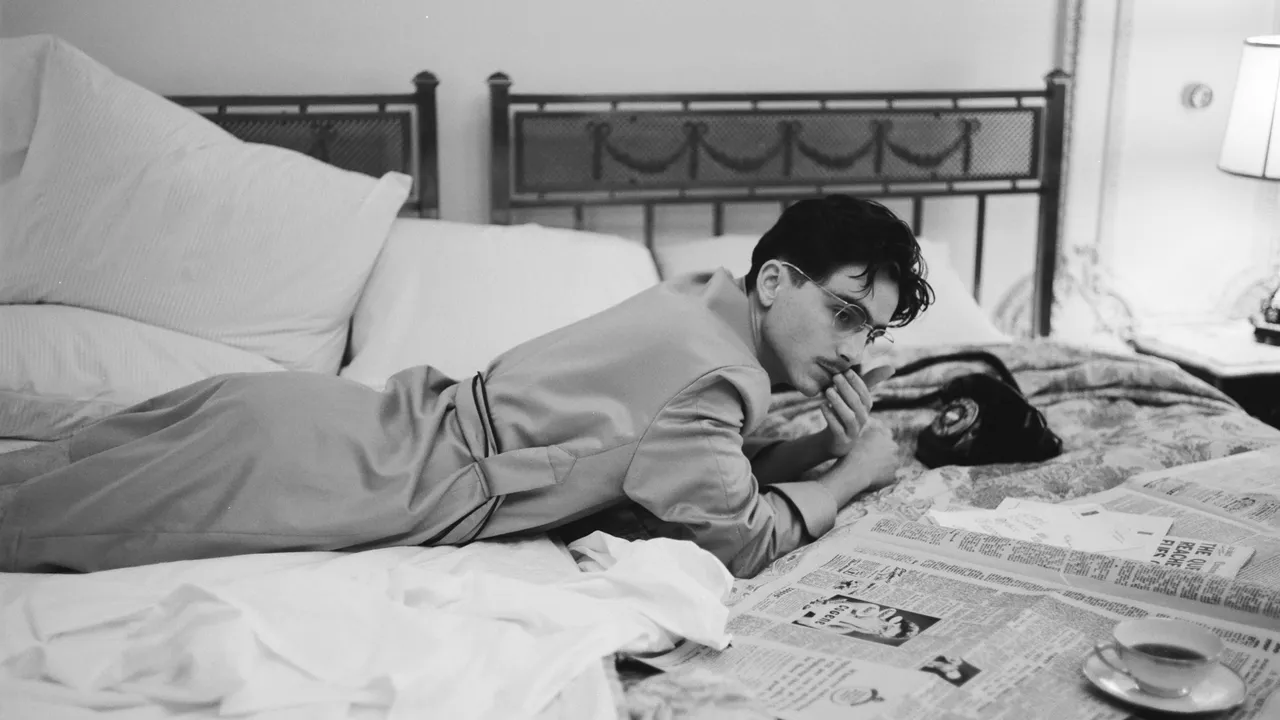
Later, I learned that the man was Atsushi Nishijima, known as Jima—an on-set stills photographer who in the past decade and a half has worked with some of our era’s most important filmmakers, among them Safdie, Yorgos Lanthimos, Ava DuVernay, and Noah Baumbach. Born in Japan in 1977, in the town of Shizuoka, about an hour outside Tokyo, Jima moved to the States to attend college. (“Me and my friend visited his uncle who lived in the D.C. area when I was fifteen, for spring break,” he told me, when we spoke by phone recently. “And I was, like, Wow, America! Everything was so big! I thought, I want to come here.”) His interest in photography was first piqued when he took an undergraduate class in black-and-white darkroom printing, and after he graduated he began to make his way—“slowly, slowly”—as a professional in New York. He fell into his current line of work almost accidentally, in the early two-thousands, after working on a project with Derek Cianfrance, who was making a TV show for Nike and needed some still images to use in the series itself. This led to Jima’s first job on a major movie set, shooting stills for Cianfrance’s 2012 drama, “The Place Beyond the Pines,” starring Ryan Gosling, Eva Mendes, and Bradley Cooper. “On the first day of the shoot, Derek took me to a room and there was Ryan Gosling, and he said, ‘Here, you guys take pictures,’ ” he told me. “That was my first time interacting with a big star.”
The fact that stills photographers often find themselves shooting very famous subjects at what might be sensitive, stressful moments on set is only one reason that the job requires a discreet, diplomatic presence. There is also the matter of the role’s essentially secondary position. The stills photographer must hover unobtrusively on the sidelines of moviemaking, taking pictures that will be used to promote a film. And yet what emerges from this elemental minorness is an art form with its own significance. “I’m documenting filmmaking on set, and eventually the photographs can become a kind of history,” Jima said. “I feel that’s my job.”