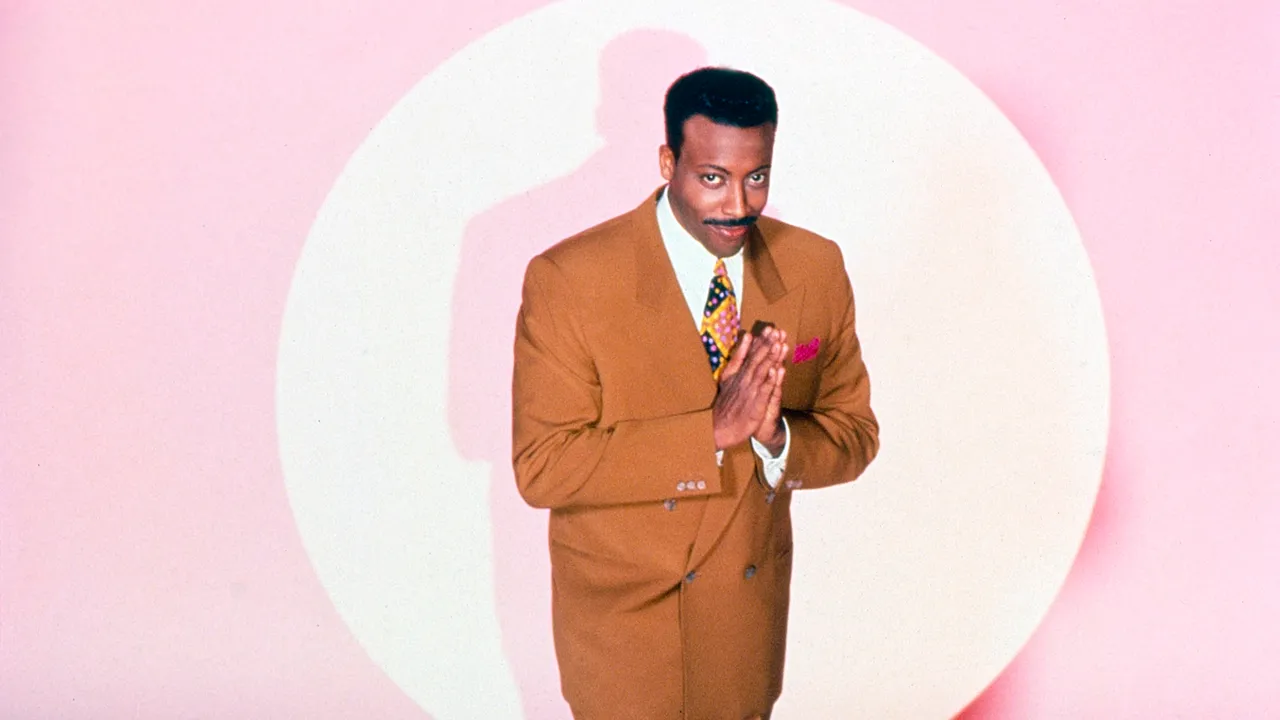
Late night isn’t just a time slot. It’s a concept, a temporal metaphor for what we can get away with under the cloak of night, when the kids are asleep, when we can claim innocence—nothing else was on! Like the “late-night” dissidents of YouTube, Hall rose to popularity by talking up the verboten. In his day, when the term “inner city” circulated as a racist bogeyman, Hall brought the soundscape of “the hood” into people’s living rooms. When promiscuity had been branded a public-health crisis by the religious right, he asked Madonna about the stamina of her boyfriend and “Dick Tracy” co-star, Warren Beatty. “Joan Collins once called him sexually insatiable,” Hall offered. Madonna begged to differ: “I would say that he’s satiable.”
In 1988, the year before his show premièred, Hall starred in “Coming to America,” a romantic comedy about an African prince (Eddie Murphy) who travels to Queens, New York, along with his aide (Hall), to find a bride. They make a stop at the Jackson Heights Y.M.C.A., where a Miss Black Awareness pageant is taking place. A reverend, also played by Hall, launches into a spirited sermon about the bikini-clad contestants: “Man cannot make it like this! Larry Flynt! Hugh Hefner! They can take the picture, but you can’t make it! Only God above, the Hugh Hefner on high, can make it for ya!”
Hall later told Howard Stern that he’d based the character, in part, on his father, Fred Hall, whom he calls, in his memoir, a “strict, conservative Baptist preacher.” Not so conservative—at sixty-five, he married Annie Martin, the twenty-one-year-old daughter of a church deacon. Hall was born to the odd couple in 1956 in Cleveland. (The “dog pound” is a reference to a raucous fan section in the city’s football stadium.) In his book, Hall describes their union as an opposites-attract situation. Fred listened to Mahalia Jackson spirituals, while Annie preferred Elvis and Ray Charles—what Fred called “hip-slapping music.” Nonetheless, Hall identifies a sensuality in his father’s sermonizing which would inspire his own late-night persona. “He doesn’t just preach,” Hall writes. “He puts on a show. With handkerchief in hand, he prowls the pulpit, he gesticulates, he growls, he shouts, he whispers.”
When Hall was five, his mother moved out, taking him with her. She worked long hours and got him a babysitter—an Emerson TV set, on which he would watch Carson, Merv Griffin, and Dinah Shore. “I get hooked on Dinah!, not what you would expect from a Black kid living in the ghetto,” he observes. Then again, representation was scarce—Jet magazine ran a column called “Television” that listed every Black person who was going to appear that week. But to the young Hall the color line wasn’t the biggest hurdle—bedtime was. He was in grade school, and Carson came on at 11:30 P.M. He writes, “I turn the sound way down, then crawl so close to the TV screen that I feel as if I’m practically inside The Tonight Show set, sitting next to Johnny.” He hosted the first “Arsenio Hall Show” in his basement. His musical guest, “Junior Brown from down the street,” sang the Temptations’ “Get Ready” on a Mattel Show’N Tell.
Fred Hall had hoped that his son would join the clergy, but Hall dreamed of becoming a magician, just like his idol, Johnny Carson. Hall’s book is in some ways a magician’s memoir of making it, capturing a working-class kid who pulls opportunities out of a hat. A teen-age cousin of Hall’s, who came to live with him and his mother after becoming pregnant, brought a book called “Magic for Beginners” home from the library. Hall taught himself tricks, sprinkling jokes into his performance: “I know all the white magicians say abracadabra. I say collard greens.”