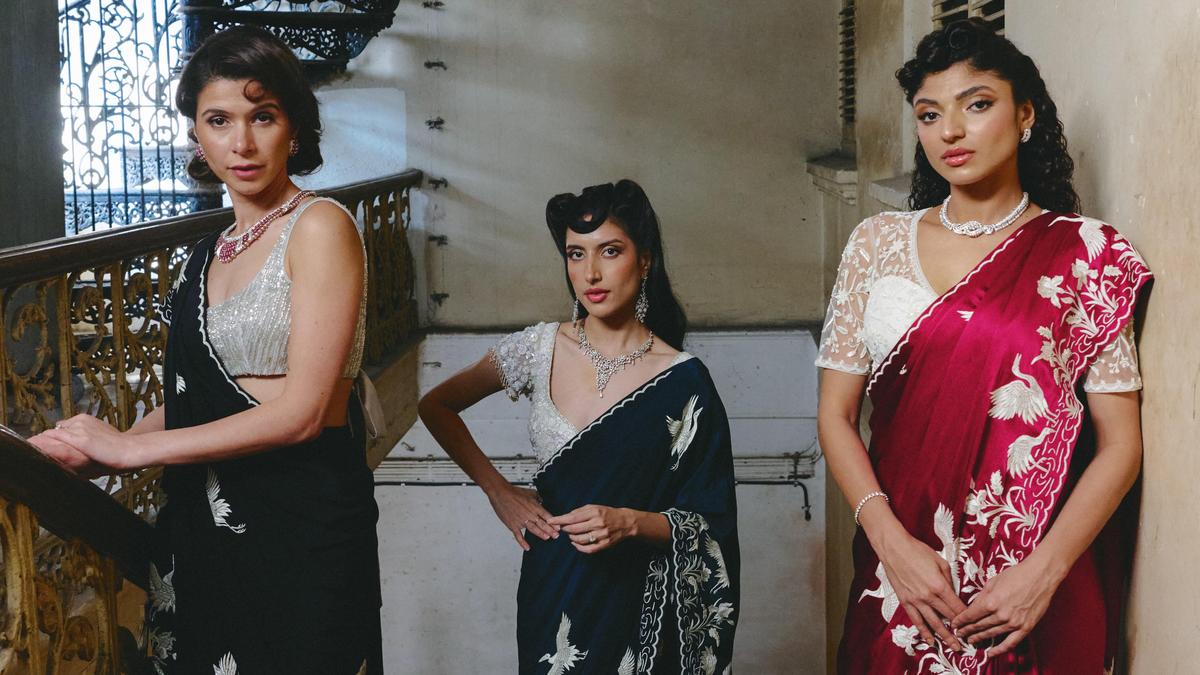
Saris from the new collection titled She Walks in Beauty
| Photo Credit: Special Arrangement
Ashdeen Z Lilaowala loves classics. So much, that for the launch of his new collection, She Walks in Beauty (named after Lord Byron’s poem), he traded modern venues for the 100 plus-year-old Albless Baug Parsi community centre in Mumbai. Instead of a runway, he went with an intimate salon style viewing, inspired by the 1850s fashion scene in Paris. This, he believes, was imperative so viewers could get a closer look at the intricate work that went into the garments. Traditional Parsi gara motifs like cranes, chrysanthemums, peonies and spides fill the body of the saris and line its borders. The work is elaborate but not loud. The pieces are soft yet bold; elegant, and classic, yet modern enough to be worn for a Gen Z wedding or even a night out.
The theme ties in beautifully with the collection which features archive-inspired saris that Ashdeen has collected over the years, through special pieces gifted from family, friends and sourced from other collectors. There are 21 saris in seven designs with a vibrant colour palette in cherry red, purple, burgundy, emerald, and black. The archive also serves as a source of inspiration for the artisans that work on the collections, helping them master signature motifs, effects and techniques that are core to the Parsi gara tradition, says Ashdeen.
The collection features archive-inspired saris that Ashdeen has collected over the years
| Photo Credit:
Special Arrangement
Largely credited with reviving the Parsi gara embroidery, Ashdeen says he does not like the accolade. “We have made it popular, more contemporary,” he agrees, adding, “We create stuff which is more wearable and across the line. It’s for a global audience.” What was bought only by older women, is now being bought by the young as well, he observes.
Earlier, it used to be a women-centric craft, and the label also had tunics for children. Men’s wear has recently been added to its fold. “Today men are peacocking in a way they never did before. Their outfits are as heavy. There’s a sense of new found boldness in Indian men to carry off embroidery and have lot of patterns in their wardrobe, especially at weddings,” says Ashdeen.
Other than saris, Ashdeen’s eponymous label also creates embroidered pants, waistcoats, jackets, gowns, and silhouettes that are Asian to a certain extent, like kimonos for example. He laughs about how he had been apprehensive about the sari gown but ended up creating them anyway. “You tend to bow when there is pressure,” he laughs and adds that if it was upto him he would have discouraged anyone wearing them.
Ashdeen is rich with anecdotes and information on Parsi culture. When he started the label in 2012, the sole purpose was to take Parsi gara embroidery as an inspiration and vocabulary to create a new range of saris and embroidery. The focus, he says, was on hand embroidery and “creating beautiful new designs instead of slavishly copying from past designs”.
Putting his textile design skill to good use, Ashdeen eventually incorporated various fabrics and crafts — bandhani, leheriya, Kanjeevaram — into his creations. “The challenge for us is to remain classic even after decades,” he says. A challenge he has probably overcome because, his creations from 10 years ago are still in demand. As part of the “2026 is the new 2016” trend that has been taking over social media, Ashdeen relaunched his collections from 2016. “People still find it wearable and we’ve been getting a good response. These are classics after all,” he smiles.
For details, log on to ashdeen.com
Ashdeen Lilaowala
| Photo Credit:
Special Arrangement
Published – March 17, 2026 12:19 pm IST