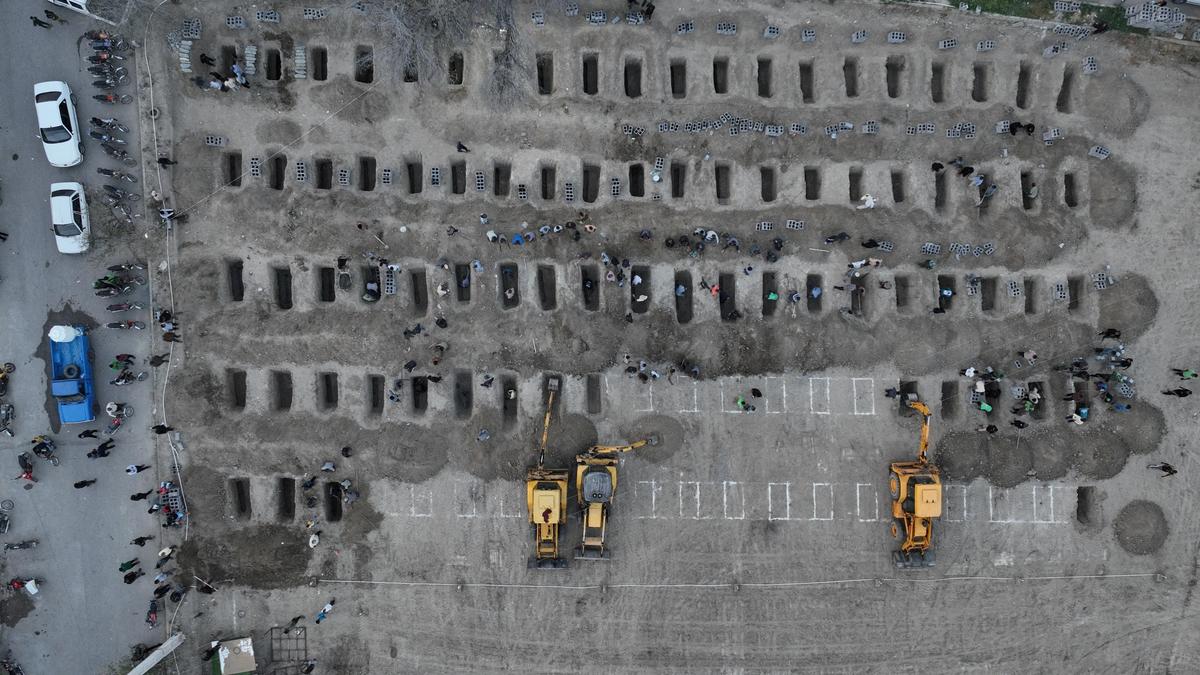
On the morning of February 28th, as hundreds of young girls were attending their classes in Minab’s Shajareh Tayyebeh school, the building was struck by a missile. Residents and rescuers, who rushed seeing black smoke rising in place of the school, found blood-stained backpacks, severed arms, and dead children buried under piles of rubble.
Their school was likely struck by one of the U.S.’s Tomahawk cruise missiles, claimed to be one of the most precise guided weapons in the world. The school was one of the casualties in the targeted attacks by the U.S. on Iran, in conjunction with Israel.
Later reports confirmed that around 168 children, mostly aged between seven and 12, were killed in the attack. The school was located adjacent to a naval compound operated by the Islamic Revolutionary Guard Corps (IRGC).
Though U.S. President Donald Trump initially suggested that Iran itself — despite not having Tomahawk missiles — may have been responsible for these attacks, media reports and the U.S.’s preliminary military investigations suggest the attack was a result of the U.S.’s use of outdated targeting data.
The Pentagon elevated its probe into the matter last week. A UN inquiry is also underway to investigate the fatal strike. Amnesty International, this week, said that the strike points to a failure by the U.S. forces to take feasible precautions to avoid civilian harm.
A war on children
However, the girls in Minab weren’t the only ones who paid the price of the ongoing war. More children are estimated to have been killed in the daily strikes launched by the U.S. and Israel on Iran in separate instances.
Less than two thousand kilometres away in Lebanon, more than a hundred children have been killed by Israel’s campaign since March 2. Reports indicate that Israeli airstrikes have completely wiped out generations of families in the country in less than two weeks. The death toll due to the ongoing conflict in Lebanon is reported to be rising faster than any other previous war that the country had previously endured.
What happened in Minab and what is unfolding in Lebanon aren’t isolated instances. Data points to a more troubling pattern — the U.S. and Israel together accounted for around 62% of “external attacks” that ended with a child casualty since 1996. External attacks refers to acts of aggression or military involvement by an actor on foreign soil.
The Hindu analysed events of external attacks that were recorded by the Armed Conflict Location and Event Data Project. While over 66,000 events of external attacks have been lethal (ending with any fatalities), around 4% of such reported attacks have ended up with at least one child fatality.
Incidences of attacks were used as a proxy, as data for child fatalities under external attacks were not separately maintained. These events offer a reliable snapshot of the extent of attacks against children during conflict. However, fatalities in individual events may be significantly higher. The data only pertains to confirmed events of deaths, therefore cases of missing children or unreported events of deaths are not included in the analysis.
A further look at the 4% reveals that close to 2,500 reported cases of external attacks have ended with a child fatality between 1996 and 2026.
A country-wise analysis of these events show that Israel accounted for about 41% of all external attacks that ended with a child fatality.
That is, about one in every nine lethal attacks (11%) launched by Israel since 1996 has killed at least one child.
No other country recorded such events as high as Israel. The figures reflect the violent escalations in Gaza and West Bank since October 7, 2023 including instances when children were killed while receiving aid; via airstrikes; and in refugee camps.
Close to 20,000 children have been killed in Gaza between October 7, 2023 and August, 2025. Infants alone accounted for 10% of these figures. This is despite the fact that Israel, globally, only accounted for 14% of lethal external attacks.
Meanwhile, Russia alone accounted for 56% of lethal external attacks since 1996. Less than 2% of them have been reported to kill a child.
As for the U.S. which ranked second, in terms of external attacks carried out by countries that resulted in a child fatality, data shows that roughly 7% of its lethal external attacks resulted in a child casualty.
Grave violation
The United Nations Security Council identifies killing and maiming of children as one of the six grave violations against children in times of war. Children in these conflict zones might also be exposed to other atrocities such as recruitment by armed groups, sexual violence, abduction and denial of humanitarian access.
Days after the Minab school strike, the UN Committee on the Rights of the Child said in a statement that the strikes on civilian infrastructure, including schools and hospitals, serve as a stark reminder that children are among the most vulnerable in armed conflicts. It added that children must never be treated as collateral damage. However, with intensifying attacks and more buildings falling to rubble, children are at an increasing risk of becoming exactly that.
Nivedha M. is interning with the Hindu Data Team
The data from the charts are sourced from ACLED
Published – March 19, 2026 07:00 am IST