For Mohammad, the assault by his home country has stirred decades-old memories of being a child in Tehran during the Iran-Iraq War. “I remember the sound,” he told me. “I remember the bombing.” He said that he is still in shock.
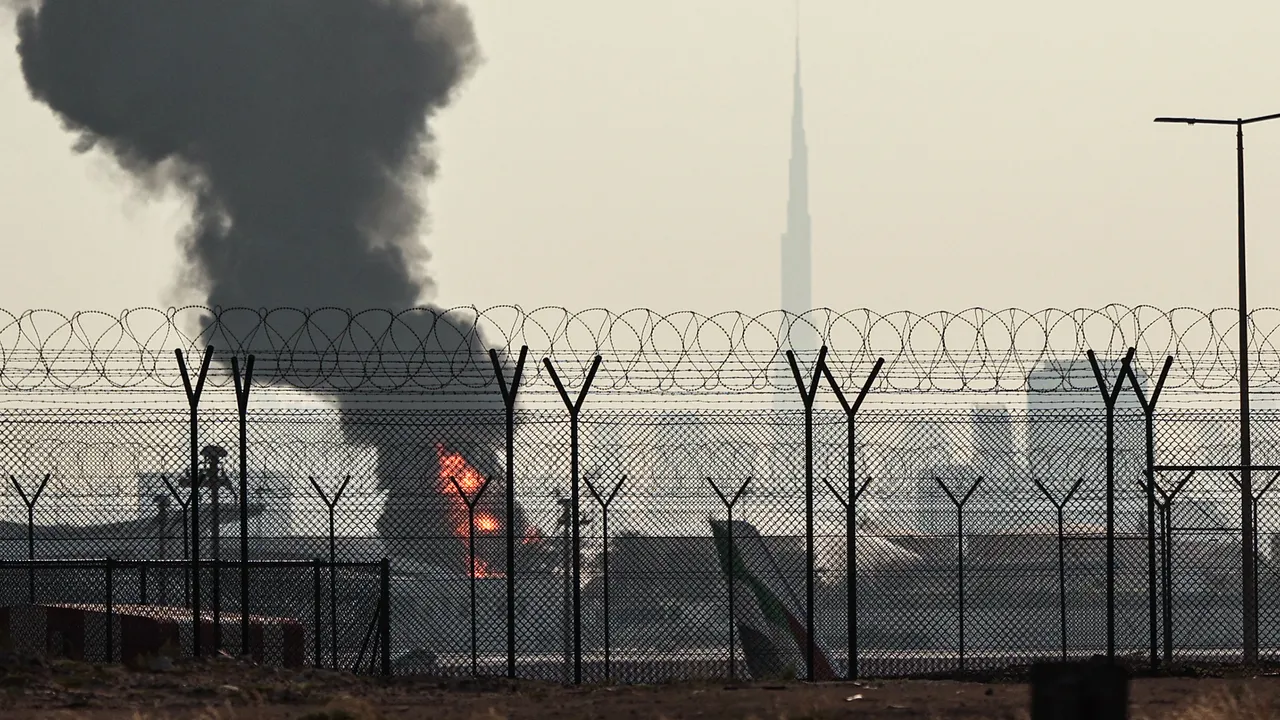
When I asked Mohammad what has kept him in Dubai all these years, he didn’t mention the skyscrapers or the landmarks. He spoke about the thrill of watching something be built in real time, and the sense of belonging he felt in the city. “Most people ask me today, ‘Why are you staying? There is nothing here,’ ” he said. “I tell them, ‘There is a future.’ ” Still, that future is becoming increasingly uncertain. Iran has launched more than nineteen hundred missiles and drones at the U.A.E. since the start of the war. Although the physical damage in Dubai has been limited, in comparison to other cities in the region, the attacks—and their emotional toll—have persisted. Three weeks into the conflict, on March 16th, a fuel tank at the Dubai International Airport was hit by a drone strike. “All of us, we are worried about what’s going to happen,” Mohammad said.
If you look up “Dubai,” you’ll find footage of sprawling shopping complexes, glass towers, and influencers posing next to infinity pools with cocktails in hand. You might also come across an array of headline-grabbing projects that the city has championed over the years, from the creation of artificial islands to sending a mission to Mars—an attempt to position itself as the pinnacle of innovation and luxury, a place where the future arrives early. This year, in partnership with Elon Musk’s Boring Company, the city began building the Dubai Loop, an underground high‑speed transit network. Dubai has also been staking its claim on artificial intelligence, weaving A.I. into government services, health care, finance and urban infrastructure—a subject that officials have mentioned at every single opportunity.
But the glittery and more extravagant aspects of Dubai have long concealed the realities of the hard work that underpins the city. For more than a century, people have come from across the Gulf, the broader Middle East, and from all over the world, searching not for glamour but for economic opportunity and political stability. As of 2026, Dubai’s population is estimated to be around three million people, with only about ten to fifteen per cent Emirati nationals and the rest expatriates from more than two hundred different countries, including large communities of Indians, Pakistanis, Bangladeshis, Filipinos, Lebanese, Egyptians, Jordanians, and Syrians.
My parents, two young Egyptians trying to build a life and start a family, moved to Dubai, from Cairo, in 1986. My father was a journalist who had received a job offer from a newspaper based in the U.A.E. “I didn’t even know what Dubai was,” he recalled. “But my boss at the time suggested I try my luck there.” Over the years, our family would go back and forth between Cairo and Dubai, though I would spend most of my childhood in the latter. My sisters and I attended British-curriculum schools, where our classrooms were filled with students who had similarly come from other countries.
Then, as now, there was a large population of Iranians in the city. (Estimates suggest that there are roughly half a million Iranian nationals in the U.A.E., most of whom live in Dubai.) In the late nineteenth century, Persian merchants began moving to Dubai, attracted to the city’s favorable trade policies; not long after, Sheikh Maktoum bin Hasher Al Maktoum, then the ruler of Dubai, declared the city a tax-free port. These merchants largely settled along the Dubai Creek, building wind-tower houses that still stand today, in what’s known as the Bastakiya district—named for Bastak, the town where some of the merchants hailed from. “They never lost their connections to their communities in Iran, speaking the same languages—mostly variants of Achomi or Larestani, which derive from Old Persian—and often funding the building of mosques and other public amenities in their villages,” Arash Azizi, an Iranian Canadian historian and author, told me. “Their networks remain intact to this day, connecting communities in Iran’s Hormozgan Province to Dubai on to London, South Asia, and other places.”