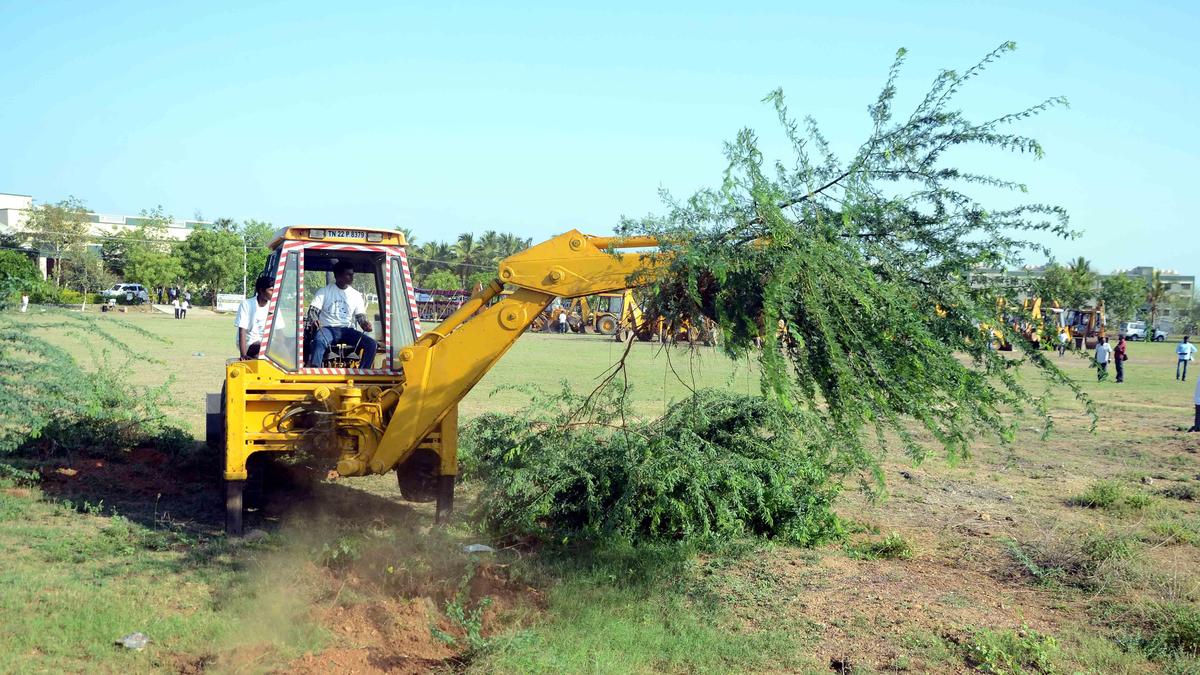
The story so far: The Madras High Court on March 18, 2026 issued a set of 34 directions for the eradication of the exotic and invasive species prosopis juliflora (seemai karuvelam in Tamil) from Tamil Nadu. One of those directions states all private landowners must uproot those plants from their properties within 30 days failing which the district administration concerned shall deracinate them and recover the costs from the landowners.
The court also made it clear if those property owners express willingness to plant native saplings, they must be given the saplings of their choice free of cost. The latest set of directives have been issued after a series of orders passed by the court in the last 12 years failed to achieve the desired result of eliminating the invasive species in toto.
Why is prosopis juliflora considered harmful?
A special Division Bench of Justices N. Sathish Kumar and D. Bharatha Chakravarthy constituted to hear environment and forest related cases has answered this question in its latest order. It pointed out the species originated in the South American countries and was introduced in other continents during the early days of colonisation for being used as firewood. “Though, initially, it served the purpose of providing firewood to the individuals and also as industrial fuel besides being used in the brick kilns and the charcoal industry, it has proven to be a disaster for our environment and ecology,” the judges said.
The court said, prosopis juliflora had destroyed the fertile lands, grasslands and the mossy and spongy earth of forests and the land beneath these trees had been transformed into barren grounds. Secondly, the exotic species had displaced the native flora. “A variety of Indian trees and plants have given way to this fittest survivor and it now enjoys a monopoly,” the order read. It also stated the growth of the invasive species had resulted in depletion of groundwater table and reduced moisture level in areas where it could be found in abundance.
When did the court begin to crack the whip?
On January 9, 2014 a Division Bench of Justices R. Sudhakar and V.M. Velumani (both retired now) had ordered removal of prosopis juliflora from all rivers and water bodies in the State “for the betterment of the farmers as well as the people of the country.” When the order was not complied with and a contempt of court petition was filed, the same Bench, on August 6, 2015 directed the State government to formulate a scheme for eradication of the invasive species “which is causing a great environment problem.”
Thereafter, former Madurai Mayor M. Patturajan (since dead) filed a public interest litigation (PIL) petition against prosopis juliflora and he was followed by Marumalarchi Dravida Munnetra Kazhagam (MDMK) general secretary Vaiko. Passing a series of orders in these two cases since 2015, the High Court had called for expert reports from bodies such as National Environmental Engineering Research Institute (NEERI) which confirmed the harmful nature of the invasive species.
In 2016 and 2017, a Division Bench of Justices A. Selvam and P. Kalaiyarasan (both retired) began making personal inspections in the southern districts, pulled up the Collectors concerned for not uprooting the trees, directed the district judges to monitor the eradication work and appointed huge number of advocate commissioners for all districts to take stock of the progress made. However, in April 2017, the two cases were referred to a Full Bench (comprising three judges).
Three different Full Benches headed by former Chief Justices Indira Banerjee, A.P. Sahi and Munishwar Nath Bhandari too were convinced with the harmful effect of prosopis juliflora and a direction was issued to the State government on February 2, 2022 to formulate a scheme for eradication of the invasive species under the supervision of the district Collectors.
It was only after this direction, the Tamil Nadu government came up with the Tamil Nadu Policy on Invasive Plants and Ecological Restoration (TNPIPER) on July 13, 2022. Thereafter, the PILs were ordered to be listed before the special Division Bench for monitoring.
What prevented the implementation of the orders?
Ever since the cases were listed before the special Division Bench of Justices Kumar and Chakravarthy in September 2022, the judges began nudging the government to intensify the deracination process and declare at least one district in the State as free from prosopis juliflora. When that did not happen, they insisted that at least two villages may be declared prosopis juliflora free every month. The judges eventually found none of the goals could be achieved because the lands on which the invasive species had grown belonged to different entities such as local bodies, forest department, public works department, Hindu Religious and Charitable Endowments department, railways, private individuals and there was lack of coordination.
On finding that the efforts put in by the court for over a decade did not yield the desired result, the judges wrote: “In this case, 11 years have gone by after this court took up the issue, and there has been no substantial progress. There are now only two options available to this Bench. First, to initiate contempt proceedings against the respondents. If a contempt action is invoked, it would only result in punishing all respondents, and that, by itself, will not yield the desired result of removing the invasive species, which is a mammoth task, however, to be completed if there is a will. Therefore, we have no alternative but to take the alternative option. That is, to issue further directions and ensure the compliance of the orders of this court.”
The judges with the assistance of amici curiae T. Mohan, Chevanan Mohan, Rahul Balaji and M. Santhanaraman came up with a set of 34 new directions which contemplate involvement of student volunteers and monitoring of the eradication work by two retired High Court judges V. Bharathidasan for the northern districts and Mr. Selvam for the southern districts.
How is the new set of directions different from previous orders?
The latest court order directs the Tamil Nadu government to name the project of eradication of prosopis juliflora and replacing it with native species as ‘Sezhumai Karuvoolam’ and states it could be implemented without any major financial burden on the State.
Since the invasive species could be used as industrial fuel, the government could auction the uprooting work to private entities, collect necessary charges and maintain it in a separate account so that the money could be used for planting and nurturing native species. The Collectors had been ordered to act as nodal officers between all government departments and the Environment Secretary had been directed to create a webpage and maintain a dashboard regarding the work done.
The government officials had also been directed to receive complaints from the public through a dedicated phone number and also through social media apps regarding the presence of prosopis juliflora in their locality and take action to uproot them. “As far as possible, the activity shall be carried out like combing operations declaring the villages to Firkas to Taluks and finally the districts being prosopis juliflora free,” the Bench ordered.
Stating native species must be planted within 30 days of uprooting of the invasive species, the judges ordered documentation of those native species under the title ‘Sezhumai Karuvoola Arasithazh’ which shall be maintained through the district tree committees. “They can engage the services of volunteers, including students and green enthusiasts, for this purpose. The goal is to maintain the data with passion, not just for compliance’s sake. At the end of the third year, if the native saplings had grown, the district-wise record shall be compiled and published as an electronic PDF on the website,” the order read.
Exceptional cases
Further, taking into consideration the possible loss of habitat for the birds, the court said: “In exceptional areas like Vedanthangal (bird sanctuary), where prosopis juliflora serves as nesting sites for birds, removal shall be carried out in a phased manner with simultaneous alternative arrangements such as planting of other species.”
Making it clear that the uprooting of prosopis juliflora must be completed well before the commencement of the next monsoon season, the judges decided to keep the PILs pending and pass further orders from time to time.
Published – March 20, 2026 04:44 pm IST