
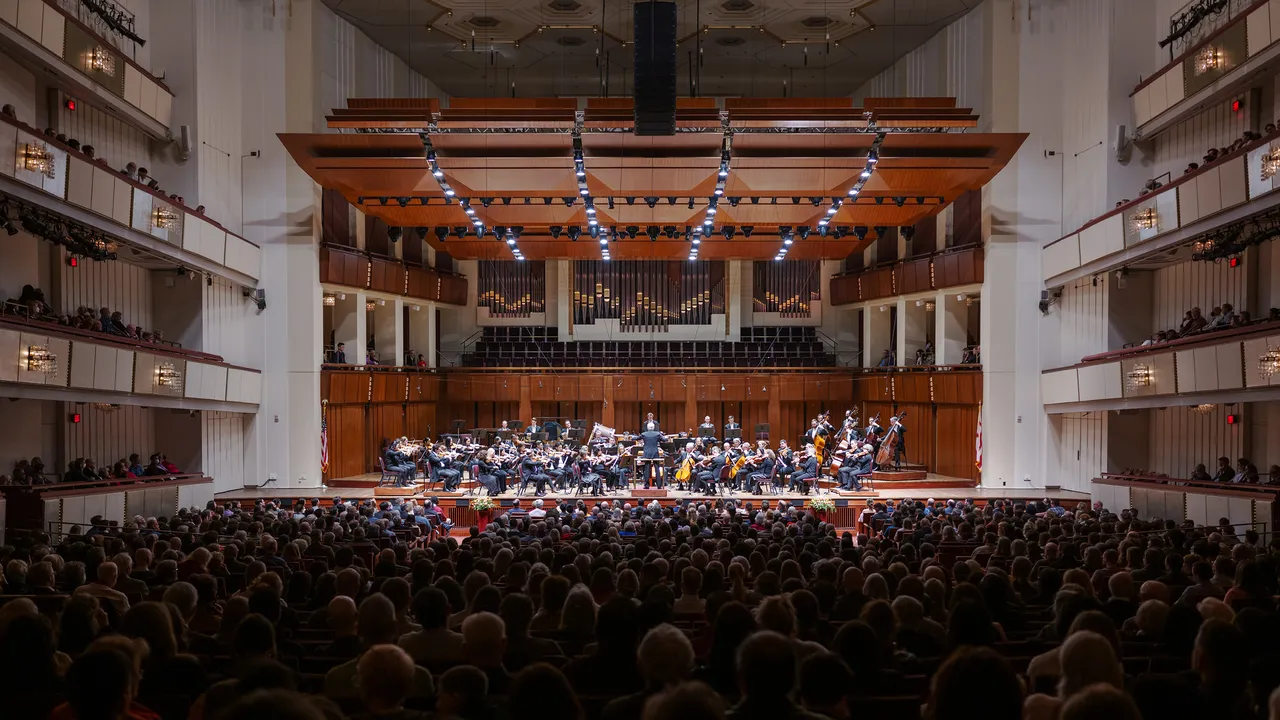
Tempting as it is to blame Trump for the Kennedy Center’s fate, he does not bear sole responsibility. The idea of a national arts center was always more of a noble dream than a reality. Kennedy’s own reputation as an arts patron rang a little hollow; most of the work was done by his impeccably cultured wife, Jacqueline Kennedy Onassis. Few Presidents, in fact, have had much time for the performing arts. Harry Truman and Jimmy Carter are the most recent ones to take a serious interest in classical music. (I met Carter in 1977, when his daughter, Amy, gave a Suzuki violin recital at a church near our house, in Northwest D.C. I was nine, and received a misleading impression of what people in power are like.) The Kennedy Center Honors, which once recognized the likes of Aaron Copland, Martha Graham, and Leontyne Price, became a site of celebrity worship long before Trump handed a medal to Sylvester Stallone. Hopes that Bill Clinton and Barack Obama would seriously boost the traditional arts largely came to naught. Cultural capital resides almost entirely in the pop realm, and politicians bow before it.
As a New Yorker cartoon by Jonathan Rosen noted, the death rattle of the Kennedy Center happened to coincide with a flap over comments made by the non-Oscar-winning actor Timothée Chalamet, who, in conversation with Matthew McConaughey, said, “I don’t want to be working in ballet, or opera, or things where it’s, like, ‘Hey, keep this thing alive, even though it’s like no one cares about this any more.’ ” Nathan Lane dryly observed that Chalamet said all this while promoting a movie about Ping-Pong—another pursuit of no interest to huge numbers of people. What’s striking is Chalamet’s use of the phrase “no one.” Millions attend ballet and opera performances every year, but the number is too small to satisfy Chalamet’s idea of success, and so he rounds it down to zero. This contempt for the minority is antithetical to democratic thinking. Like it or not, Chalamet finds himself on the same page as Trump.
On my most recent visit to Kennedy Center, I attended a concert by the PostClassical Ensemble, which, since 2003, has been presenting thematic programs that emphasize broader artistic and political contexts. This was PostClassical’s farewell to the center before it, too, moves on to other venues, and the event was sold out. To be sure, it took place in the Terrace Theatre, which has four hundred and ninety seats—an unimpressive number if you are seeking global domination but more than respectable if you are examining connections between music and the visual arts in Berlin in the nineteen-twenties.
Ángel Gil-Ordóñez, who conducts the PostClassical Ensemble, and Drew Lichtenberg, a guest curator for the evening, avoided any direct political comments, but the selections spoke clearly enough on their own. We heard Kurt Weill’s “Oil Music,” a satire of the oil industry, and Hanns Eisler and Bertolt Brecht’s “The Ballad of §218,” an attack on German anti-abortion legislation. The audience seemed in tune with the implicit message. One young guy was wearing a “resist” T-shirt. A distinguished-looking white-haired gentleman sported a bright-blue cap with the legend “make lying wrong again.” But no one was expecting to start an uprising. What mattered was the freshness of the programming and the spark of the performances—above all, the sly, idiomatic singing of the soprano Melissa Wimbish.
A few days earlier, I went to Lisner Auditorium, at George Washington University, to see Washington National Opera’s production of Scott Joplin’s “Treemonisha,” which the great ragtime composer wrote in his later years, in the hope of gaining admission to the classical arena. Here, too, the audience was in a punchy mood. When Timothy O’Leary, the company’s general director, came out onstage, he received perhaps the most raucous ovation I have ever heard bestowed on an arts administrator. It was testimony not only to the logistical difficulty of what O’Leary and Francesca Zambello, W.N.O.’s artistic director, have achieved—moving an opera company on short notice is no easy matter—but also to the spirit of independence in which it was done. When O’Leary began to say something about “creative freedom,” cheers drowned him out. This wasn’t just empty rhetoric. Staging a pioneering opera by a Black composer is the sort of enterprise that Grenell liked to dismiss as “D.E.I. bullshit.”