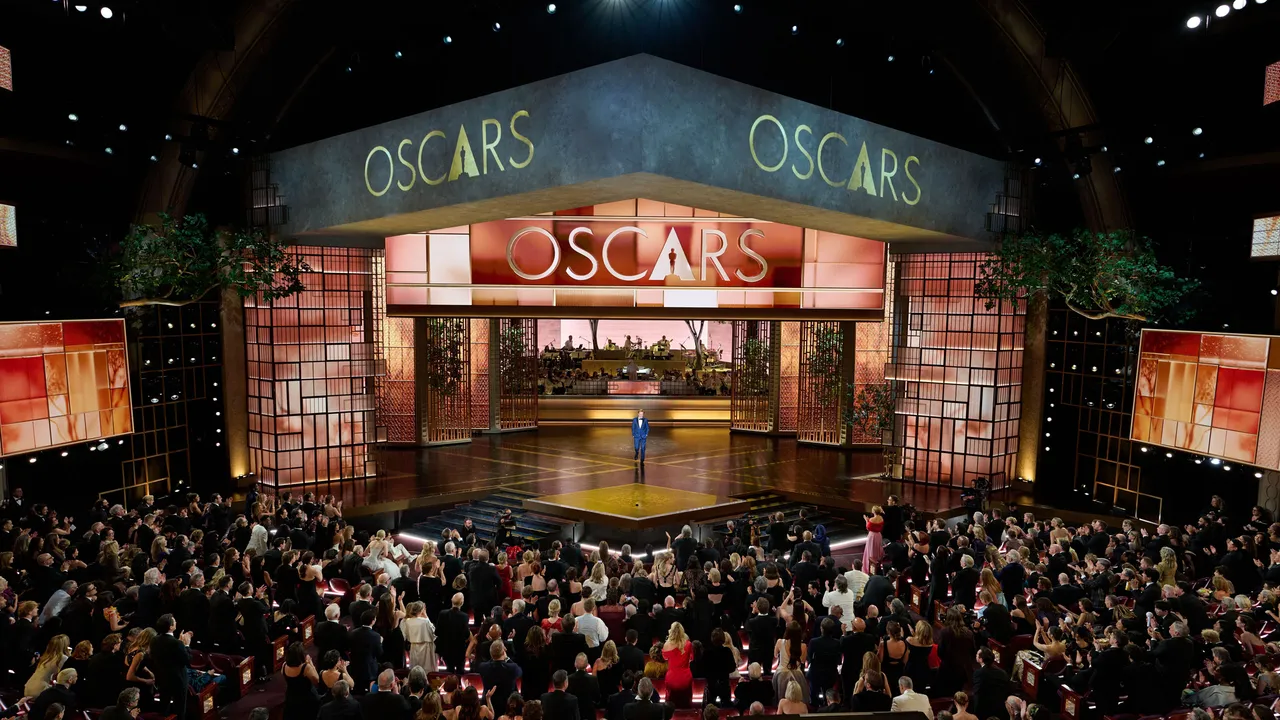
In Hollywood, and at the Oscars, “hope” is a very big word. Chloé Zhao used it in her recorded introduction to a clip from her film “Hamnet,” and Conan O’Brien, hosting the festivities, offered it as a reason to hold that big party in troubled times. He exhorted the crowd to enjoy the night “in the spirit of optimism.” But the most hopeful moment of this year’s ceremony came at the very end, when the final award, for Best Picture, was bestowed upon “One Battle After Another.” Its writer and director, Paul Thomas Anderson, a film-history fanatic who’d already just collected two awards (for Best Director and for Best Adapted Screenplay), offered a history lesson, citing the five nominees for Best Picture who were in the running fifty years ago, at the 1976 ceremony: “Jaws,” “Barry Lyndon,” “Nashville,” “Dog Day Afternoon,” and “One Flew Over the Cuckoo’s Nest” (which won). Here’s the good news: the best four of this year’s ten nominees in the category—“Sinners,” “The Secret Agent,” “Marty Supreme,” and, yes, “One Battle After Another”—are better movies than those five putative classics. (I’m sure that Anderson didn’t mean it that way, but, to quote Hamnet’s dad, “What’s done is done.”)
What makes these new films better is their wilder, freer, more original and personal approach to cinematic form, in addition to their candor about history—their directors’ manifest self-consciousness regarding their own, and their films’, place in the world, and in the art of movies itself. As Lynette Howell Taylor, the president of the Academy, said in her speech, the organization that voted on these awards comprises more than eleven thousand members, from around the world, and, at least to some extent, the results suggest greater openness and curiosity than earlier generations of Oscars might have shown. “One Battle After Another” was the night’s big winner, with awards in six categories (Picture, Director, Supporting Actor, Adapted Screenplay, Editing, and the first ever for Casting), ahead of “Sinners,” with four (Actor, Cinematography, Original Screenplay, and Score), and the tone of O’Brien’s opening monologue, oscillating between zingers and earnest gravity, suggests why.
“One Battle After Another,” with its opening scene involving a military-run concentration camp for rounded-up immigrants, its colossal second half centered on organized resistance to help immigrants avoid government raids, and its vision of a cabal of white (and Christian) supremacists holding secret sway in Washington, was practically torn from the headlines in advance. Its vision of indignation and resistance lurked behind every one of O’Brien’s thinly veiled jokes about Donald Trump (whose name was never mentioned) and his reference to “chaotic, frightening times,” and behind Jimmy Kimmel’s gag on the muzzled media of “North Korea and CBS,” and echoed the acceptance speech of David Borenstein, a co-director of “Mr. Nobody Against Putin” (which won Best Documentary Feature), who explained, correctly, that his film shows the authoritarian outcome of compromise, complicity, and government co-option of media. “One Battle After Another” is a movie of notable artistry, indeed one of the year’s best, but its triumph is less aesthetic than political.