Category: Movie Review

  • ‘Pennu Case’ movie review: An average con drama sans any exciting elements

    ‘Pennu Case’ movie review: An average con drama sans any exciting elements

    [ad_1]

    <!–[if IE 9]><![endif]–>

    A scene from ‘Pennu Case’.
    | Photo Credit: Special Arrangement

    The least of the expectations that one would have from a movie having a con woman as its protagonist is a few intelligently pulled off con jobs. In Febin Sidharth’s debut directorial Pennu Case, Rohini (Nikhila Vimal) is right away introduced to us as someone indulging in marriage fraud, with her ‘victims’ spread across Kerala and Karnataka. But it leaves a lot to be desired when it comes to actually portraying how she fooled each of the men into getting married to her or how she made her escape, leaving them in the lurch.

    At one point, the police team led by CI Manoj (Hakim Shahjahan) is shown mapping her targets to the rural belts of Kerala, but after this, very little is revealed about what she actually does on the ground. She just disappears after each of the weddings, we are told. Rohini managing to not have photographers for the weddings, citing her camera shyness, is probably the only interesting bit of writing in these sequences. Only in the case of one victim do we get to see how she goes about convincing a hapless man that she is the one for him. But not much imagination has not been put to use in staging these scenes too.  

    This approach is perhaps true of almost the entire film, in which the screenwriter and the director appear to be taking half measures all through. In such an approach, every other scene hits below the expected mark, leaving hardly any impact. This is evident especially in the supposedly humourous scenes, which hardly evoke even a chuckle. Unlike how it was promoted, the film’s tone is more on the serious side for much of its run-time. Just like the recent series Nagendran’s Honeymoons, also with a protagonist who commits marriage fraud, Pennu Case fails to use any of the possibilities of the material at hand. 

    As the film reveals its big twist towards the end, the earlier withholding of details appears to be quite deliberate. Of course there were intelligent and interesting ways of going about this, but the screenwriter chooses the easy way out. Nikhila Vimal gets a character which holds a lot of potential, but it appears quite under-written. She also approaches the character in a laidback manner, which might have worked for a different kind of character, not for a con woman.

    All of it appears to be part of the deception that the film indulges in to make the final twist effective. Though it helps land Pennu Case in average territory, this part is also not particularly inventive, but derived from the famous final moments of a 1990s movie. If only they managed to add a little dose of excitement. 

    Pennu Case is currently running in cinemas

    Pennu Case (Malayalam)

    Director: Febin Sidharth

    Cast: Nikhila Vimal, Hakim Shahjahan, Shivajith, Aju Varghese

    Storyline: A con woman indulging in marriage fraud lands in police net, but there is more than what meets the eye.

    Runtime: 112 minutes

  • ‘His & Hers’ series review: This Alice Feeney adaptation starring Jon Bernthal and Tessa Thompson offers sporadic thrills

    ‘His & Hers’ series review: This Alice Feeney adaptation starring Jon Bernthal and Tessa Thompson offers sporadic thrills

    [ad_1]

    <!–[if IE 9]><![endif]–>

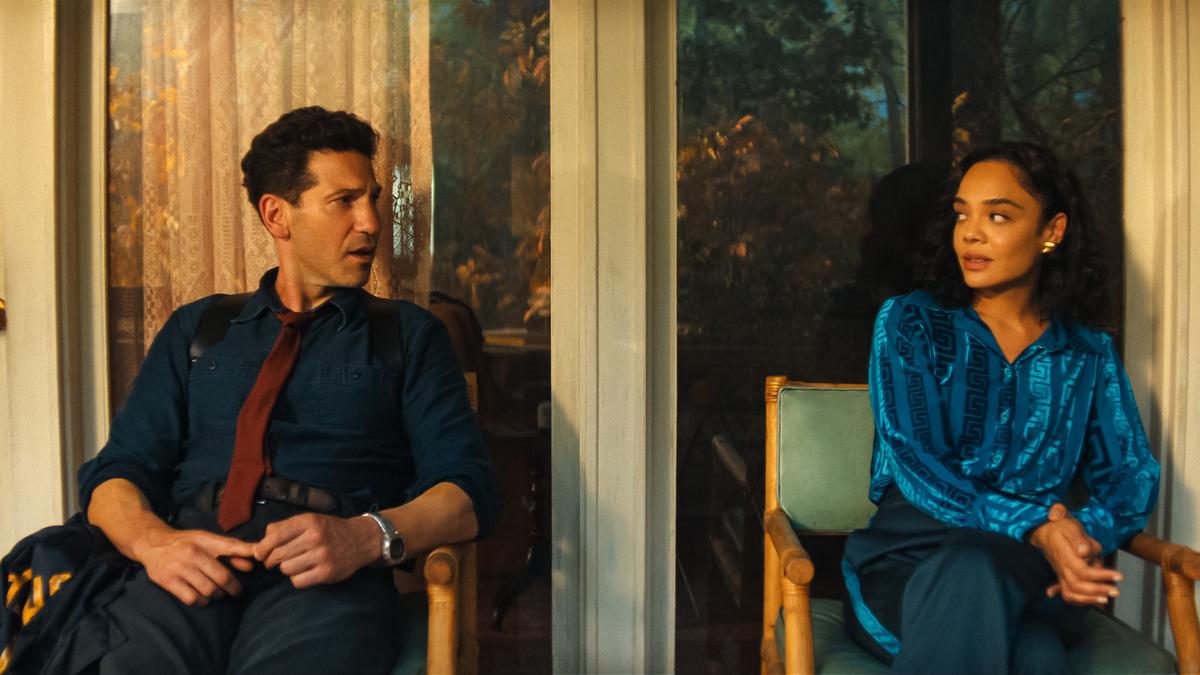
    Jon Bernthal as Detective Jack Harper and Tessa Thompson as Anna in ‘His & Hers’
    | Photo Credit: Netflix

    After Run Awaymoved the Harlan Coben novel’s US setting to England, His & Hersis set in Dahlonega, Georgia, not in the pretty village of Blackdown in the UK of Alice Feeney’s 2020 novel on which the show is based.

    That is not the only change the mini-series makes from the source material. In the book, all the characters are uniformly awful, and there is harm to animals, which thankfully the show eschews. Some new characters have been introduced, and some arcs have been excised. The jury is out on the effect the changes have on the show.

    Tessa Thompson as Anna in Episode ‘His & Hers’

    Anna (Tessa Thompson) is a news anchor for WSK TV News who took a leave of absence following a family tragedy. Lexy (Rebecca Rittenhouse) fills in for Anna and then takes over following Anna’s continued absence. When Rachel (Jamie Tisdale) is murdered in Dahlonega, where Anna grew up, she sees it as an opportunity to get back on television. She gets Lexy’s husband, Richard (Pablo Schreiber), with whom she had an affair, to be her cameraperson.

    Detective Jack Harper (Jon Bernthal), Anna’s estranged husband, is in charge of the case. Jack lives with his sister, Zoe (Marin Ireland), who is a flighty single mum to a little girl, Meg (Ellie Rose Sawyer).

    His & Hers Season 1  (English)

    Creator: Dee Johnson

    Adapted by: William Oldroyd

    Episodes: 6

    Cast: Tessa Thompson, Jon Bernthal, Pablo Schreiber, Marin Ireland, Sunita Mani, Rebecca Rittenhouse, Crystal Fox, Chris Bauer, Poppy Liu

    Storyline: A reporter and a detective, who had been married and are now separated, investigate a series of murders that might have a connection to their younger selves

    When Rachel’s friend Helen (Poppy Liu), the headmistress of St Hilary’s Girls School, is also murdered, Anna is forced to look to her past as she went to school with Rachel and Helen. The series switches back in time to Anna’s 16th birthday when something terrible happened.

    As students at St Hilary’s, Rachel (Isabelle Kusman) was rich, pretty, popular and cruel, with Helen (Tiffany Ho) and Zoe (Leah Merritt) following her lead, bullying Anna (Kristen Maxwell), whose mum Alice (Crystal Fox) worked as a cleaner, and Catherine (Astrid Rotenberry), who was an outsider because of her size and the fact that her elder sister died — teenagers can be cruel.

    Detective Priya Patel (Sunita Mani), Jack’s junior partner, begins to suspect Jack when he tries to tamper with the evidence, while Jack realises to his horror that he is being set up to take the fall. Priya does not buy Jack’s theory that Rachel’s husband, Clyde (Chris Bauer), is guilty.

    (L to R) Jon Bernthal as Detective Jack Harper and Sunita Mani as Priya in ‘His & Hers

    Blackmail, kinky sex, secrets and lies power His & Hers along to its wholly ludicrous conclusion. Jack is surely the worst detective ever to grace our screens, and his confrontation with Clyde is outright laughable. Priya is the only sensible character in all the overwrought twists and reveals.

    His & Hers is genre television at its most commonplace, with six episodes trundling along with attendant eye-rolls, bad fashion (what is with all those terrible pantsuits and hideous earrings?) and snorts of laughter into popcorn or crisp sabudana vadas. Watching His & Hers will not make you rue wasting five hours of your life; on the other hand, giving it a miss would not be that terrible either.

    His & Hers is currently streaming on Netflix

  • ‘Mana Shankara Vara Prasad Garu’ movie review: Chiranjeevi’s playful return, with Venkatesh in tow

    ‘Mana Shankara Vara Prasad Garu’ movie review: Chiranjeevi’s playful return, with Venkatesh in tow

    [ad_1]

    Certain things are a given in a film written and directed by Anil Ravipudi. There will be ample comedy, even if much of it is unabashedly silly. Viewers familiar with his work know not to expect nuance, or much by way of technical polish. In Mana Shankara Vara Prasad Garu, his first collaboration with Telugu superstar Chiranjeevi, Ravipudi leans into these strengths, loading the film with humour and fanboy moments that bank on the actor’s nostalgic appeal. The chief pleasure lies in watching Chiranjeevi clearly enjoying himself, aided by an extended cameo from Venkatesh Daggubati and the presence of Nayanthara.

    The film, which nearly opens with the aesthetic of a television serial, takes time to settle into its rhythm. The opening stretch makes its intentions clear: this is not a story that invites scrutiny of a national security officer’s professional rigour. Shankara Vara Prasad (Chiranjeevi), touted as one of the country’s finest, is introduced as an affable middle-class man cheerfully tackling household chores, before effortlessly turning into a one-man wrecking crew.

    Mana Shankara Vara Prasad Garu (Telugu)

    Director: Anil Ravipudi

    Cast: Chiranjeevi, Nayantara, Venkatesh Daggubati, Zarina Wahab

    Runtime: 164 minutes

    Storyline: An officer estranged from his wife has to win her, and their children back, and he stops at nothing.

    When the opening action sequence unfolds in a library and the score by Bheems Cecirolio loudly proclaims that ‘Boss is back’, Chiranjeevi makes it count. At 70, playing a character in his mid-40s, he proves he still has the moves. Even the dance numbers are smartly calibrated — nostalgic in flavour, yet choreographed with enough restraint to feel age-appropriate. Throughout, Chiranjeevi looks comfortable as a genial family man who can, when required, slip into mass-hero mode with a touch of class.

    The story treads familiar ground. Shankar is estranged from his wife Sasirekha (Nayanthara), a successful businesswoman, and longs to win her — and their two children — back. There are no real surprises in a narrative that banks heavily on comedy. A running gag involving a television serial that mirrors Shankar’s life, along with humour that pokes fun at his own persona, helps keep the film moving.

    Sasirekha and her father (Sachin Khedekar) are written in broad strokes reminiscent of how the elite business class was caricatured in films of the 1980s and 90s. Decades later, Anil Ravipudi offers much the same archetypes, merely dressed in contemporary styling. The wafer-thin plot, stretched to 164 minutes, could have wrapped up halfway through had Shankar and Sasirekha simply sat down to talk. Some gags — including those built around ‘OTP’ jokes — fall flat. But then, the film seems to argue, does it matter as long as there is a steady supply of jokes, however uneven?

    The school portions and the matter-of-fact way in which Shankar recounts his past keep things engaging for a while. Post-interval, however, the momentum dips as both comedy and drama turn predictable. A subplot involving an antagonist feels like a sore thumb, and Ravipudi brings back his lucky charm, actor Venkatesh Daggubati.

    The Chiranjeevi–Venkatesh portions are slightly underwhelming, as if the film is weighed down by the expectations that come with pairing two superstars. There are moments that work, though. Chiranjeevi’s restrained portrayal of a brooding family man contrasts Venkatesh’s gleefully over-the-top turn, and once the two give in to full-blown Sankranti revelry in a dance number, the theatre predictably erupts. The nostalgic nods to their hits from the 80s and 90s also land well.

    Venkatesh Daggubati and Chiranjeevi in the film
    | Photo Credit:
    Special Arrangement

    The stoic anchor here is Nayanthara. Her role breaks no new ground and carries a heavy sense of déjà vu, but she navigates the thin line between playing an archetypal upper-class snob and a self-assured woman with grace. The character deserved more depth, yet she makes it work with poise.

    Catherine Tresa, Harshavardhan and the rest gamely play along in supporting roles that are not meant to be taken seriously. After The Raja Saab, this is another film where Zarina Wahab lends dignity to her limited screen time, leaving a quiet impression.

    One of the film’s bigger let-downs is its cinematography, which remains merely functional. The music, too, is hit and miss. Given Ravipudi’s enviable box-office track record, perhaps it is time he demanded more from his technical crew, not just his writers.

    Mana Shankara Vara Prasad Garu offers enough fun to gloss over its dull stretches. And it leaves you with at least one unexpected takeaway: the next time you hear ‘Sundari’ from Thalapathy by Mani Ratnam, featuring Rajinikanth, you might just smile.

    Published – January 12, 2026 02:53 pm IST

  • ‘Bhartha Mahasayulaku Wignyapthi’ movie review: Ravi Teja’s comedy is watchable but generic

    ‘Bhartha Mahasayulaku Wignyapthi’ movie review: Ravi Teja’s comedy is watchable but generic

    [ad_1]

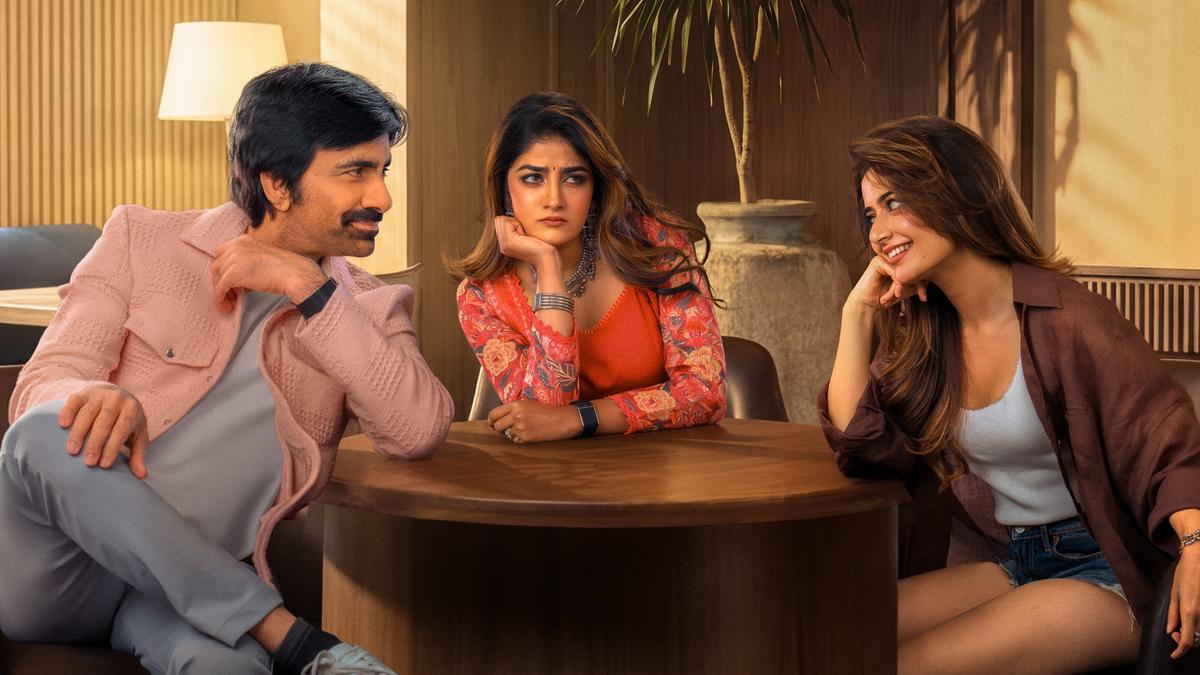
    Bhartha Mahasayulaku Wignyapthi’s team did well to prepare viewers for what they could expect from the Sankranti release. Despite its done-to-death premise of a cheating husband sandwiched between two stubborn women, it was deemed to be a departure for Ravi Teja from his loud action fares, in the capable hands of director Kishore Tirumala who is known for his lighthearted entertainers.

    Ravi Teja is in fairly good company in his latest outing to deliver on the promise. Apart from the leading ladies Dimple Hayathi and Ashika Ranganath, a formidable bunch of comedy actors — Satya, Sunil, Vennela Kishore, Getup Srinu and Muralidhar Goud — provide the actor enough fodder to be his good old cheery self.

    Yet, if you expect a festive fare that would go all guns blazing, you might be in for a mild disappointment. These are desperate times in Telugu cinema when viewers are expected to be happy with the bare minimum. For starters, the film consciously avoids anything high-stakes. Every scope for high-pitch drama is converted into a gag, laced with pop-culture references and odd coincidences.

    What begins as a casual fling between a married man, Ram a.k.a Satya (Ravi Teja), and Manasa (Ashika Ranganath) in the middle of an international business trip, balloons into an out-of-the-blue mess when the latter lands in Hyderabad, disrupting Ram’s otherwise stable marriage with Balamani (Dimple Hayathi). The more Ram tries to conceal the truth, the deeper he lands in trouble.

    Bhartha Mahasayulaku Wignyapthi (Telugu)

    Director: Kishore Tirumala

    Cast: Ravi Teja, Dimple Hayathi, Ashika Ranganath

    Runtime: 130 minutes

    Story: A married man is tormented by the ramifications of a fling he has during an overseas trip.

    The self-aware first hour is a breeze and serves as a reminder of the director’s flair for comedy. Ravi Teja is at home playing a flawed husband consumed by guilt over a one-night stand. The tension around his infidelity is explored well through the supporting cast — the loyal assistant Leela (Vennela Kishore), an occasionally straying Sudarshan (Sunil), and the young Trinetrudu (90s: A Middle Class Biopic child actor Rohan Roy).

    Tirumala uses an old-time device — the alter-ego — to expand on Ram’s guilt, a creative choice that helps Ravi Teja flaunt his famously unabashed dialogue delivery. However, with an anxious husband, a liberated woman, and a loyal wife at the helm, one expects the writing to take stock of changes in modern-day relationships and upgrade the template. Instead, it resists any effort to push the bar.

    Post intermission, though the humour works in parts, the director runs out of ideas to escalate the conflict. The subplot around Manasa’s rowdy brother Rakesh Shetty (Tarak Ponnappa) is a failed bid to generate tension in between the flippancy. The hotel episode around the generator starts well, but is stretched beyond necessity. The fight sequence too feels needless.

    The dumb-charades episode with the entire cast in place should have been a firecracker, but it lacks vigour and only contributes to the cacophony. The effort to cater to the Insta-reels crowd is evident with the party versions of the Karthika Deepam title track and the Pinni song. Despite the song and dance routines being easy on the eyes and catchy, they appear randomly squeezed into the narrative.

    The climax is also a reflection of lazy, convenient writing. The mix of lengthy monologues and absurd events can leave the audience confused on whether it wants to be a cautionary tale for men or poke fun at itself. Bhartha Mahasayulaku Wignyapthi works best when its lead character admits his mistake and makes a valiant attempt to put it behind him.

    The desperate bid to justify Ram’s affair and paint himself as a victim of an over-protective wife in the final monologue feels unnecessary. The film could have been a fun take on changing relationship norms, though its conservative approach makes it a lost opportunity. The joke around a Spanish woman’s tattoo and how she is ‘sold property’ (referring to her OTT and satellite rights) is despicable.

    While this is not the quintessential Ravi Teja film one expects, the actor’s restraint in humour is an advantage, and he is aided by Sunil who is back in his element and Vennela Kishore in a regular but entertaining appearance. Satya’s ‘bellam’ episode starts with promise, although it doesn’t explode enough.

    Both leading ladies, Ashika and Dimple, hold their own with their confident presence and dance their hearts out in the catchy folk number ‘Vammo Vayyo’. Yet, more could have been done with their parts than reducing them to representations of the ‘wife’ and the ‘other woman’ who fight for the man and occasionally groove alongside him in dream sequences.

    Bhartha Mahasayulaku Wignyapthi is a mixed bag on the whole. Although it hints at the director and the actor’s return to form in flashes, it is barely a reflection of their complete potential. It is like paying for a full ticket but stepping out partially satisfied.

    Published – January 13, 2026 03:33 pm IST

  • ‘The Night Manager’ Season 2 review: Tom Hiddleston’s tortured suave secret agent rocks sophomore season

    ‘The Night Manager’ Season 2 review: Tom Hiddleston’s tortured suave secret agent rocks sophomore season

    [ad_1]

    When The Night Manager, based on John le Carré’s eponymous book, came out in 2016, it showed a new way forward for the espionage thriller. The 1993 novel is significant in le Carré’s oeuvre, as it represents a shift from the Cold War to the shady dealings of billionaire arms dealers propped up by a corrupt “espiocracy.”

    The Night Manager (English, Season 2) 

    Episodes: 3 of 6

    Creator: David Farr

    Starring: Tom Hiddleston, Hugh Laurie, Olivia Colman, Tom Hollander, Diego Calva, Camila Morrone, Paul Chahidi, Hayley Squires, Indira Varma, Noah Jupe

    Runtime: 58 minutes

    Storyline: As part of his work at MI6, Jonathan Pine sees a ghost from the past and goes down a very dangerous rabbit hole.

    In Jonathan Pine, le Carré fashions a protagonist different from the bureaucratic, tired Smiley. Pine goes after the arms dealer, Roper, as much for revenge as for a strong sense of right and wrong.

    The six episode mini-series written by David Farr was shiny, sleek and smart. Apart from the gorgeous locations (Switzerland, Majorca, Morocco and the U.K.), the cast, led by the trifecta of Tom Hiddleston as Pine, Hugh Laurie as Roper, and Olivia Colman as Angela Burr, the intelligence officer determined to bring Roper down, was incendiary.

    With le Carré insisting on no sequels, The Night Manager was always understood to be a mini-series. Even though le Carré gave the go-ahead to continue Pine’s story after watching the show, Farr waited for the right idea. The first three episodes of Season 2 prove emphatically that the wait has been worth it.

    Following the events of Season 1 where Roper is put in prison for his evil deeds and killed four years later, Pine has a new name and identity. He is working in the MI6 surveillance unit, the Night Owls, and Burr has retired to France. On a routine surveillance, when Pine recognises a mercenary he met at Roper’s grand gala arms exhibition, he cannot help but follow up on it.

    Rex Mayhew (Douglas Hodge), Pine’s boss, tells him to let it go, as Pine is dead for all intents and purposes. When Mayhew is killed, Pine goes off the reservation to follow the trail, which leads to a Colombian arms dealer Teddy (Diego Calva) a Roper devotee.

    There is also the beautiful Roxanna (Camila Morrone), who is the fixer for Teddy’s shady shipments. With the Chief of the Secret Intelligence Service Mayra Cavendish (Indira Varma), involved and Pine’s team compromised, the time has come for Pine to assume yet another secret identity and infiltrate Teddy’s operation.

    With Sally (Hayley Squires) from the Night Owls on the outside and Basil Karapetian (Paul Chahidi), a senior MI6 officer providing what help he can off the books, Pine is pretty much alone in his quest to unearth Teddy’s patron. And when he does find out at the end of Episode 3, he is as gobsmacked as the rest of us.

    The montage of Pine assuming the identity of a rich, dodgy banker, 43-year-old Matthew Ellis, is delicious eye candy as are the locations that include Spain, the U.K. and Colombia. The tension is ratcheted to unbearable levels, till we, like Sally, have to use a hand fan while $20 million appears, disappears, and reappears in the nick of time.

    ALSO READ: ‘His & Hers’ series review: This Alice Feeney adaptation starring Jon Bernthal and Tessa Thompson offers sporadic thrills

    The cherubic Danny (Noah Jupe), whose rescue was Pine’s way into Roper’s inner circle in Season 1, is older and wiser now, while the fact that Pine has named his cat Corky (after Roper’s dangerously damaged gopher), shows the past is a constant presence with him.

    Hiddleston shrugs on his changeable Pine personality like a second skin (tight shirts and all), while Calva is suitably scary and Morrone the right amount of sultry. In the nine years since Season 1, thrillers such as The Agency and The Day of the Jackal have adopted similar elements, so Season 2 does not carry the same “breaking new ground” aura.

    However, with its glossy shine, intelligent while not being indulgent plotting, and superb cast and locations, it is a worthy sophomore season to the multiple award winning show.

    The Night Manager is currently streaming on Amazon Prime Video with fresh episodes dropping every week till February 1

    Published – January 13, 2026 06:08 pm IST

  • ‘Anaganaga Oka Raju’ movie review: Naveen Polishetty strikes again in an uneven yet fun ride

    ‘Anaganaga Oka Raju’ movie review: Naveen Polishetty strikes again in an uneven yet fun ride

    [ad_1]

    <!–[if IE 9]><![endif]–>

    Naveen Polishetty and Meenakshi Chaudhary in ‘Anaganaga Oka Raju’
    | Photo Credit: Special Arrangement

    Two years after the urban romcom Miss Shetty Mr Polishetty(2023), actor-screenwriter Naveen Polishetty returns with another film laced with humour. In contrast to the restraint he showed in that film, Naveen unabashedly plays to the gallery in Anaganaga Oka Raju. The humour is delivered through gags that come at such a rapid pace that the audience may not get a breather to pause and reflect.

    The story, screenplay and dialogues, written by Naveen and Chinmayi Ghatraju, who is also credited as creative director, weaves in an angle of social responsibility. Within the broad framework of outrageous comedy, the sense of purpose given to the principal characters makes this film stand apart from Naveen’s earlier madcap comedy, Jathi Ratnalu(2021).

    Director Maari makes Naveen (as Raju) take centrestage for much of the film. The opening portions establish clearly that the film is not intended to be taken seriously and the humour might largely stay in the no-brainer zone. The story arc is extremely predictable. Anyone acquainted with mainstream cinema can gauge what is likely to happen soon after the opening episode. Yet, the writing ensures few sharp lines that make the gags work.

    Anaganaga Oka Raju (Telugu)

    Director: Maari

    Cast: Naveen Polishetty, Meenakshi Chaudhary 

    Runtime: 150 minutes

    Storyline: A lazy, entitled brat who wants to lead an easy life is in for a rude shock that changes the course of his life.

    Somewhere in Peddapalem, Andhra Pradesh, Raju is a descendant of a zamindar who once had wealth that could have lasted generations. What’s left now is a hollow reminder of the past, but Raju puts up a show of wealth. Driven by a sense of entitlement and laziness, he sets out to do the obvious — find a wealthy bride so that he can live life king size.

    The initial half hour is shaky and the film finds its rhythm once Charulatha (Meenakshi Chaudhary) is introduced. When Raju crosses path with Charulatha, who is decked with more jewellery than she can possibly carry on her slender frame, it’s easy to predict the twist. The writing of the humour makes up for this predictability, and a string of gags poke harmless fun at films ranging from Baahubalito Titanic, artistes from Arijit Singh to Ranbir Kapoor, and even K-dramas. 

    Naveen is in great form as he sails from one gag after another. Some of the nonsensical fun does not land, but he sets the stage for outlandish humour, such that when he unleashes the idea of ‘Peddapalem branch of Goa’s Baga beach’, it is easy to give in to the fun.

    Mickey J Meyer’s music complements the fun, and the humorous mood makes it easier to overlook the limitations of the technical departments. 

    Once the key twist is revealed, the film loses its momentum for a while. Thankfully, the narrative sidesteps the possibility of an envious antagonist taking a cliched route to settle scores. The humour and drama feel stretched in some segments, as though the makers ran out of ideas. A couple of songs too seem unwarranted.

    The film is redeemed when it shifts gears from an outrageous comedy to a social satire that taps into reel addiction and apathy for ground-level issues. The story does not break new ground. We have seen similar episodes in other political dramas, but it still has enough depth to make the transformation of the protagonists convincing.

    The film rests heavily on Naveen’s shoulders and he puts up a vibrant show, making both the humour and the final emotional moments work. Within the limited scope given to her character, Meenakshi makes an impression. Rao Ramesh and other actors are wasted in under-written parts.

    Anaganaga Oka Raju could have benefitted with sharper, crisper writing. Despite the uneven narrative, Naveen’s comic timing and Meenakshi’s graceful screen presence make the film immensely watchable.

  • ‘Taskaree’ series review: A Neeraj Pandey special that rewards patience

    ‘Taskaree’ series review: A Neeraj Pandey special that rewards patience

    [ad_1]

    Neeraj Pandey has this knack for taking us to those forbidden spaces where offenders and upholders of the law become two sides of the same coin. He teases you with dribs and drabs of information, making us guess which side his characters would flip. This week, with Taskaree, the coin is golden, and the field of special ops is Mumbai International Airport. Celebrating the unsung heroes of India’s customs department, the series portrays their battles against organised crime with limited firepower.

    The thrill that the word taskaree evokes is missing from smuggling. Mounted like a pulpy page-turner in the mould of Special 26Taskaree follows a procedural thriller format: a tight-knit team of underdogs versus a shadowy antagonist, building tension through sedate operations lined with glorious temptations and threats to life and limb.

    Starting with routine customs checks at airports and quirky couriers of contraband, it spirals into global pursuits involving corruption, betrayal, and high-tech smuggling ops. Following an outrage in Parliament, the minister brings in smart yet honest officer Prakash Singh (Anurag Sinha), to curb the growing smuggling menace at the Mumbai airport.

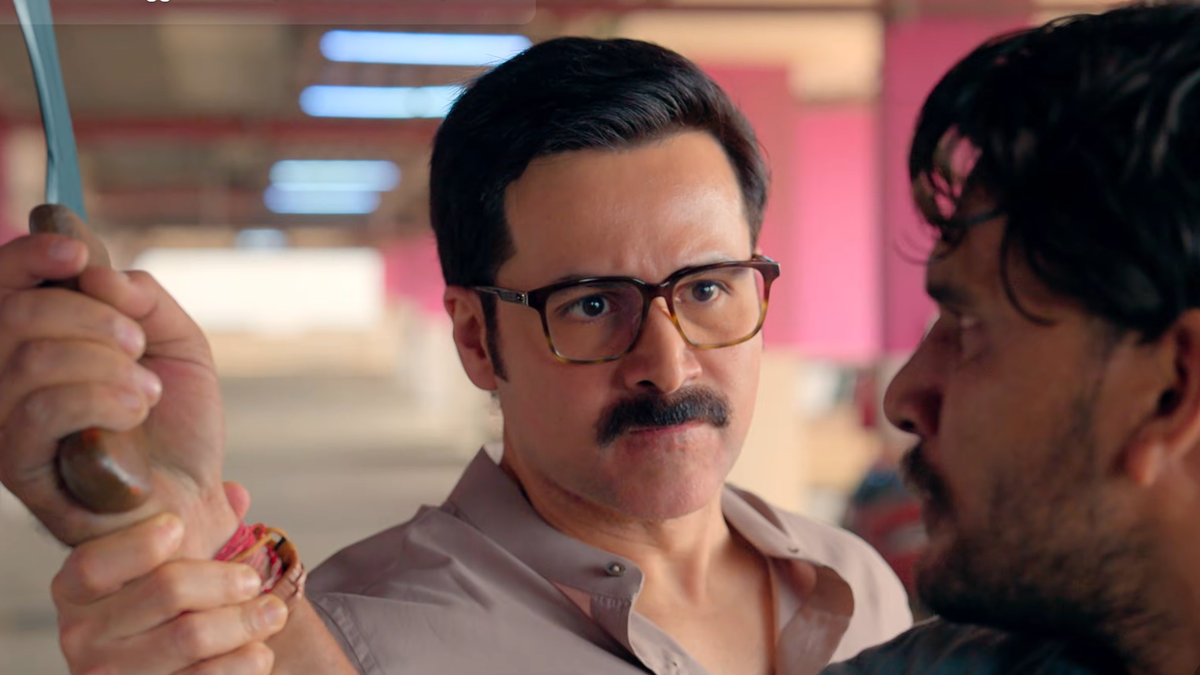
    Prakash sets up his own crack team led by Arjun Meena (Emraan Hashmi), Mitali (Amruta Khanvilkar), and Ravinder Gujjar (Nandish Sandhu). They are up against the moles within, and a smuggling syndicate lorded over by Bada Chaudhary (Sharad Kelkar), whose influence spans Europe, West Asia, and Southeast Asia.

    Avoiding flashy bouts of vengeance, Chaudhary follows a considered carrot-and-stick policy to infiltrate and win over the system, but Arjun turns the tables on him, as he finds cracks in Chaudhary’s lair. As he makes an air hostess, Priya (Zoya Afroz), permeate Chaudhary’s gang in the fictitious Al Dera, a traditional hub of smuggling in West Asia, the art of seduction takes over. It tests logic, but the delicate game of fox and geese brings us to the edge of our seats.

    Taskaree (Hindi)

    Director: Neeraj Pandey

    Cast: Emraan Hashmi, Sharad Kelkar, Nandish Sandhu, Zoya Afroz, Anurag Sinha, Amruta Khanvilkar, Freddy Daruwala

    Episodes: 7

    Synopsis: It follows dedicated customs officer Arjun Meena and his elite team at Mumbai airport as they battle a powerful international smuggling syndicate.

    In a seven-episode series, it’s quite natural to be apprehensive about how long screenwriters could hold attention with the modus operandi of smuggling. But Pandey, along with co-directors B.A. Fida and Raghav Jairath, and co-writer Vipul Rawal, combine research and representation well to get a grip on life rolling on the conveyor belt of airport security.

    While the authentic procedural details, such as customs protocols and smuggling tactics, provide a solid foundation for the sharp dialogue to land, Pandey’s ability to humanise officers and smugglers through subtle character moments and backstories, keeps the narrative emotionally charged. Blending patriotism, duty, and grit with a critique of systemic flaws, the multi-episode arc escalates into a high-stakes roller coaster, where creative flair keeps pace with procedure. Shot in Germany, Bahrain, and Thailand, the spirited camerawork and smart editing make the seemingly drab drills visually engaging.

    ALSO READ: Neeraj Pandey calls out AI-altered ‘Raanjhanaa’ ending as ‘disrespectful’, slams Eros for excluding creator

    Strong performances make it more credible. Emraan, riding high in his new avatar, brings grounded, no-nonsense heroism to a role demanding quiet courage. Anurag steps up from the sidelines to make Prakash the series’ guiding light. Zoya, winsome, skillfully masks vulnerability and fear with style. Nandish, an honest officer ensnared by deceit at home and work, elicits empathy for the endangered species. Sharad works as the villain, though more colour was expected from Chaudhary’s character. There are passages that feel custom-made for Pandey’s growing pantheon of honest officers, but in the end, it rewards patience.

    Taskaree is currently streaming on Netflix.

    Published – January 14, 2026 03:11 pm IST

  • ‘Vaa Vaathiyaar’ movie review: Karthi, Nalan Kumarasamy whip a stale ‘Anniyan’ redux

    ‘Vaa Vaathiyaar’ movie review: Karthi, Nalan Kumarasamy whip a stale ‘Anniyan’ redux

    [ad_1]

    For over four decades, until his death in 1987, a multi-hyphenate actor, politician, and philanthropist had been a beacon of hope for the Tamils all around the world. Through his films, he became a vigilante of justice, a leader of liberation, and the voice of the voiceless. As the Chief Minister of the state, his legacy only grew exponentially. Even today, windshields of autorickshaws, mirrors on barbershops, radios at tea shops and photoframes on local food joints sing his praise, and even today, in the deepest corners of a million hearts, his name is etched as a symbol of hope. MG Ramachandran’s storied legacy is bigger than life itself. It’s an emotion that altered the fate of Tamil Nadu once and forever.

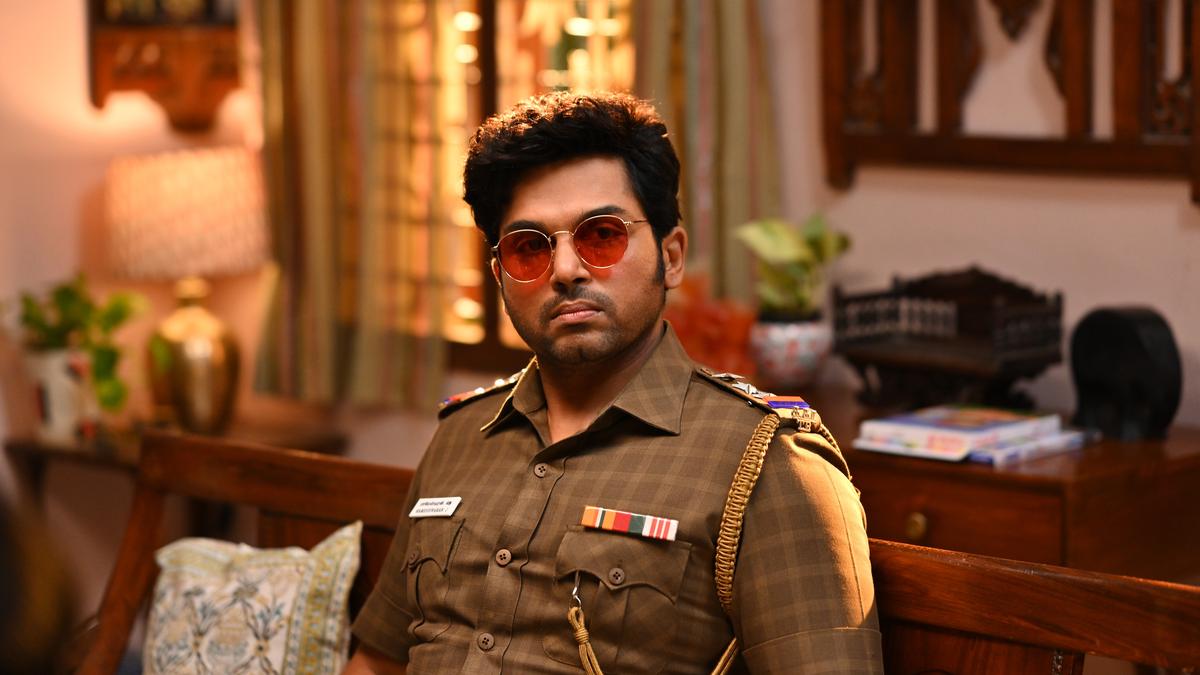
    Now, picture this: what if, nearly 40 years after his death, MGR resurrects from the dead and possesses a cop to fight injustice? This wacky thought, with some tweaks, seems to be the seed of an idea that has driven Tamil filmmaker Nalan Kumarasamy to take a detour into the masala cinema genre. In his latest vigilante fantasy entertainer Vaa Vaathiyaar(named after MGR’s famous moniker, meaning ‘teacher’), actor Karthi plays Rameshwaran J a.k.a Ramu, the inspector of the Puliyur Kottam station in the fictional town of Maasila (we don’t know why they needed to fictionalise the city, but the interesting titbit is that ‘Puliyur Kottam’ is the name of the ancient town where Chennai now stands).

    Karthi in a still from ‘Vaa Vaathiyaar’
    | Photo Credit:
    Special Arrangement

    His grandfather Bhoomipichai (Rajkiran), an ardent fan of MGR, believes that his grandson is a reincarnation of his idol and nurtures him with the same principles and ideals that were professed by the superstar. But an incident that happens when he’s young tells Ramu that being MGR doesn’t offer you the pleasures of life — you have to be Nambiar (actor, famous for starring as the antagonist in many MGR films). And so, Ramu learns the subtle art of cheating cleanly — achieving the means to an end with dubious ways — a skill that makes him a one-of-a-kind corrupt cop.

    He is tasked to investigate a hacktivist group called the Yellow Face that has leaked information about a conspiracy involving the Chief Minister of the state (Nizhalgal Ravi) and a business tycoon, Periyasaami (Sathyaraj, with eerie prosthetic teeth), who are conspiring to steal €142 million at the cost of several innocent lives. During this investigation comes the most anticipated part: Ramu inadvertently develops an alter-ego and unknowingly transforms into a whip-wielding, horse-riding MGR who vows to take down the corrupt enemies.

    Vaa Vaathiyaar (Tamil)

    Director: Nalan Kumarasamy

    Cast: Karthi, Krithi Shetty, Sathyaraj, Rajkiran

    Runtime: 129 minutes

    Storyline: A cop’s life changes when he develops the alter-ego of late legendary actor MG Ramachandran and fights against evil, corrupt politicians

    Firstly, for much of the first half, Vaa Vaathiyaar seems to be precisely the kind of masala film that Nalan Kumarasamy had promised during the pre-release interviews. It has a fantastic, quirky set-up, and it is always fun to see Karthi play a jolly-go-lucky and morally ambiguous character like Ramu. The pre-intermission reveal makes you wonder about how MGR’s style of fighting justice would hold against a new-world order where filth runs deep into politics and where any and all technology helps the corrupt more.

    But then, everything goes awry for Vaa Vaathiyaar in the second half. As one feared from the promo material of the film, the MGR persona comes too close to becoming a laughing stock, especially when it veers into the romance zone in a scene featuring Vaathiyaar and Wu. After using the popular MGR songs ‘Unnai Arindhaal’ and ‘Naan Ungal Veettu Pillai’ in one of the best scenes of the film, Nalan chooses to remix ‘Raajavin Paarvai’ for a song sequence, but its awful placement tests your patience — it’s as if someone told Nalan that placing a song post intermission is a necessary ingredient in the masala formula.

    There have been countless films like Anniyan and Tughlaq Durbar that follow an ordinary man who develops an alter-ego that fights against injustice, and it’s always fascinating to see the two identities collide or converse with each other. The same happens here, and Karthi shines as a performer in scenes that feature both personalities. However, the stakes aren’t as immediate as you would hope, and so these moments stick out like a sore thumb. Only an eye mask and make-up differentiate Vaathiyaar and Ramu, and even if you were to buy that it’s a disguise difficult to crack (not hard for Superman fans), that the antagonists hardly come any closer to figuring out Vaathiyaar’s identity is a bummer.

    Krithi Shetty and Karthi in a still from ‘Vaa Vaathiyaar’
    | Photo Credit:
    Special Arrangement

    Moreover, the high-concept needed a bigger canvas. After a point, all that the MGR persona does to take on the villains is… fistfighting or fighting with his whip. But what more can he do when he is put amidst such a stale evil-corporate-corrupt-politician backdrop? Of course, it’s courageous on Nalan’s part to speak about the Thoothukudi police firing incident, but how it’s all woven together feels contrived, as if it were all about following a tested screenwriting formula.

    The thread about Krithi’s Wu, which promised a genre twist, ends up going nowhere. And so we get nothing about who she is or what her connection with the owl she finds in a tree is. That she falls in love, not with Ramu, but with a persona of a yesteryear actor, without digging into how this happened, raises questions in you, but all that the film seems to say is that she is a wackadoodle.

    The climax, in particular, is a chaotic mess that leaves you with a brain-freezing aftertaste. In fact, the choppy second half and the hurried narration make one wonder why a film like Vaa Vaathiyaar had to be just 120-odd minutes. Perhaps Nalan could have salvaged the film with a scene or two more in the second half. Of course, we didn’t expect Vaa Vaathiyaar to be a standard Nalan Kumarasamy film, but this could still have become an interesting masala film.

    In any case, Vaa Vaathiyaar isn’t a tribute worth reawakening the spirit of the puratchi thalaivar. If anything, what’s truly fascinating about this exercise is the idea that an actor, known for playing vigilantes in films, has, in a way, done the same after nearly 40 years since his death. The legacy lives on.

    Vaa Vaathiyaar is currenly running in theatres

    Published – January 14, 2026 06:29 pm IST

  • ‘People We Meet on Vacation’ film review: Tom Blyth and Emily Bader’s sweet rom com checks all the right boxes

    ‘People We Meet on Vacation’ film review: Tom Blyth and Emily Bader’s sweet rom com checks all the right boxes

    [ad_1]

    <!–[if IE 9]><![endif]–>

    A still from ‘People We Meet on Vacation’.
    | Photo Credit: Netflix/YouTube

    People We Meet on Vacation is predictable, but also pretty and sweet, with all those lovely vacations minus the lost baggage and delayed flights. Based on Emily Henry’s 2021 New York Times bestseller, the film follows wild child Poppy (Emily Bader) and Mr Reliable Alex (Tom Blyth), who are nevertheless the best of friends.

    People We Meet on Vacation (English)

    Director: Brett Haley

    Cast: Tom Blyth, Emily Bader, Sarah Catherine Hook, Miles Heizer, Lukas Gage, Lucien Laviscount, Alan Ruck, Molly Shannon, Jameela Jamil

    Storyline: Despite being opposites temperamentally, Alex and Poppy are the best of friends till a summer in Tuscany changes everything

    Runtime: 118 minutes

    Everyone but Poppy and Alex can see they are in love, and the film takes two hours, seven vacations, and a wedding for them to realise it. Told through a series of flashbacks, the story begins with a disastrous road trip from Boston College to their hometown in Linfield, Ohio, marks the beginning of Poppy and Alex’s friendship.

    On a camping trip in Canada, they meet wild Buck (Lukas Gage), who has ‘memento mori’ tattooed on his chest, making Poppy think of her grandfather’s open-casket funeral instead of his hot body. Alex and Poppy make a promise to spend a week together every summer wherever they are.

    Poppy drops out of college and moves to New York to work as a travel writer for a popular magazine. In the present, as Poppy returns from yet another trip to an empty fridge and piles of mail, she wonders if this life is all it is cracked up to be.

    Her editor, Swapna (Jameela Jamil), wonders where her favourite travel writer, who would have killed to have this job five years ago, has gone.

    Poppy gets a call from David (Miles Heizer), Alex’s brother, asking her why she has not RSVPed for his wedding in Barcelona. She says she cannot make it as she has a work thing in Santorini (fancy!) and also that Alex and his girlfriend Sarah (Sarah Catherine Hook) might not want her there.

    We learn that Alex and Poppy have not spoken to each other since a vacation in Tuscany two years ago. Despite initially not wanting to go for the wedding, Poppy does make it to Barcelona and there is the wedding, memories, Taylor Swift songs, the rain, a broken air conditioner, declarations of love, a misunderstanding and a final sweet reconciliation.

    ALSO READ: ‘Song Sung Blue’ movie review: Hugh Jackman and Kate Hudson sing their hearts out in a lovely musical biopic

    The movie seems to have long stretches where nothing happens and then rushes through the big drama in the last 20 minutes. All the locations are sun-kissed and lovely, and Bader has excellent comic timing. The chemistry between Bader and Blyth is good with Lucien Laviscount once again saying “mate” (since when did ‘mate’ become shorthand for British?) and not getting the girl.

    While People We Meet on Vacation most definitely does not herald the revival of the rom-com, it is a pleasant enough way to spend two hours.

    People We Meet on Vacation is currently streaming on Netflix

  • ‘Nari Nari Naduma Murari’ movie review: Sharwanand eases his way through a breezy rom-com

    ‘Nari Nari Naduma Murari’ movie review: Sharwanand eases his way through a breezy rom-com

    [ad_1]

    The line-up of Telugu films this Sankranti feels like a heavy main course menu prepared with one common ingredient: comedy. Most of these films rely on feeble plots and take pride in being not-so-serious ventures designed to deliver escapist fun with liberal doses of humour and romance.

    At the risk of being a comic indulgence, Nari Nari Naduma Murari, the last of the Telugu films slated for this season, caters diligently to its target audience. Helmed by director Ram Abbaraju of Samajavaragamanafame, it plays within its boundaries. The story revolves around a man’s desperation to eliminate all obstacles that stand in the way of his marriage with his love interest.

    Gautham (Sharwanand), a 20-something son to single parent Karthik (VK Naresh), goes out of his way to help his father get married again. Meanwhile, he is in a steady relationship with architect Nithya (Sakshi Vaidya). An unexpected issue arises when her father insists on a register marriage, which could expose Gautham’s past with his ex, Dia (Samyuktha Menon).

    At its heart, the film is a confusion comedy. One error leads to a series of lies that makes things worse for Gautham and those around him. By the time he attempts to undo the harm, it seems too late. Or is it? 

    Nari Nari Naduma Murari (Telugu)

    Director: Ram Abbaraju

    Cast: Sharwanand, Samyuktha, Sakshi Vaidya, Naresh

    Runtime: 145 minutes

    Story: A man is forced to cross paths with his ex to ensure that his marriage to his lady love is not foiled.

    The major advantage of the film is the restraint and assurance in humour. The situations are inherently funny, the screenplay is fluid and complemented by witty dialogues delivered by a dependable cast.

    Ram Abbaraju is clearly aware of the tone he wants to maintain. The characters care two hoots about being politically correct and revel in their goofiness. Karthik is consistently shamed by those around him for marrying a much younger woman while his son is yet to tie the knot. Despite the ageist shaming, the scenario is milked to the fullest to generate inoffensive laughs.

    There’s a smart pulihora reference to suggest something’s brewing between Gautham and Nithya. 

    An auto-driver mistakes a woman for being pregnant and leaves her at the hospital, only to realise she is merely overweight! Both the father and the son approach the same tattoo artist — one to get a tattoo of his wife and the other to remove the tattoo of his ex.

    Each time there’s a possibility of the film falling prey to such frivolity, the lightness in the treatment and the fuss-free execution come to the rescue. Though the story is essentially Gautham’s, the trajectories of the supporting players, from the three fathers (of Gautham, Nithya, Dia) to the registrar and the junior advocate, are not compromised. All these characters get their due.

    Yet, some fatigue sets in as the film finds many ways to delay the inevitable. The flashback episode between Gautham and Dia is just functional. Though the duo is destined to part ways, the reason is too flimsy. The scenes bringing the three leads together at work hardly make an impression. The makers go slightly overboard with the film industry-specific references too.

    Ultimately, Nari Nari Naduma Murari rises above your average rom-com because it has something to say beyond its flashy premise. The need for integrity and honesty in relationships is emphasised neatly, giving it adequate depth. 

    While retaining his strength in verbal comedy, Ram Abbaraju tries his hand at a style of humour that’s lighter than Samajavaragamana, and is reasonably successful.

    This film is right up Sharwanand’s alley. Apart from the self-deprecating humour, he lends Gautham enough gravitas to make the audience empathise with him, despite all his follies. Sakshi Vaidya has an elegant screen presence and looks at ease, while Samyuktha puts forth an assured, confident performance, bringing authenticity to the part.

    However, the heavy lifting is primarily done by the supporting cast. Naresh is the showstealer, sporting unapologetically funky tees and having a blast playing a man who finds love at 60. Sudarshan proves to be more than a handful as the hero’s sidekick, while it is relieving to see Sunil making the most of meaty comedy roles of late. Satya tickles your funny bones but is underutilised. Vennela Kishore, Sampath, Srikanth Iyengar, and Siri Hanmanth too deliver the goods.

    Vishal Chandrashekhar’s songs don’t interrupt the narrative much; both the female leads get a song each, and there is a ‘Kolaveri Di’ style male pathos number too. ‘Bhalle Bhalle’ is the pick of the lot, thanks to Haricharan’s mellifluous voice and Brinda’s vibrant choreography. Visually, the film remains bright and peppy throughout. The easy-on-the-eye costumes, scenic locations and the props help.

    Nari Nari Naduma Murari is a lightweight rom-com with some purpose to its existence besides the mischief, fun and frolic. It remains breezy with plenty of situational humour and caters to family viewing, steering clear of double entendre.

    Published – January 15, 2026 10:33 am IST

  • ‘The Chronology of Water’ movie review: Kristen Stewart’s luminous first portrait is buoyed by a fearless Imogen Poots

    ‘The Chronology of Water’ movie review: Kristen Stewart’s luminous first portrait is buoyed by a fearless Imogen Poots

    [ad_1]

    The Chronology of Water is an act of sustained immersion. Written and directed by Kristen Stewart in her directorial debut, the film adapts Lidia Yuknavitch’s memoir into a piece of cinema that morphs like memory under pressure. It moves in pulses, returns without warning, and binds sensation to thought so tightly that the distinction erodes. Stewart builds the film from fragments, contending that trauma and desire occupy the same space, yet the effect accumulates until the experience feels corporeal.

    Premiering in the Un Certain Regard section at Cannes 2025, The Chronology of Water traces the life of writer Lidia Yuknavitch, moving from a childhood marked by sexual abuse through years of addiction, sexual volatility, artistic formation, and eventual authorship. The film represents the culmination of Kristen Stewart’s long drift toward auteurship, following a decade spent gravitating toward filmmakers like Oliver Assayas, Rose Glass, David Cronenberg and Pablo Larrain, invested in interiority, fragmentation, and bodily presence. Her association with Yuknavitch’s memoir thus feels earned, and she approaches the material as someone attuned to first-person fracture— uninterested in smoothing experience into coherence, and ready to translate a writer’s relationship to memory into a cinematic grammar of her own.

    The Chronology of Water (English)

    Director: Kristen Stewart

    Cast: Imogen Poots, Thora Birch, Michael Epp, Jim Belushi, Earl Cave

    Runtime: 128 minutes

    Storyline: A woman becomes a competitive swimmer and later a writer, after surviving an abusive childhood

    The organising principle is Yuknavitch’s own method of recall. Events surface as split-second flashes, and Stewart incorporates this as a formal mandate. Shot on faded 16mm, the image feels chafed, almost lacerated with its grain. Close-ups dominate, faces and skin filling the frame until context becomes secondary to sensation. Water appears as environment, memory trigger, and method of escape, returning whenever Lidia’s sense of self thins out.

    Olivia Neergaard-Holm’s violent but strangely effervescent editing, refuses chronology. Stewart’s formal instincts here carry a clear affinity with the French New Wave, particularly in the way the film privileges interruption over continuity. Cuts jump across decades— forward into moments that feel premonitory and backward into scenes already shown. Time compresses, then spreads, and what emerges is a lived simultaneity— the abruptness of the temporal pastiche recalling a lineage of cinema as a site of thought in motion, alive to the act of looking.

    A still from ‘The Chronology of Water’
    | Photo Credit:
    BFI

    A phenomenal Imogen Poots delivers an amphibious performance built from exposure and transformation. She carries Lidia from adolescence through middle age without smoothing the joins. The body does the work. Poots registers want, revulsion, hunger, and exhaustion as physical states, often within the same shot. Her eyes sharpen when desire appears. Her posture collapses when shame takes over. Even joy lands with a tremor, as if it has to pass through prolonged resistance first. Her performance never farms sympathy, simply holding its ground and letting proximity do the rest.

    The film’s early passages establish a domestic climate governed by fear and control. Lidia’s father, played by Michael Epp, occupies the frame as a terrorising off-balance force. Stewart frequently keeps him outside the image, letting his voice and gestures encroach without granting him visual dominance. The abuse is staged through implication, sound, and aftermath, and what matters is the imprint it leaves. Lidia’s mother practices absence and silence as a survival tactic, and Thora Birch, as the adult sister, carries endurance in her stillness, her each glance shaped by a sense of complicity.

    Swimming offers Lidia an early system of control. In the water, the body obeys rules that feel earned. Stewart films these sequences with restraint, allowing the repetition of flesh and liquid to do the work. When that structure collapses, the film pivots into a period of drift. Sex, drugs, and volatility are now interspersed as attempts at recalibration. Stewart stages sexual encounters through texture and proximity, with skin and breath prioritised over choreography. Pleasure and pain also share the same grammar, avoiding provocation for its own sake and staying focused on cause and consequence.

    The act of chronicling her memories and lived experiences comes when Lidia moves to Oregon and enrolls in a creative-writing workshop led by Ken Kesey, played with gravelly generosity by Jim Belushi. As Ken Kesey, Belushi plays the first adult in Lidia’s life who listens without domination, meeting her journals, fragments, and jagged prose with recognition. Their scenes shift the film’s cadence as Kesey pushes her toward precision, toward letting language bear the full weight of experience instead of bleeding it out. Stewart uses voiceover as an extension of that process, letting Yuknavitch’s words exist alongside the images instead of governing them. Writing begins to function as an outlet for Lidia to move forward without erasing what came before.

    A still from ‘The Chronology of Water’
    | Photo Credit:
    BFI

    Formally, the commitment to fragmentation can be exhausting, and the renunciation of conventional progression flattens certain transitions. Lidia’s emergence as an established writer appears with an air of inevitability that underplays the labour of the present tense. Scenes sometimes end before behaviour can settle into a recognisable pattern. This constraint affects Poots as well, forcing emotion into emblematic states instead of sustained development. The choice does feel deliberate, aligned with the film’s thesis, but it often narrows the range of modulation. Still, the achievement remains substantial. Stewart demonstrates an instinct for translating interior states into cinematic action without leaning on exposition or sentiment.

    The Chronology of Water is a tremendous debutant work shaped by commitment and risk. It continuously resists comfort and trusts sensorial accumulation; Stewart directs with an understanding that fidelity to experience can demand formal experimentation. It holds, even when it strains, because it remains anchored to the body at its centre, attentive to shifts in pressure, buoyancy, and drag, and willing to let those forces determine its course.

    The Chronology of Water is currently running in theatres

    Published – January 15, 2026 04:26 pm IST

  • ‘Thalaivar Thambi Thalaimaiyil’ movie review: A superb Jiiva lights up Nithish Sahadev’s firecracker comedy

    ‘Thalaivar Thambi Thalaimaiyil’ movie review: A superb Jiiva lights up Nithish Sahadev’s firecracker comedy

    [ad_1]

    One man’s sanity is another man’s circus. Wonder who said this? The mad man who just had a great time at the theatres on a Pongal day watching Falimy-director Nithish Sahadev’s extremely satisfying Tamil debut Thalaivar Thambi Thalaimaiyil (TTT).

    The spark that lights this rapid-fire cracker of a comedy lies in the matchstick that a mentally unstable man holds as he locks himself in his uncle’s house and attempts to burn it down. When Jeeva (Jiiva) rescues him, the former asks him one simple question that hums beneath the surface of this fantastic comedy: “Am I a good guy or a madman?”

    And in TTT, every single character does something that borders on absurdity, and this proves to be the comedy gold mine that Nithish spends in this two-hour taut dark comedy. Take, for instance, the character of Ilavarasu; he is supposed to be doing a million things on the night before his daughter Sowmya’s (Prathana Nathan) wedding. Instead, when the news comes that his elderly neighbour has died inauspiciously, he spirals and begins to accuse the deceased’s son, his arch-enemy, of having killed his father to disrupt the wedding.

    What would you say about Mani (Thambi Ramaiah), the man who wouldn’t even feed medicine to his bedridden father Chellappa, but now claims some newfound affection for him after his death, because it provides him with an opportunity to attack Ilavarasu’s ego? He declares that he would hold a grand funeral procession for his father the following day at 10:30 AM, the same time as the muhurtham next door.

    Stuck between these two unhinged families is the Panchayat President, Jeeva Rathinam, who vows to preside over both the ceremonies and sort out the issue, one that only seems to pull him into the dirt every step of the way.

    Thalaivar Thambi Thalaimaiyil (Tamil)

    Director: Nithish Sahadev

    Cast: Jiiva, Prathana Nathan, Thambi Ramaiah, Ilavarasu

    Runtime: 115 minutes

    Storyline: A panchayat president gets stuck in a precarious position when an elderly man passes away on the day of his neighbour’s wedding, ensuing chaos and mayhem.

    The brilliance of Nithish’s script, original and neatly structured, comes from how he populates the world with many colourful characters, who all wreak havoc in the already chaotic situation, or become victims of the same, like Kanniyappan, the groom, and his family, who have no idea what’s awaiting them at the bride’s house.

    With every hurdle Jeeva escapes, you already begin to anticipate what the other set-ups in the plot might have in store, like Thavidu Moorthi (Jensen Dhivakar is impressive as always), Jeeva’s rival from the opposition party, whose only aim is to light a new match whenever the quarrel seems to get quiet. You also begin to wonder what Chellappa’s brothers, a trio of hardened criminals, plan to do. Then what about the ‘one-sided lover’ who persistently follows the bride Sowmya? When is he going to create trouble?

    Even in his first film, Falimy, Nithish took a hilarious swing at these leeches who claim to be in love and live in their own delusional world. Here, when the stalker harasses Sowmya, it is her reaction and the subsequent consequences of that explosion that pivot the film further into the absurd.

    A still from ‘Thalaivar Thambi Thalaimaiyil’
    | Photo Credit:
    Special Arrangement

    Nithish displays an exceptional ability to create easy chuckles out of the ordinary almost every five minutes. Like a moment when Jeeva casually escorts a troublesome man out of a conversation and closes the door on him so nonchalantly. Or the fate of a banana seller who regrets asking for a lift from Jeeva. Or when a couple of oppari grannies stumble into the wedding ceremony instead of the funeral next door. Or something as simple as a man jumping into a pit. Even a small dog gets its moment to crack you up.

    But that’s not all. What makes TTT a memorable outing is all that it does beyond the laughs. This is a film with its heart in the right place. The sub–plot around the panchayat water tank that oversees the two houses says so much more than a whole film that speaks about the topic could have.

    One feels elated for Jiiva; this light-hearted and breezy role brings forth the performer in him and makes him more likeable than most films he has done in the last few years. Meanwhile, composer Vishnu Vijay, known for scoring music for films such as Thallumaala, Falimy, Premalu and Alappuzha Gymkhana, helps set the rhythm to Nithish’s chaotic world.

    For a long time, a Malayalam-esque film, at least on Tamil pop culture, automatically seemed to point at an artsy slow-burner. With more titles like TTT in both languages, that notion is bound to get dismantled. While there have been similar attempts at comedy in Tamil recently, they have all inadvertently veered towards direct social messaging; here, Nithin places his bets on the subtext to do its job, as all good films do.

    Thalaivar Thambi Thalaimaiyil is precisely the kind of grounded dramedy that Tamil cinema fans who watch Malayalam films have yearned for. Now let’s hope that more actors and producers see value in pursuing such gems, and perhaps this might be the start of a healthy trend of Malayalam-esque Tamil films — that is never a wrong thing to aspire for.

    Thalaivar Thambi Thalaimaiyil is currently running in theatres

    Published – January 15, 2026 04:16 pm IST

  • Delving deep into Dikshitar’s kritis and the manuscripts that preserve them

    Delving deep into Dikshitar’s kritis and the manuscripts that preserve them

    [ad_1]

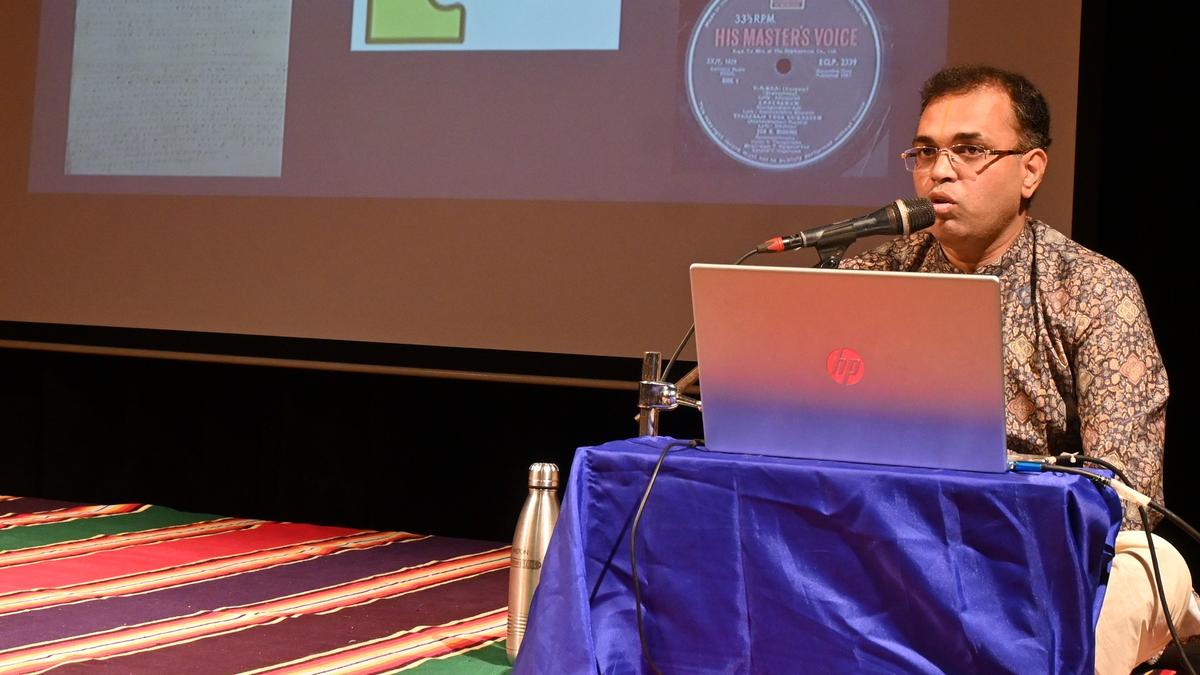
    In his lec-dem at the Music Academy, T.R. Aravindhan discussed ‘Muthuswami Dikshitar’s kritis in unpublished manuscripts.’ His search threw up five unpublished compositions in a manuscript available with the descendants of the Thanjavur Quartet family, who were direct disciples of Dikshitar. Of the five, ‘Sri kamakshi’ (geetham), ‘Charanu kamakshi’ (charanu) and ‘Manonmani’ (mangalam) are given as Malavagowla janyams. ‘Charanu charanu’ is given as Sankarabharanam janya, and ‘Jaya jaya’ as Sri raga janya. The manuscript says ‘Jaya jaya’ is a Thodayam. Interestingly, even today ‘Charanu charanu’ and ‘Jaya jaya’ are part of the bhajan sampradaya. King Serfoji composed a form known as nirupanam, where a central theme is taken, and many musical forms such as geethams, charanus, and mangalams are used. Aravindhan’s hypothesis was that the five compositions, all in praise of Ambal, could be part of a nirupanam by Dikshitar.

    Four of the compositions are notated, and the raga can be inferred from the sahitya. Aravindhan pointed out that Dikshitar shows Megharanjani as an elaborate raga in ‘Venkatesa’ , but shows it in a scalar form in ‘Charanu kamkashi’.

    ‘Venkatesa’ also has a lot of vakra prayogas. ‘Sa ri ga ma and ma ga ri sa’ are used less in ‘Venkatesa’, but in ‘Charanu kamakshi’, only these are used. In ‘Venkatesa’, nishadam in the phrase ‘ma ni, ni ga’ appears to be discordant, but not so in ‘Charanu kamakshi’.

    ‘Sri kamakshi namostute’ is in raga Padi, Adi tala. In this composition, nishadam occurs twice in one avartha. And in his popular ‘Sri guna palitosmi’, Muthuswami Dikshitar uses the phrase ‘pa da pa ni sa’ often. Ramaswami Dikshitar uses nishadam much less.

    “For the composition ‘Manonmani’, we get the name of the raga in the lyric as Mechabowli, but no notations are available. Shahaji composed mangalams in Mechabowli, Malavasri and Pantuvarali. So maybe there was a Shahaji influence in the choice of the raga”, said Aravindhan. Tyagaraja, for example, used Pantuvarali, for his ‘Shobane’.

    ‘Charanu charanu’ is in raga Arabhi. The raga for the composition ‘Jaya jaya’ is said to be in a janya of Sri. The name Manohari occurs in the lyric. But Sangita Sampradaya Pradarshini (SSP) mentions raga Manohari as a janya of Gangatarangini. Was there another Manohari, which was a janya of Sri? Exploring the possibility, Aravindhan said that there seem to have been ragas with the same name but with different features. For instance, Shahaji says raga Velavali is a janya of Sri. But in a manuscript in Saraswathi Mahal library, Velavali is given as a sampoorna raga and a janya of Sankarabharanam. Using the notations, Aravindhan ruled out Shuddha Dhanyasi, Manirangu and Brindavana Saranga as the raga of ‘Jaya jaya’, leaving only Rudrapriya. Aravindhan said that since Rudrapriya had many variants, a definitive conclusion was difficult.

    A manuscript of Bharatam Natesa Iyer, a sishya of Sabhapati Nattuvanar, descendant of the Quartet, had ‘Vadanyeswara’ (raga Devagandhari) a kriti not found in SSP. The chittaswaram follows a pattern similar to that found in ‘Kshitija’ (Devagandhari). There is a publication of ‘Vadanyeswara’ by Mudicondan Venkatrama Iyer.

    Aravindhan discussed variations of ‘Chandrambhaja’ seen in various versions. In a manuscript of Ambi Dikshitar, Aravindhan found that the madhyama kala portion of the sahitya did not have the line ‘kamaneeya vara kataka raasyaadeepam’, or the chittaswaram. A book published by Ambi Dikshitar’s disciples, Vedanta Bhagavatar and Anantakrishna Ayyar in 1937, carried the chittaswaram, but not the ‘kamaneeya’ line. Anantakrishna Ayyar published a book in 1957, with the extra line and chittaswaram. In SSP, the extra sahitya line is not mentioned, but chittaswaram is given. Anantakrishna Ayyar’s daughter Champakavalli’s manuscript records both the extra line and the chittaswaram. Mahadeva Bhagavatar’s manuscript shows the extra line, but has no chittaswaram.

    Dikshitar Kirtana Malai, published in 1949 by Kallidaikurichi Sundaram Ayyar, has the chittaswaram, but not the line. Aravindhan concluded that although manuscripts give us a lot of information, they are not easy to interpret, and one must tread cautiously.

  • Vignesh Ishwar was at his imaginative best at his concert for Maarga

    Vignesh Ishwar was at his imaginative best at his concert for Maarga

    [ad_1]

    <!–[if IE 9]><![endif]–>

    Vignesh Ishwar’s concert for Maarga in December 2025.
    | Photo Credit: Special Arrangement

    Vignesh Ishwar’s offering at Maarga was one of the most memorable experiences of the December 2025 Music Season.

    Vignesh’s voice glides effortlessly at the lofty D shruti, enriched by a sensitive and mature Carnatic aesthetic and an expansive repertoire. The concert was elevated by the accompaniment — mridangam maestro Umayalpuram Sivaraman, Sayee Rakshith on the violin and B.S. Purushottam on the kanjira.

    In the 250th birth anniversary year of Muthuswami Dikshitar, most musicians have featured his compositions prominently in their concerts. Vignesh opened his recital with ‘Sri nathadi gurugoho’ in Mayamalavagowla, embellishing it with an imaginative and well-crafted niraval. Sayee’s returns were marked by sensitivity and restraint. The veteran mridangist’s playing stood out for its tonal quality — its naada echoing through the new Ramakrishna Mission TAG Auditorium in T Nagar.

    ‘Sogasuga mridanga talamu’ in Sriranjani followed in a brisk tempo, the mridangam accompaniment creating a sense of spaciousness despite the pace. At one point, the veteran asked Vignesh to sing ‘Marubalka’ — he delivered it with striking beauty.

    Vignesh’s niraval, particularly in the madhya sthayi, revealed his musical intellect. The swarakalpana that followed was equally impressive, with Sayee Rakshith’s violin weaving meaningful and well-structured patterns even at breakneck speed, matching the vocalist phrase for phrase with remarkable assurance.

    Clearly moved by Sivaraman’s musicianship, Vignesh paused to remark, “At 90, he is playing the way he did 50 years ago.” Sivaraman, in turn, responded with grace, observing, “It takes a musician of Vignesh’s calibre to sing like this.”

    Vignesh’s rendition of ‘Vadanyeshwara’ in Devagandhari was followed by the Kamboji alapana, with both Vignesh and Sayee at their imaginative best. ‘Sri subrahmanyaya namaste’ emerged as a fitting centrepiece marked by weighty phrases that perfectly matched the gravitas of the raga. The niraval at the familiar line ‘Vasavaadi sakala deva’ was developed with a steady structural sense.

    Sivaraman’s dynamic choice of sollus, closely mirroring the musical flow, and his engaging interactions with the violin during the climactic swara passages — often extending beyond the vocalist’s korvai, as is his wont — heightened the concert’s appeal. The tani avartanam commenced with a brief opening round that focussed on gradually building tempo.

    Sivaraman continually shaped and expanded the rhythmic architecture, his signature three-gati korvai marking the point at which the tani ascended to an altogether different plane. The shorter exchanges between Sivaraman and Purushottam leading up to the finale were especially engaging.

    The post-tani session included ‘Sapasya kousalya’ and ‘Parulanna mata’. Both pieces were rendered with distinction.

    This was a concert that seamlessly wove vidwat, imagination, and shared musical empathy.

  • ‘Happy Patel’ movie review: Vir Das tom-toms his absurdist humour

    ‘Happy Patel’ movie review: Vir Das tom-toms his absurdist humour

    [ad_1]

    <!–[if IE 9]><![endif]–>

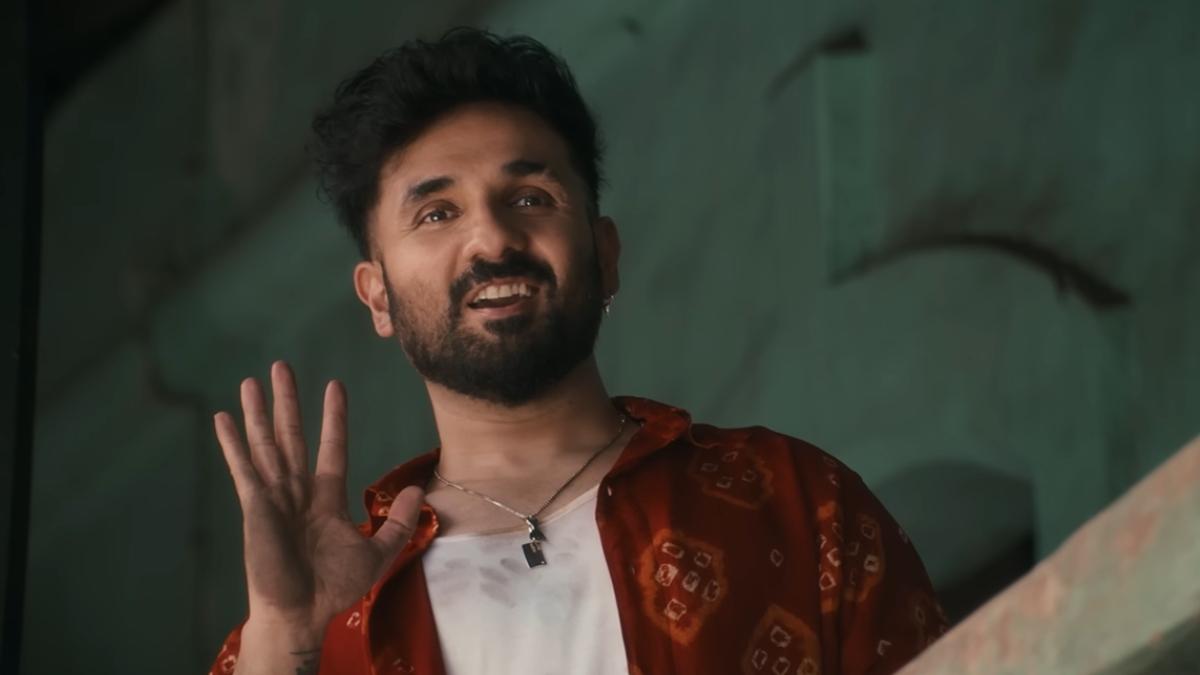
    Vir Das in ‘Happy Patel’
    | Photo Credit: Aamir Khan Productions

    Those who have followed Vir Das’ comedy specials would know that he blends satire with observational humour better than most. He voices the experiences of the misfits, and his skits capture everyday absurdities arising from cultural clashes, racism, and jingoism.

    This week, Vir shifts stage, turning his pet peeves into an irreverent and frenetic parody of our times. Making his debut as a director, he turns up ‘in and as’ Happy Patel, a clumsy British spy with Indian roots. More at ease in the culinary terrain, perhaps because of his genetic composition, than picking clues, Happy is sent on a mission to Goa to rescue a British scientist from the clutches of a vicious crime lord, Mama (Mona Singh). Her favourite recipe is ‘cut-let’ and she is seeking a formula for fair skin. Happy mispronounces Hindi, and here lies most of the ingenuity in writing. Tum (you) becomes Tom and so on. On his crazy hunt for Mama, he rhymes with his Sikh handler (Sharib Hashmi) and loses his tasting finger to Mama and his heart to dancer Rupa (Mithila Palkar).

    Happy Patel: Khatarnaak Jasoos (Hindi)

    Directors: Vir Das and Kavi Shastri

    Duration: 121 minutes

    Cast: Vir Das, Mona Singh, Mithila Palkar, Sharib Hashmi

    Synopsis: A wannabe spy discovers his Indian roots as he sets out on a high-stakes rescue of a scientist from a ruthless crime lord in Goa.

    Seemingly targeted at an urban audience that turns up for niche stand-up or sit-down comedy gigs after a few drinks, Happy Patel falters and fumbles in keeping us high in the cinematic form. Vir and co-director Kavi Shastri mock faux heroism, make fun of Bollywood tropes and racial profiling, and challenge stereotypes associated with immigrants, but the presentation leans on cringe, providing exaggerated caricatures a field day. The subversive tone toggles between inconsistent and incoherent, the punches announce their presence from a distance, and the gags turn out to be more gas than substance.

    Mona Singh in the film
    | Photo Credit:
    Aamir Khan Productions

    We know Vir consciously picks pandemonium over plot and expects the audience to read the coded meaning in the mauling of the syntax, but too much self-awareness kills the fun and emotional engagement as the writers (Vir and Amogh Ranadive) constantly wink at the audience, pointing out or presenting the narrative’s own artificiality as anarchy. The anything-goes approach sets in early, and Aamir Khan’s rumbustious entry doesn’t spark the expected curiosity. Apart from underlining that the film’s tone should be read in the context of Delhi Belly, Imran Khan’s return to the scene doesn’t add much.

    Channelling his personal battles into an artistic form, Vir is efficient, but he comes across as more natural on stage than on screen. Mona makes the most of the meat in her lean character, while Sharib Hashmi and Mithila Palkar go with the flow. Talking of the flow, Vir’s compositions and choreography are in sync with the madcap flavour.

    A still from the film
    | Photo Credit:
    Aamir Khan Productions

    There are a few unalloyed moments of fun and surprise, like the M joke and the 8 PM moment, but after a point, the wordplay becomes so repetitive that it starts to wear on the nerves. As they say, when style overrides substance, the joke wears thin.

    Happy Patel: Khatarnaak Jasoos is currently running in theatres

  • ‘Rudra’ presents the many facets of Shiva

    ‘Rudra’ presents the many facets of Shiva

    [ad_1]

    <!–[if IE 9]><![endif]–>

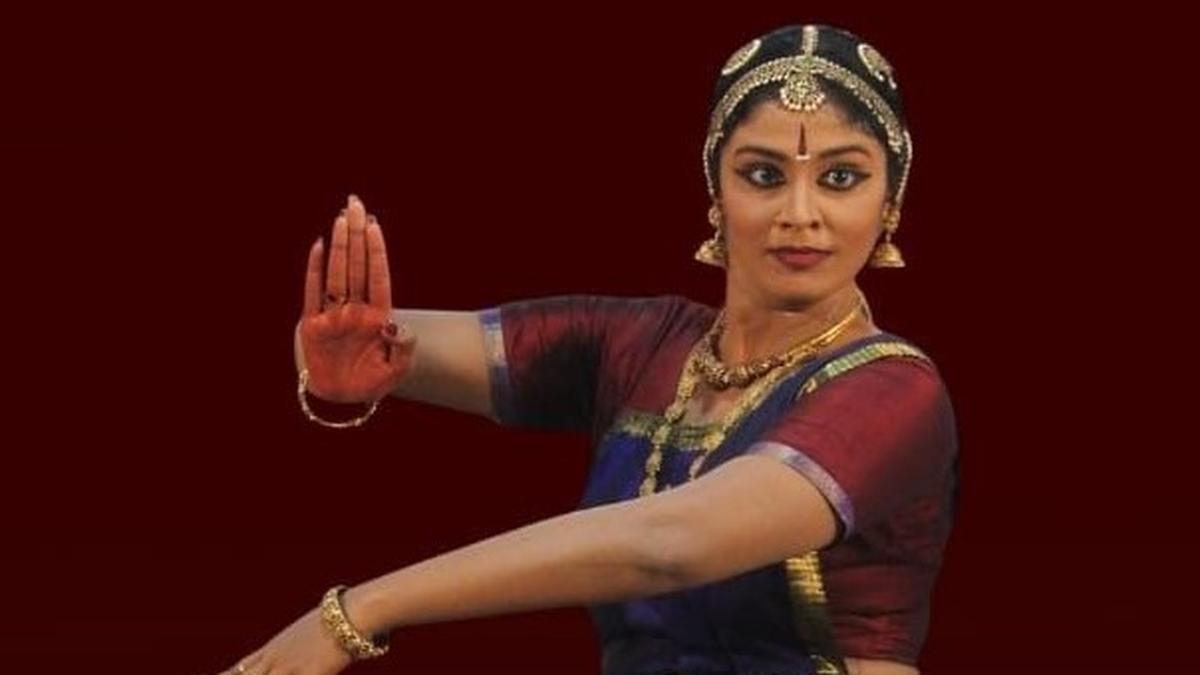
    Shruti Umaiyaal.
    | Photo Credit: Special Arrangement

    Shruti Umaiyaal, student of Meenakshi Chitharanjan, presented a thematic solo ‘Rudra’, under the auspices of Bharat Kalachar.

    Commencing with ‘Sankara sri giri nadaprabho’, a composition by Swati Tirunal in raga Hamsanandi, Shruti established the theme through energetic, clear movements.

    As the recital progressed, one got to witness a string of pieces, each showcasing the lord of dance through different perspectives — the lovelorn nayika, the angry mother and the dedicated devotee.

    The highlight of the evening was the pada varnam ‘Yenneramum avarai ninaithaenadi’, a composition by Pandanallur Srinivasa Pillai in Chakravaham. Here, the viraha nayika was depicted with depth. The choreography and compering by Meenakshi Chittaranjan that clearly delineated the sthayi bhava made the experience enjoyable.

    This was followed by a traditional padam, a nindha sthuthi in Kalyani, ‘Yethai kandu nee ichai kondaiyadi magale’ ’. On seeing her daughter’s intense love for Shiva, the mother calls him a madman, and asks her daughter what she found in him, a mendicant who lives in the cemetery. The nayika quotes Thirugnanasambandar’s lines ‘Kadalagi kasindu’, reiterating her boundless devotion to Shiva.

    The recital concluded with K.N. Dandayudhapani Pillai’s thillana in raga Hindolam, seeking Nataraja’s grace.

    The orchestra — Meenakshi Chitharanjan (nattuvangam), Gomathi Nayagam (vocals), Sakthivel Muruganandam (mridangam) and Karaikaal Venkata Subramanian (violin) — was an asset to the performance.

  • Keerthana Ravi’s ode to Dikshitar

    Keerthana Ravi’s ode to Dikshitar

    [ad_1]

    <!–[if IE 9]><![endif]–>

    Keerthana Ravi.
    | Photo Credit: Special Arrangement

    Keerthana Ravi, a disciple of Padmini Ramachandran and Rama Vaidyanathan, began her performance for the Iyal, Isai, Nataka vizha of Narada Gana Sabha with Muthuswami Dikshitar’s ‘Jambupathe’ in Yamuna Kalyani — not a common choice for a dance recital. Seeking a path to true bliss, this song is filled with varied descriptions, and the dancer portrayed them through interesting sancharis.

    This was followed by Swati Tirunal’s ‘Pannagendra sayana’. This interesting Ashtaragamalika composition begins with raga Sankarabharanam and travels through other ragas, ending with Bhoopalam. The song describes Padmanabha’s reclining form and his radiant personality and the nayika’s yearning for him. Keerthana conveyed these through appropriate gestures and movements.

    Keerthana Ravi explored the beauty of rain in her thillana in Miyan ka Malhar.
    | Photo Credit:
    Special Arrangement

    The final thillana in Miyan ka Malhar, composed by Karthik Hebbar, was a delightful piece, exploring the beauty and the sensory experiences of rain.

    Keerthana needs to plan her repertoire, keeping in mind the time frame. It is difficult to maintain the momentum when one starts the recital with a Chowka Kala Dikshitar kriti in the afternoon slot. Also, a little more azhutham in Karthik’s rendition of the kriti would have enhanced the impact.

    Kalliswaran Pillai on the nattuvangam, Harsha Samaga on the mridangam and Vivek Krishna on the flute lent fine support.

  • ‘28 Years Later: The Bone Temple’ movie review: Ralph Fiennes and Jack O’Connell are worthy adversaries in a post-apocalyptic nightmare

    ‘28 Years Later: The Bone Temple’ movie review: Ralph Fiennes and Jack O’Connell are worthy adversaries in a post-apocalyptic nightmare

    [ad_1]

    <!–[if IE 9]><![endif]–>

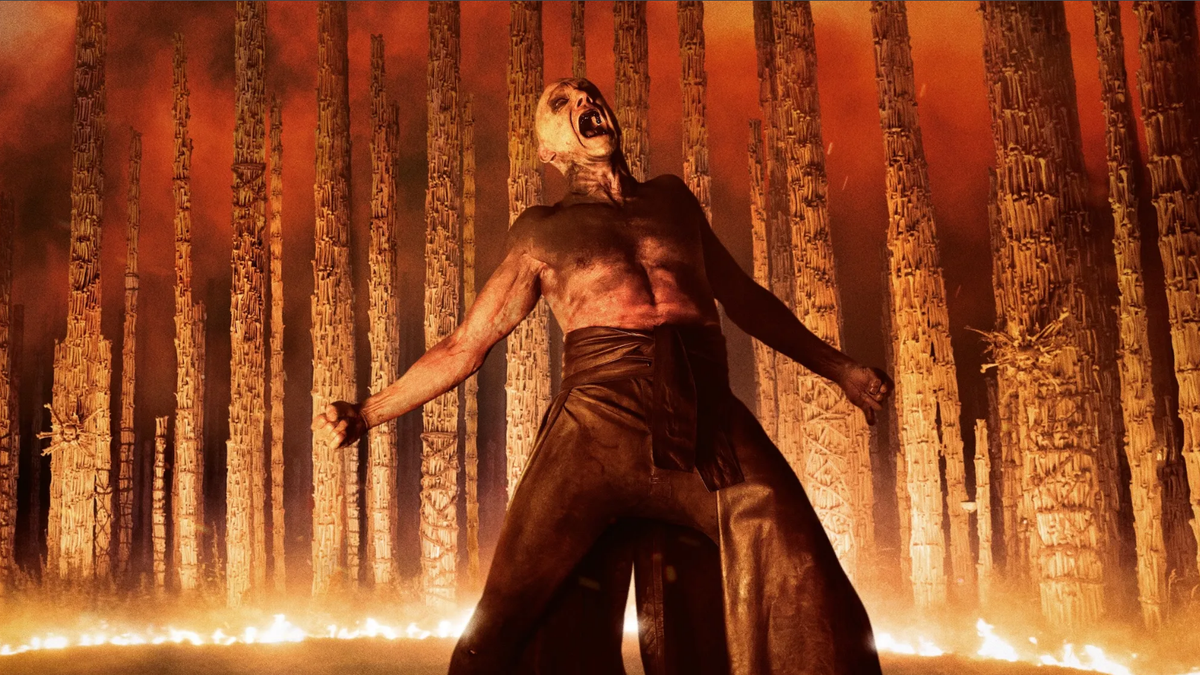
    A still from ‘28 Years Later: The Bone Temple’
    | Photo Credit: Columbia Pictures

    What will be the soundtrack of the world hurtling towards destruction? According to Ralph Fiennes’s Dr Ian Kelson there will be Duran Duran (‘Ordinary World’, ‘Girls On Film’, ‘Rio’), Radiohead (‘Everything In Its Right Place’) and Iron Maiden (‘The Number Of The Beast’). Icelandic composer Hildur Guðnadóttir has created an exquisite score for this sequel to Danny Boyle’s 28 Years Later, with the needle drops flawlessly timed.

    28 Years Later: The Bone Temple, the fourth instalment of the 28 Days Later film series, picks up where the last movie left off, with young Spike (Alfie Williams) captured by the psychopathic gang leader Sir Lord Jimmy Crystal (Jack O’Connell) and his feral “Jimmies”. Spike earns his place in the gang by accidentally killing one of the Jimmies.  

    28 Years Later: The Bone Temple (English)

    Director: Nia DaCosta

    Cast: Ralph Fiennes, Jack O’Connell, Alfie Williams, Erin Kellyman, and Chi Lewis-Parry

    Runtime: 109 minutes

    Storyline: Dr. Kelson finds himself in a shocking new relationship with consequences that could change the world as he knows it, while Spike’s encounter with Jimmy Crystal becomes a nightmare he can’t escape

    Shocked and disgusted at the brutality and violence of the Jimmies and their depraved leader, Spike finds a kindred spirit in Jimmy Ink (Erin Kellyman). Kelson, meanwhile, continues to build a memorial to all the lives lost to the rage virus.

    An imposing Alpha, whom Kelson names Samson (Chi Lewis-Parry), is addicted to morphine and comes daily to Kelson for a hit, giving Kelson the idea of developing and trying out an antidote to the rage virus on Samson.

    A still from ‘28 Years Later: The Bone Temple’
    | Photo Credit:
    Columbia Pictures

    Written by Alex Garland, who wrote the earlier movie as well, Nia DaCosta takes the directing reins from Boyle to create, in O’Connell’s words, a “weird, deranged cousin” of the earlier film. While the sweeping, heart-breaking beauty of the earlier film is dialed down, The Bone Temple thrums with the earlier film’s energy.

    There are still scenes of stark beauty, including the ivory columns and pyramids of Kelson’s memorial. The moth alighting on the pelvic bone that Kelson is curing is pregnant with foreshadowing. While the zombies are not on screen so much, they are a presence nevertheless and the violence is gnarly.

    The build-up to the meeting between Kelson and Jimmy (“the Satanist and the atheist”) has a satisfying pay-off. Fiennes burns up the screen as Kelson, whether humming Duran Duran, or doing a full-on performance of ‘The Number Of The Beast’.

    And there are the quieter moments too, when he remembers the before days, when one was sure of the order of things or when he wryly tells Samson, he is treating him free of charge, as he is NHS.

    A still from ‘28 Years Later: The Bone Temple’
    | Photo Credit:
    Columbia Pictures

    O’Connell as Jimmy is an apt foil to Fiennes — at once deranged, demented and childlike, never having grown up after being betrayed by his father when he ran away as a child from the ravening hoardes.

    The first film dealt with isolationism and the nature of mythmaking; this one looks at the nature of evil; and the third, also to be directed by Boyle, will look at redemption. With a view to the third film, Jim (Cillian Murphy) the survivor from the first film, makes an appearance towards the end of 28 Years Later: The Bone Temple quoting Winston Churchill’s “Those who fail to learn from history are doomed to repeat it.”

    The best of genre films rise above the framework to ask weightier questions, which is what the 28 days Later movies have consistently done for zombie movies. That deep thought, achieved in such style and with a rocking soundtrack, is a delicious extra.

    28 Years Later: The Bone Temple is currently running in theatres

  • ‘Greenland 2: Migration’ movie review: Gerard Butler does all the heavy lifting in limp sequel

    ‘Greenland 2: Migration’ movie review: Gerard Butler does all the heavy lifting in limp sequel

    [ad_1]

    <!–[if IE 9]><![endif]–>

    A still from ‘Greenland 2: Migration’.
    | Photo Credit: Lionsgate Movies/YouTube

    Watching Greenland 2: Migration, one almost feels as though one is in a time capsule watching all those big disaster movies from the ‘90s, in single-screen theatres that looked like palaces with velvet curtains and chandeliers.

    It was the time of slides saying “chatterboxes keep quiet,” and where popcorn, cheese sandwiches or curry puffs came hot in aluminium trays at the interval.

    Greenland 2: Migration (English)

    Director: Ric Roman Waugh

    Starring: Gerard Butler, Morena Baccarin, Roman Griffin Davis

    Runtime: 98 minutes

    Storyline: Five years after the comet strikes Earth, the bunker is no longer safe, and the Garritys strike out for the crater, where life has apparently hit the reset button

    It was the time of radioactive lizards with eyes as big as Gol Gumbaz, hurtling comets, rising seas and an alien susceptible to a cold. But once you realise it is 30 years on in a world that has lost its innocence to a rapacious virus, you are less willing to grant as much leeway to a lazily made sequel.

    Greenland in 2020 was a critical and commercial success with Gerard Butler playing the world-weary action hero‑family man‑tech expert, John Garrity. A comet named Clarke (after the science fiction writer Arthur C Clarke) was scheduled to hit the Earth and end life as we know it.

    At the end of the movie, after many trials, John, with his wife, Allison (Morena Baccarin) and insulin-dependent son Nathan (Roman Griffin Davis takes over from Roger Dale Floyd) reach a bunker in Greenland just as a large chunk of the comet hits the earth.

    Five years later, the earth is still not a particularly safe space with earthquakes, radiation, tsunamis and other jolly things blighting existence. John is now a scout, while also attending to repairs in the bunkers, owing to his training as a structural engineer. At a meeting, there is discussion of food supplies running low and a decision to be taken on whether to respond to a call for help.

    While the mean army man reasonably says they cannot feed anyone more, Dr. Amina (Amber Rose Revah) asks for the matter to be put to vote and when the snowcat is sent out to get the refugees, an earthquake destroys the bunker.

    Garrity and others head to the coast, fight over lifeboats, drift without food, water or fuel to England and then go on to France where the Clarke crater is a new Eden where the air is fresh and land is fertile.

    ALSO READ: ‘People We Meet on Vacation’ film review: Tom Blyth and Emily Bader’s sweet rom com checks all the right boxes

    Greenland 2: Migration suffers from a woeful lack of logic, even of the film kind. How is it that everyone looks well fed and groomed even as we are repeatedly told they are running out of food? How are there still bullets given the way people are shooting at each other? How are vehicles still running on fuel?

    Why are robbers or insurgents fighting in an area controlled by the army? And of course, the bridge across the English channel, which is now a dry wasteland, has to collapse exactly at the moment when our heroic gang is creeping across.

    Every time there is a crisis, it is as if the makers got bored and decided to move on. So despite running out of fuel, the lifeboat drifts to Liverpool, and Nate’s diabetes is reduced to “pack all the insulin.” Still it is fun to see the ever-dependable Butler do his melancholic routine and that is about all one can say for the haphazardly conceived sequel.

    Greenland 2: Migration is currently running in theatres

  • ‘Frieren: Beyond Journey’s End’ Season 2 premiere review: Hello old friend, hisashiburi…

    ‘Frieren: Beyond Journey’s End’ Season 2 premiere review: Hello old friend, hisashiburi…

    [ad_1]

    Two years ago, when I joined this organisation as a rookie still trying to earn his chops, the idea of devoting an entire column to an unassuming melancholic fantasy anime felt a little absurd. Kanehito Yamada and Tsukasa Abe’s lesser-known Japanese series about a couple millenia-old elf processing grief through detours and half-remembered conversations hardly seemed like obvious material. This was a newspaper with a long history of schooling ambition, after all. And yet, I wrote it anyway.

    I dubbed Frieren: Beyond Journey’s End the “future of fantasy”, with a confidence that felt reckless even as I typed it. If you’ll forgive a moment of shameless self-promotion, the piece really took off. It found its way onto the Frieren subreddit, blowing up on Twitter and Instagram, and eventually reached a few seniors at the organisation, who seemed quite amused. Heck, the crowning jewel of that run was realising it had even found its way onto Frieren’s Wikipedia page, which still feels unreal. Along that ripple effect, Frieren had carved out a small space for me, a niche I could stand inside and speak clearly from. For a storytelling medium rarely taken seriously by Indian media, it sure felt like a small act of faith from an eager, if slightly nervous, little otaku writing about something he loved without knowing who would listen. Looking back now, it almost feels like I owe her everything.

    Two years since, the road goes ever on, and so have I. The distance between that first column and this sophomore premiere is filled with a montage of shaky confidence assembled piece by piece and a voice shaped through passion and repetition. Now, watching this beloved elven mage finally return carries with it the familiar pang of a Himmel flashback. The memory of where I was last time enriched what I was seeing now. I thought I understood this series, that I was prepared, but this mischievous little elf still had a few surprises up her sleeve.

    Frieren: Beyond Journey’s End Season 2 (Japanese)

    Director: Tomoya Kitagawa

    Cast: Atsumi Tanezaki, Kana Ichinose, Chiaki Kobayashi, Nobuhiko Okamoto, Hiroki Tochi, Yoji Ueda

    Episodes: 1 of 10

    Runtime: 25 minutes

    Storyline: Frieren, Fern, and Stark leave the magic city of Äußerst behind and travel along a road in the northern lands

    The second season of Frieren slips back into step beside you with the devotion of a Samwise Gamgee, already walking before you notice. Nearly thirty years have passed since Himmel’s funeral, and for Frieren, that span barely registers. For the rest of the world, it has reshaped borders, dangers, and lives. The episode holds that imbalance gently, allowing time itself to remain the central pressure point, as always.

    What struck me most watching this premiere was how deeply personal its layered minimalism still felt. The simple narrative device of the magic-nullifying crystals buried beneath the earth rearranges the emotional geometry of the group. Frieren and Fern lose access to magic, and Stark becomes the axis on which everything turns. The choice to introduce this limitation serves to clarify what the series values. As the unfathomable power of the two mages drains away, what remains is pure, undying faith in their commrade.

    A still from ‘Frieren: Beyond Journey’s End’ Season 2
    | Photo Credit:
    Crunchyroll

    Stark’s role during this sequence develops with subtlety. He has always carried physical strength alongside emotional hesitation, and the premiere treats that tension earnestly. Faced with protecting two companions rendered defenceless, Stark’s fear surfaces once more, and his choice neither mocks nor dramatises it. His decision to flee, carrying both Frieren and Fern to safety, frames courage as stewardship, and the moment echoes earlier stories Frieren recalls about Himmel and Eisen, drawing a clean, romantic line between generations.

    Frieren’s own response to Stark’s hesitation also reveals her own incremental growth. Earlier in the series, emotional cues often passed her by unnoticed, but now, she seems to anticipate them better. Her reassurance feels learned rather than innate, shaped by decades of regret and observation, and the series continues its long project of redefining wisdom as something acquired through attention and mindfulness.

    The episode’s second half, centred on Stark’s potential departure with Wirbel, flows with similar restraint. Fern’s anxiety expresses itself through care, as she tends to the objects she’s been given, holding memory in her hands. A brief exchange with Frieren about these keepsakes unfolds softly, though with unsurprising weight. Frieren now notices and remembers. This is the same elf who once struggled to grasp why gifts mattered at all, but the accumulation of time has finally seemed to find direction.

    When Stark speaks to Fern later, he talks about encouragement, about becoming braver because someone believed in him. The moment resonates effortlessly because it feels so deeply lived-in. Relationships in Frieren evolve through proximity, through shared inconvenience, and even through simply staying — that rhythm mirrors real, organic growth.

    Visually, the episode continues to impress without seeking attention with hand-drawn excellence. This opener slips back into form with tranquil worlds, stray adventures and one very funny elf. The wide skies, lush forests, and meticulous regard for movements all reinforce the sense of time pressing against the characters. Evan Call’s marvellous music drifts in and out. Everything serves the same purpose: to let the moment breathe.

    A still from ‘Frieren: Beyond Journey’s End’ Season 2
    | Photo Credit:
    Crunchyroll

    What I didn’t expect in those early months of writing about Frieren as an enthusiastic outsider was how completely the show would burrow into the wider conversation, evolving into something larger-than-life that actually mattered to people far beyond me. By the close of its first season, it had climbed to the very top of MyAnimeList’s global rankings, dislodging long-cherished classics that had been permanent furniture for years without gimmicks or evangelism — a feat no other series has managed in the platform’s long history of rabid voters. And the bitter turbulence that followed Solo Levelling’s obnoxious sweep at the Anime Awards last year also spoke to how deeply people had come to care about Frieren, and how it set a standard for what fantasy could be.

    In the time since, every major genre release has been discussed against Frieren’s example, whether anyone admits it or not. High fantasy like Delicious in Dungeon, Clevatess, the latest Sentenced to Be a Hero, and even the upcoming Witch Hat Atelier, have all promised scope, scale, or subversion of some sort. Very few promise patience. Fewer still excavate memory with such grace. That gap keeps widening, and Frieren remains unbothered and very hard to ignore.

    As the trio resumed their journey toward Ende, I couldn’t help but reflect on the same click I felt two years ago when we published that first piece and wondered if I’d gone too far out on a limb. Frieren has walked this road before, but she walks it differently now, awake to the weight and warmth of the people beside her, each step reshaping the memory as it’s being made. Watching her once more, I felt the same curvature of experience, looking back at my own path since and choosing to keep going as the road goes ever on.

    There is no other anime (dare I say, television even) operating on a register this intimate. I don’t fully understand how it keeps happening, but something in the way this show is put together still finds its way past me every single time. I remain mildly baffled by how the sum of its parts keeps slipping through my defences, leaving me in tears all over again.

    Two years ago, I called Frieren the future of fantasy, and I feel that conviction resurface with sharper clarity. Nobody else is telling stories like this, and somewhere between then and now, she taught me how to tell mine with more care too.

    It’s good to see you again, old friend.

    New episodes of Frieren: Beyond Journey’s End Season 2 stream weekly on Crunchyroll