
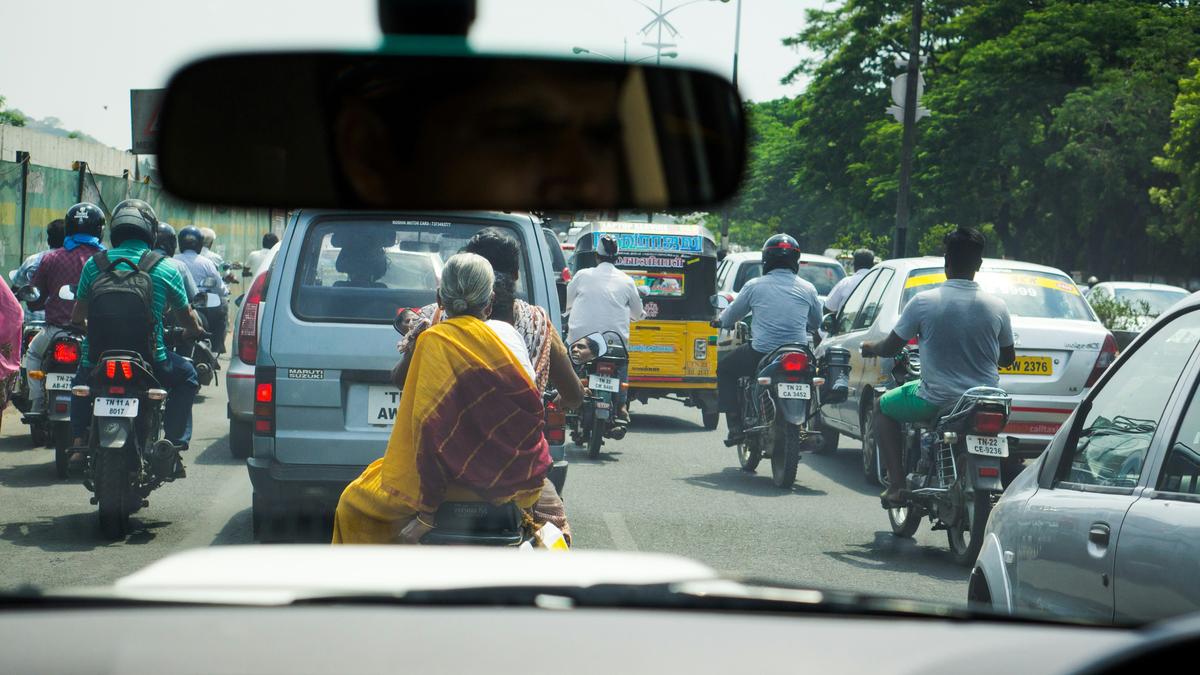
In India, urban noise is relentless yet it is largely under-recognised as a public health concern. The average Indian urban traffic reportedly routinely reaches 80-100 dB, exceeding the World Health Organization’s recommended 70 dB limit, creating a recognised risk of hearing loss.
Noise-induced hearing loss (NIHL) has long been viewed as an occupational disease of factories and mines. Scientific evidence challenges this assumption. Chronic exposure to environmental noise, particularly road traffic, can cause clinically measurable damage even in the absence of industrial hazards.
Physiological impact
Scientific evidence suggests what cities dismiss as background noise may in fact be producing measurable biological injury.
CSIR-National Environmental Engineering Research Institute senior technical officer Satish K. Lokhande said NIHL typically first appears around 4 kHz. In a 2022 study on firecracker noise, Dr. Lokhande documented how repeated exposure to intense sound peaks, often exceeding 85 dB, “accumulates auditory stress,” initially causing a temporary threshold shift that becomes permanent with sustained exposure.
In another 2023 study of road tunnels that he co-authored, Dr. Lokhande found sound levels between 78.9 and 86.5 dB(A) with peak energy again concentrated at 4 kHz. Urban road traffic contributes a continuous, moderately elevated noise environment, often punctuated by horns and construction activity.
(dB(A) is short for A-weighted decibels, a sound level in decibels that has been adjusted to reflect how sensitive human hearing is at a certain frequency.)
This auditory stress doesn’t stay confined to the ear. Chronic noise activates the hypothalamic-pituitary-adrenal axis, an important hormone-signalling system that coordinates the body’s response to stress and helps regulate energy use, immunity, mood, and sleep-wake timing. It elevates cortisol, blood pressure, and cardiovascular strain. Night-time traffic noise also fragments sleep, disrupting deep and REM stages and impairing cognition.
While Indian biomarker data remain limited, international studies have also linked long-term environmental noise exposure to cardiovascular and metabolic risk.
Health accounting
India’s legal framework recognises noise as an environmental pollutant under the Noise Pollution (Regulation and Control) Rules 2000. The Rules prescribe permissible limits for residential, commercial, and silence zones. Monitoring is episodic, concentrated around festivals or public complaints and rarely linked to health outcomes.
A 2024 study in NatureScientific Reports, led by Markandeya, formerly of the department of Civil Engineering at IIT-BHU Varanasi, examined long-term traffic noise exposure among professional drivers. It revealed a clear dose-response relationship between cumulative noise exposure and changes in the hearing threshold, especially in frequencies critical for speech.
Most urban monitoring relies on fixed-location decibel readings at select junctions or in specific time windows. Such snapshot measurements capture momentary intensity but don’t account for the length of exposure or cumulative auditory burden.
Dr. Markandeyaexplained that permissible exposure duration decreases logarithmically as decibel levels rise. “At 121 dB(A), exposure may be considered safe for one hour over a lifetime, whereas at 133 dB(A), the same duration would be unsafe.” he says, noting that CNE functions not as a snapshot but as a lifetime audit of auditory burden.
Thus, he added, cumulative noise exposure can bridge this ‘gap’ because it integrates intensity and duration, and more closely reflects real-world auditory risk.
However, India’s National Ambient Noise Monitoring Network isn’t designed to capture cumulative exposure in urban environments.
‘Underestimated burden’
Delhi Technological University professor of environmental engineering Rajeev Kumar Mishra also said, “Averages like Leq and Ldn ignore impulsive peaks from honking — which increase auditory strain.”
Leq is the constant sound level that would deliver the same total acoustic energy as the real, time-varying sound over a specified period, e.g. 1 hour, 8 hours, etc. Ldn is the 24-hour Leq-like metric but it also penalises noises between 10 pm and 7 am more to reflect greater sleep disturbance. Both levels are measured in dB(A).
“Indian planning underestimates the hearing burden,” Dr. Mishra added. Thus honking rules are unimplemented and there are no real quiet zones, leaving the damage to spread unchecked.
NIHL often remains invisible within healthcare. Doctors attribute hearing loss to ageing, habits or individual susceptibility rather than environmental exposure. High-risk groups including drivers, traffic police, roadside vendors also remain underdiagnosed without systematic screening.
Lucknow’s Sanjay Gandhi Post Graduate Institute of Medical Sciences ENT specialistAmit Kesari said that among high-risk groups, traffic police are most vulnerable due to long hours at busy intersections in open areas. Early-stage loss may appear as a 4 kHz dip in audiometry and specialised tests such as DPOAE can detect early changes. He also suggested screening these groups with audiometry every five years to quantify actual loss.
At present linking hearing loss specifically to traffic noise remains challenging due to clinical and awareness-related reasons. The classic 4 kHz dip associated with NIHL has been more consistently documented in occupational settings than in diffuse environmental exposure, and patients rarely attribute hearing loss to traffic noise.
“Traffic noise is more immediately associated with stress, anxiety, and blood pressure,” Dr. Kesari said.
Evidence-based action
In May 2023, 231 traffic personnel underwent hearing screening at Ahmedabad’s Police Stadium, conducted by Satyen Engineer, CEO of independent research outfit Yhonk India and “hearing care company” WeHear. They found the mean hearing thresholds of the left and right ears to be 44.4 dB and 42 dB, respectively, placing 60.6% and 54.5% of personnel above 40 dB.
While the findings weren’t peer-reviewed, they offered field-level evidence demonstrating occupational hearing risk among the country’s traffic police, and raised troubling questions.
“Until we have systematic data from drivers, traffic police, and other high-exposure groups, we are only estimating the scale of the problem,” Dr Kesari said.
Adamas University, Kolkata, civil engineer Argha Kamal Guha suggested that cities consider introducing low noise emission zones in places where frequent honking is known to elevate exposure levels. Such a measure, he said, could include rerouting traffic and restricting the noisiest vehicle categories, especially if the hotspots are near hospitals, residential neighborhoods, and educational institutions.
In the final analysis, integrating environmental noise metrics with routine hearing assessments, Dr. Kesari suggested, would allow earlier detection and more accurate estimation of risk. As he put it: “We have the evidence. What we lack is the mechanism to act on it.”
Rohan Singh is an independent science journalist based in Lucknow. Harish C. Phuleria is associate professor, IIT-Bombay.