Guru Pasumarthi Rattiah Sarmaon the nattuvangam; Murali Sangeeth on the vocals, Kalamandalam Sreerang on the mridangam and Hariprasad Subramaniam on the flute.
| Photo Credit:
Umesh Kumar
Pasumarthi Rattiah Sarma and Kavya Harish presented Kuchipudi Yakshagana. Guru Rattiah Sarma, 85, was born into the tradition and remains one of the last bastions of the original dance theatre-art. The pieces were from the old repertoire and included kalapams, sabdams, daruvus (padams) and thillanas, the main attraction being the old-style Kuchipudi. Kavya, the disciple of gurus Sarma and Sreelakshmy Govardhan, has imbibed the rustic spirit of the style as well as the buoyancy of the steps. Her timing, acting and vocals were excellent.
Kavya Harish presented old-style Kuchipudi
| Photo Credit:
Umesh Kumar
The brisk pace and quick-changing nadais were maintained all through the sabdam. The ‘Hiranyakashipu Pravesha daruvu followed, and featured strong stamping and striking posturing. There were two daruvus from Siddhandra Yogi’s ‘Bhama Kalapam’— with Sathyabhama in viraha, suffering Cupid’s flower arrows as others ridicule her, and dictating a letter for Madhavi to be sent to Krishna when the time was right.
Guru Pasumarthi Rattiah Sarma and Kavya Harish.
| Photo Credit:
Umesh Kumar
Guru Sarma anchored the programme with strong nattuvangam. He made two appearances with the cymbals around his neck, continuing the nattuvangam. You could see his comfort with the stage and his agility, especially in the ‘Lekha’ episode, where he sat on the floor with Sathyabhama to write the letter. When Madhavi is tasked with checking the signs, Guru Sarma replied wittily, ‘The time is right for the letter, but not for Kuchipudi Yakshgana in Chennai!’
The expert orchestra of the soul-stirring programme featured Murali Sangeeth (vocals), Kalamandalam Sreerang (mridangam) and Hariprasad Subramaniam (flute).
Vinitha Nedungadi
| Photo Credit:
Umesh Kumar
Vinita Nedungadi, a senior disciple of Kerala Kalamandalam Kshemavathy, has introduced a new aspect into the graceful vilamba kala movements of Mohiniyattam. A slower pace gives time to delve deeper into the movement, and the music is more drawn out, emphasising melody rather than rhythm. There was some good Sopana and Carnatic music as well — Sundar Das (vocals) and Suresh Ambadi (violin).
Vinitha impressed with her innate grace
| Photo Credit:
Umesh Kumar
The mukhachalam in ragamalika, Panchari talam, composed by Kavalam Narayana Panicker, was a lasya nritta piece, and offered the joy of experiencing gentle music and movement. The slow, full arcs and the deep torso bends ending in a slow dhi dhi thai were poetic.
‘Parthasarathy Varnanan’ composed by Kottakal Madhu from the ancient Kili Paattu brought out the dancer’s mature abhinaya.
Vinitha Nedungadi supported by mridangist Kallekulangara Unnikrishnan and narrator and nattuvangam artiste Anjitha Nambisan.
| Photo Credit:
Umesh Kumar
The varnam in Sahana, Adi, composed by Kottakal Madhu from the Malayalam translation of Tagore’s Gitanjali, presented a nayika awaiting her love. For the most part, she is in viraha until she finally realises that everything in Nature reminds her of him, and thus she feels his presence.
The mridangist (Kallekulangara Unnikrishnan) was unobtrusive yet responsive. So was the narrator and nattuvangam artiste Anjitha Nambisan. Vinita finished her recital with a piece on Ardhanareeshwara.
Rajashree Warrier
| Photo Credit:
Umesh Kumar
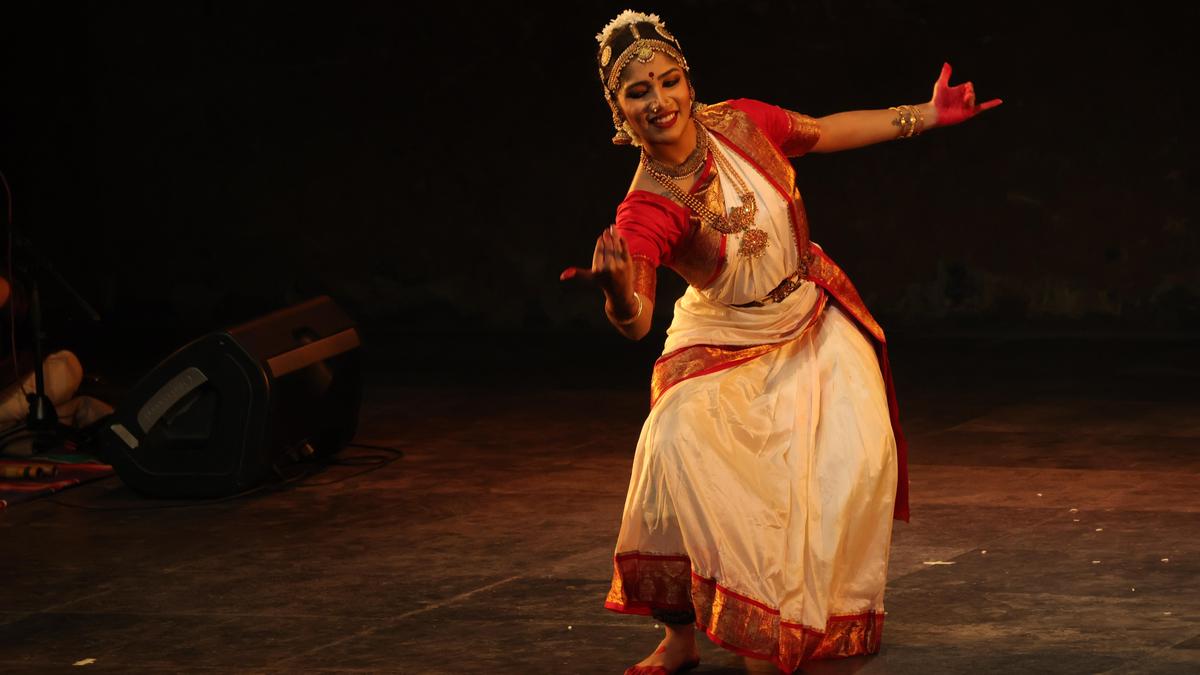
Bharatanatyam dancer Rajashree Warrier seems to follow her own distinct approach. There was a predominance of abhinaya in her presentation of excerpts from Andal’s Vaaranam Aayiram followed by the violin maestro Lalgudi Jayaraman’s Charukesi varnam, ‘Innum en manam’ in Adi tala.
With a preference for the tripathaka mudra, Rajashree’s nritta is all about straight lines. She is quietly mature and never steps out of character in the abhinaya.
Rajashree Warrier presented excerpts from Andal’s Vaaranam Aayiram
| Photo Credit:
Umesh Kumar
Following the varnam, she presented two compositions from Advaita philosopher and saint Sadasiva Brahmendral — ‘Manasa sancharare’ (Sama, Adi) and ‘Pibare rama rasam’. She made them mini-solo dance dramas by inserting Kuchela’s story from the point of view of his long-suffering wife in the first and Ahalya’s in the latter. Both displayed sensitivity and finesse.
Her orchestra was superb — Uduppi S. Srinath (vocals), RLV Hemanth Lakshman (nattuvangam), Kalamandalam Sreerang (mridangam) and Hariprasad Subramaniam (flute). The low-key nattuvangam in the non-nritta parts helped the music remain enjoyable.
Koodiyattam exponent Usha Nangiar
| Photo Credit:
Thulasi Kakkat
Usha Nangiar’s ‘Ahalya’ brought the curtains down on this memorial for Chandralekha. Usha is a well-known Koodiyattam artiste — she has the distinction of being trained under the legendary Ammanur Madhava Chakyar and performing along with him. Her research into old attaprakarams brought to light female characterisations that had been lost over time. Usha is one of the best traditionalists and is an innovator too.
The almost-two hour ‘Ahalya’, taken from the Adhyatma Ramayana, was a painstaking account of Ahalya’s life after her marriage to Sage Gautama.
Usha’s performance stood out for her nuanced acting prowess and facial expressions.
| Photo Credit:
Thulasi Kakkat
Usha’s nuanced acting prowess and facial expressions shone in the performance. Her quiet pathos as the condemned Ahalya brought tears to the eyes.
The percussive support — Kalamandalam Rajeev and Kalamandalam Vijay on the mizhavu, Kalanilayam Unnikrishnan on the edakka and Athira on the thalam — heightened the appeal.
Published – January 16, 2026 05:20 pm IST