
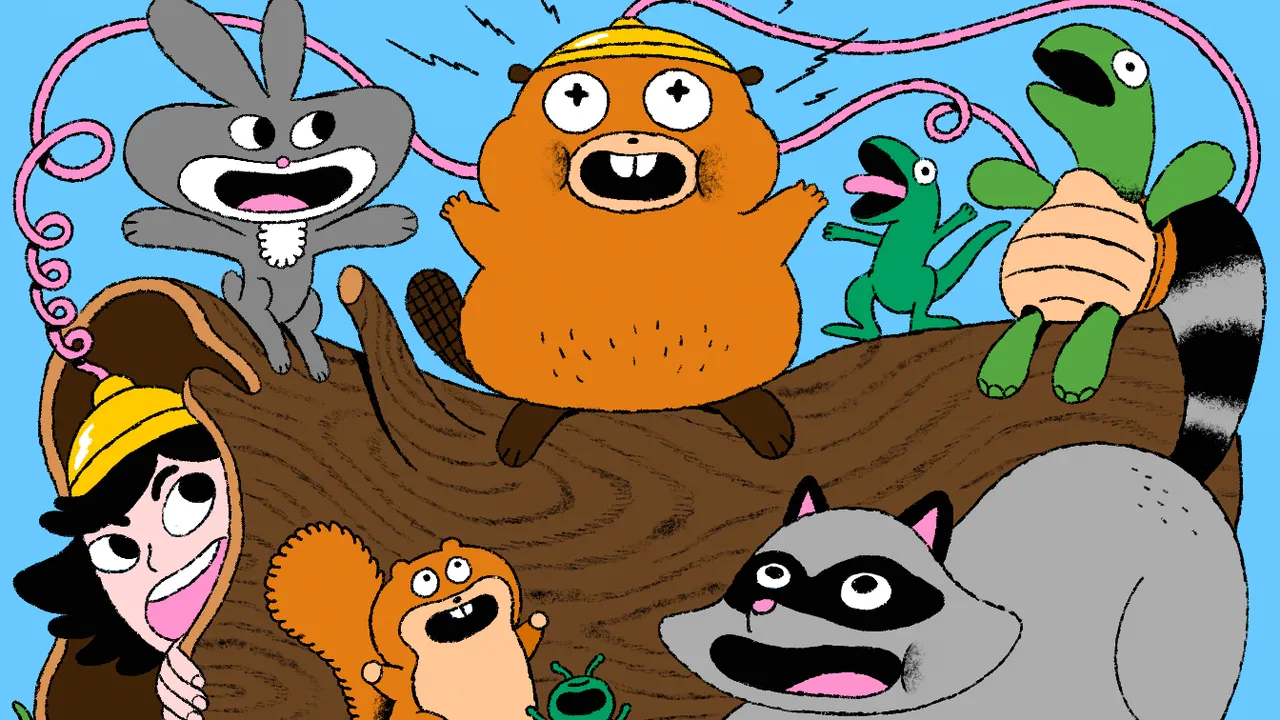
The script is by Jesse Andrews, who co-wrote the Pixar comedy “Luca” (2021), a sunny tale of youthful self-discovery and the seemingly unbridgeable chasm between the human and natural worlds. “Hoppers,” though much unrulier in its construction, is onto something similar. Mabel is a freckle-faced, messy-haired misfit, with a love of nature that she inherited from her late grandmother (Karen Huie). She’s an activist at heart, and she wants only to protect her grandmother’s favorite place: a tranquil local glade that, thanks to an industrious beaver colony, has long been a haven of biodiversity. Now, however, the beavers have inexplicably vanished, and they appear to have taken all the birds, fish, insects, and other forest creatures in the vicinity with them. Mabel has her suspicions as to why, especially since Jerry (Jon Hamm), the popular mayor of Beaverton, is trying to build a highway through the area and can do so only if it is cleared of wildlife.
Bent on restoring the beavers to their rightful home, Mabel defies Dr. Sam’s warnings and impulsively commandeers the technology. In beaver form, she makes her way deep into the forest, stumbles on the glade’s various displaced residents, and finds, to her delight, that she can understand their language (and so, of course, can we). Elsewhere, though, the rules that govern this furry fiefdom defy easy comprehension. The animals prove welcoming enough to a bushy-tailed outsider like Mabel, but this isn’t exactly Zootopia. The food chain is in full and pitiless effect, and no one bats an eye, or side-eyes a bat, when natural predatory impulses kick in.
The place has its unnatural elements as well, starting with a system of government that takes the notion of an “animal kingdom” to goofily literal-minded extremes. All of Mabel’s new forest friends—there are deer, rabbits, turtles, raccoons, and a singularly gloomy bear—bow down to a beaver sovereign, King George (Bobby Moynihan), a gregarious and naïve soul who embraces a humble, communal ideal of living. He believes that all creatures great and small, humans included, are acting on a pure-hearted devotion to the common good. “We’re all in this together,” he’s fond of declaring. None of his subjects question this way of thinking, and their zomboid passivity ultimately feels more creepy than charming. Mabel, it appears, has found her way into a village of the dammed.
The plot thickens from there, with an escalating outlandishness that makes “The Wild Robot” (2024), another animated mashup of animals and androids, look like a nature documentary. Mabel wants the beavers to return to the glade and block Mayor Jerry’s highway, and, to that end, she investigates—and exposes—how he engineered the animals’ mass exodus in the first place. An emergency summit is convened, where the genial George is joined by louder, angrier rulers from across the animal kingdom. There is a royal goose with a bulbous beak, voiced by the late Isiah Whitlock, Jr. Meryl Streep lends her imperious dulcet tones to the role of an orange-winged monarch, who, alas, does not call herself Butterfly McQueen. In these moments, “Hoppers” plays like a loopy riff on an Old Testament tale, one in which it’s the animals who get kicked out of Eden. With their eyes newly opened to the full knowledge of human evil, they hatch a uniquely deranged revenge plot, the stupefying and sometimes horrifying particulars of which I’ll leave for you to discover. Suffice it to say that Mabel suddenly realizes she’s gone too far, in both her deception and her activism. She must save the day and make amends.
The dispensing of moral instruction is an often tiresome staple of child-friendly animation, but the lessons that Mabel must learn—to be less impulsive, less strident, and more willing to see the good in others—also turn out to be shrewd organizational and negotiating tactics. The more “Hoppers” goes on, the more it comes to resemble a bonkers political farce, in which such pressing matters as the rights of animals, the fate of the environment, and the destructiveness of human greed can be resolved, or at least productively debated, in a flurry of cross-species coalition-building. The movie’s conclusions are reasonable, centrist ones, perhaps disappointingly so; viewers whose empathy with the four- and six-legged denizens of the glade has been aroused will surely find themselves crying out for mayoral blood. More than once, an insect gets squished for comic effect, and you have to wonder why, in the spirit of all being in this together, the filmmakers didn’t dare to add a human life or two to the body count. Can’t we take it? Haven’t we earned it, with our vainglorious conquests and wanton destruction of the natural world? To root passionately against one’s own species is one of the great, subversive pleasures of moviegoing; certain films in the “Planet of the Apes” series knew this and exploited it for all it was worth. So did “Avatar.”