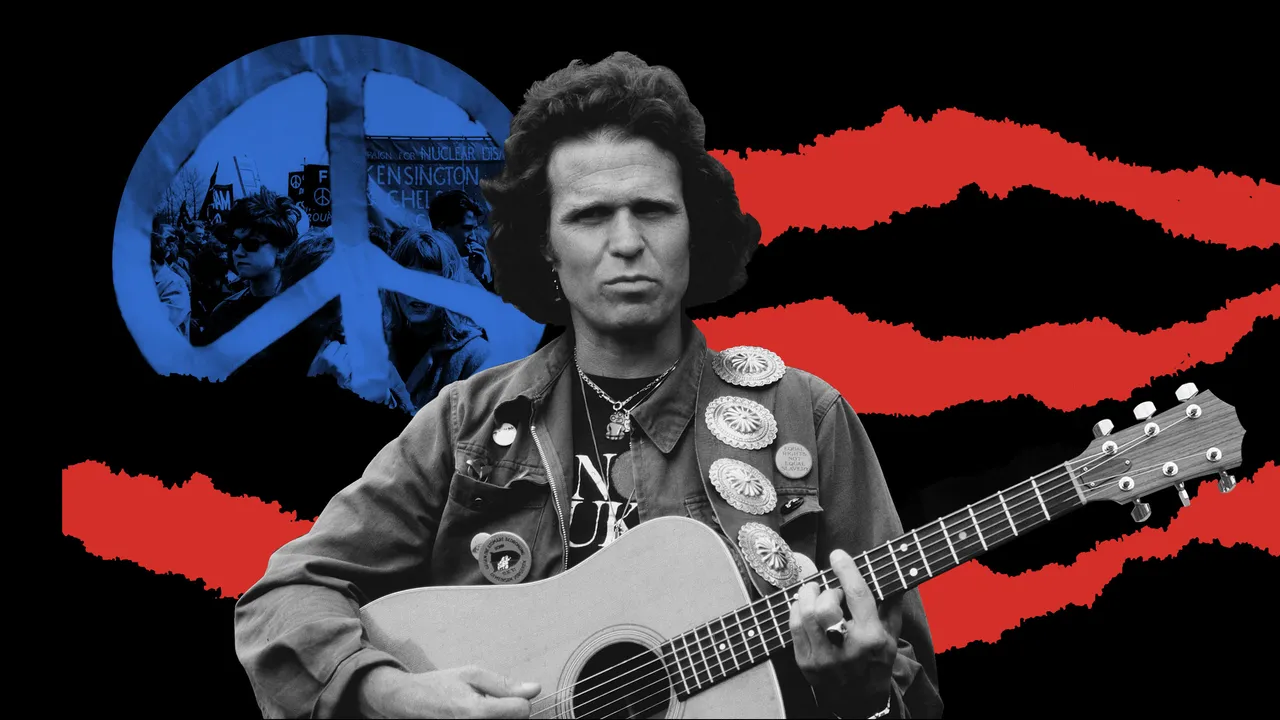
If there is a modern audio component to what we can loosely call the Resistance, it exists in the form of podcasts and the vertical-video clips they generate: a million short-form videos of people talking into USB microphones have replaced not only rousing political speeches but also music as the main vehicle for rabble-rousing. What this transformation means is that we are producing a flood of effective, enervating, and disposable media about political dissent. It is a theatre for pundits and satirists but not for poets and artists. What I have not been able to decide, reflecting on the legacy of Country Joe, is whether this is a good or a bad thing.
I first saw the clip of McDonald at “Woodstock” when I was in the eighth or ninth grade. It left a deeper impression on me than anything else in the film, save for the flashes of crowd nudity. Around this same time, a kid at my school let me listen to a truly profane album that his father, Patrick Sky—another folksinger, whose career followed a trajectory not unlike McDonald’s—had recorded in the early seventies. “In the draft board here we sit / Covered o’er with Nixon’s shit,” Sky sang. All the cursing and naughtiness felt pretty thrilling, which was probably why I was so struck by Country Joe spelling out “F-U-C-K” with the Woodstock crowd. I also thought these songs were very funny. And although this might sound precocious for a seventh grader—especially one who wasn’t as smart as he thought he was—I recall appreciating that the song was so explicit not only in its language but in its message.
Thinking back, I wonder if my attraction to the directness of the “I-Feel-Like-I’m-Fixin’-to-Die Rag” might have been a sign that, for work, I would ultimately choose political commentary over novel-writing, which was what I did in my twenties. There was something distinctly unsatisfying to me in a song like “Where Have All the Flowers Gone?,” which felt far too plaintive, almost passive in its protest. What I wasn’t thinking about then—and, frankly, don’t really worry much about now—is how those words would age. A fiction-writing friend of mine back in my youth told me that he wanted his books to feel timeless and eternal. My work, I’ve long accepted, is ultimately ephemeral and meant only to change opinions, not move people’s hearts. It is simply true that direct and topical political dissent is ultimately disposable. We don’t remember “It’s one, two, three / What are we fightin’ for?” as much as we remember “How many roads must a man walk down / Before you call him a man.”
Still, Country Joe did provide a beat and a melody, something large crowds of people could dance to—watching him and the Fish at Woodstock was probably a lot more fun than tweeting angrily on your phone in your bedroom. There is no question that the hippies did a better job at turning dissent into something appealing and dangerous. At the same time, I suspect that what I perceive as the spiritual arrogance of the aging hippies comes from the aesthetic allure that the sixties and seventies still hold over this country.
Why can’t the left generate that kind of aesthetic political identity anymore? Why isn’t there a giant movement of neo-hippies starting phone-free communes somewhere up among the pot farms of Humboldt County, or even in arid West Texas? My suspicion is that the atomized way we now experience so much of what we take in, through social media, discourages it. We get blunt talk and, occasionally, stirring images of big rallies. Nothing else feels as efficient as firing off a tweet, maybe trying to organize an instant protest. The right, by contrast, has produced new tribes that wear the same hats and come up with names for themselves, such as the Groypers, even though they, too, mostly express themselves by talking into microphones and webcams. What I’ve previously called the ideology of the internet—a broad anti-authoritarianism, and a hostility to institutions—is perhaps better suited to reactionary culture.
It’s a strange situation. I tend to think that political talk should be direct rather than swathed in pretty verses and the sound of a dulcimer. But I admit to feeling a bit jealous of the old hippies. They did not all age gracefully, but so many stayed committed to some cause, which is more than I fear I will be able to say for myself. When the war finally ended, the books had been written, and the country more or less agreed that they were right about Vietnam and civil rights, there was still the music and an idea, however increasingly faded, of living free.