The United States and Israel launched an attack on Saturday (February 28, 2026) on Iran, plunging West Asia into a new conflict that U.S. President Donald Trump said would end a security threat to the United States and give Iranians a chance to topple their rulers.
The strikes put nearby oil-producing Gulf Arab countries on edge as fears of escalation in the region grew, and Israel said Tehran responded by launching missiles towards Israel.
Iran, which responded to the strikes with its own counterassault, warned of retribution. Ali Larijani, the secretary of Iran’s National Security Council, said on Saturday (February 28, 2026) that Israel and America will “regret their actions.”
Day 1
Israel and U.S. jointly attack Tehran calling it a ‘pre-emptive action’. Code-named as Operation Roaring Lion or Operation Epic Fury, several key Iranian cities including Tehran, Qom, and Isfhan was attacked.
The strikes killed Iran’s Supreme leader Ayatollah Ali Khamenei, as well as over 200 civilians.
In a retaliatory move, Iran fired a barrage of missiles on Israel’s Tel Aviv and Jerusalem and U.S. bases in West Asia.
U.S. Fifth Fleet base in Bahrain, Al Udeid Air Base in Qatar, Ali Al Salem Air Base in Kuwait, Al Dhafra Air Base in the UAE were among Iran’s target. Prominent tourist destinations in Dubai, including Burj Khalifa and Palm Islands too were reportedly attacked.
Day 2
Continuing the joint U.S.-Israeli offensive on Iran, the U.S. military announced on Sunday (March 1, 2026) that it had destroyed the headquarters of Iran’s Islamic Revolutionary Guard Corps, a key pillar of the country’s security establishment.
Meanwhile, an Iranian missile strike on the Israeli town of Beit Shemesh leaving at least nine people dead and 28 others injured, according to first responders at the site. Iranian news agency ISNA reported that Gandhi hospital in northern Tehran was targeted by joint U.S.-Israel strikes.
Responding to Iran’s attacks on military bases in Gulf countries, France, Germany and the United Kingdom issued a joint statement declaring that they were prepared to safeguard their interests by taking “defensive action” against Iran if necessary.
In Iran, the government named Ayatollah Alireza Arafi to lead its interim leadership council following the killing of Supreme Leader Ayatollah Ali Khamenei.
Day 3
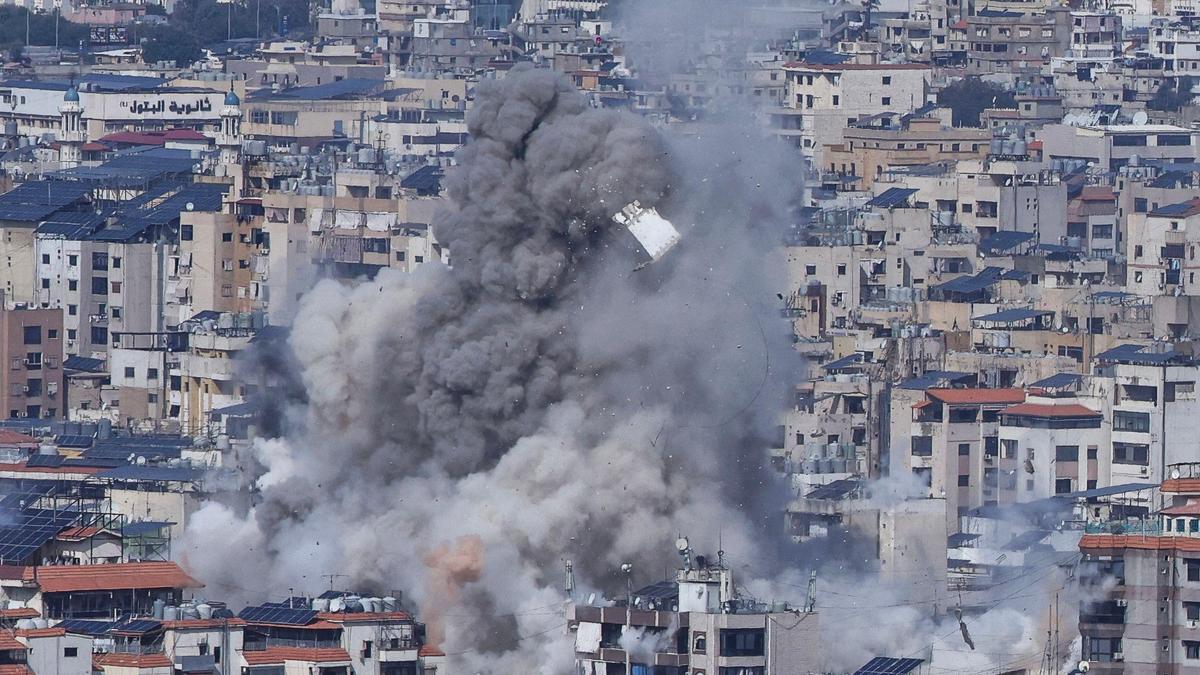
On the third consecutive day of the conflict, Israel launched a barrage of strikes on Beirut after the Lebanese militant group Hezbollah fired missiles across the border early on Monday (March 2, 2026).
In a development that could threaten nearly a fifth of global oil shipments and push crude prices sharply higher, the commander of Iran’s Revolutionary Guards declared that the Strait of Hormuz had been closed and warned that Iran would set fire to any vessel attempting to pass through.
In the Gulf, Kuwait announced that it had intercepted hostile drones as part of Iranian retaliatory strikes targeting neighbouring states in response to U.S. and Israeli attacks on Iran.
Iran also said it had launched missile strikes on an Israeli government complex in Tel Aviv, as well as on security and military facilities in Haifa, in addition to an attack in east Jerusalem.
Day 4
Amid the rapidly intensifying conflict in West Asia, more than 780 people have been killed in Iran since the United States and Israel began their strikes on February 27, 2026, the Iranian Red Crescent reported.
Israel’s military said on Wednesday (March 4, 2026) that it had launched a “broad wave of strikes” on targets inside Iran, hours after the Islamic Republic fired three separate barrages of missiles towards Israeli territory.
Meanwhile, loud explosions were heard on Tuesday night (March 3, 2026) in Iraq’s Erbil and across Doha, Dubai and Abu Dhabi in the United Arab Emirates. Authorities in Dubai said the blasts were the result of “interception operations” carried out by air‑defence systems.
Saudi Arabia’s Defence Ministry said that an attack involving two drones on the U.S. Embassy in Riyadh caused a “limited fire,” following an earlier incident at the U.S. Embassy in Kuwait, which subsequently announced that it would remain closed until further notice.
Day 5
Despite the continuing U.S.-Israeli bombardment, Iran is “trying” to expedite the appointment of a successor to Ayatollah Ali Khamenei as Supreme Leader, state television reported on Wednesday (March 4, 2026).
Israel’s Defence Minister, Israel Katz, meanwhile warned that Israel would target and assassinate any Iranian leader chosen to succeed Ayatollah Khamenei.
As the conflict entered its fifth day, Israel carried out fresh strikes on Iran and Lebanon. Lebanese state media reported that a residential building was hit in the latest bombardment. In southern Lebanon, Israeli forces entered the town of Khiam as part of their ground operation against the Iran‑backed Hezbollah.
The Israeli military stated that Iran retains significant missile‑launching capability, even as Israel continues to target launch sites across the Islamic Republic. Separately, Mohammad Mokhber, a senior aide to the late Supreme Leader, said on state television that Iran has no intention of negotiating with the United States and is capable of sustaining the war “for as long as we want.
Meanwhile, a U.S. submarine attacked an Iranian warship, which sank in the Indian Ocean off the coast of Sri Lanka on Wednesday, bringing the West Asian conflict closer to the Indian subcontinent. At least 83 people were killed in the torpedo attack. U.S. Defence Secretary Pete Hegseth confirmed the strike at a press conference in Washington, D.C.
A senior Iranian official said that a public ceremony for citizens to pay their respects to the country’s Supreme Leader, Ayatollah Ali Khamenei, which was originally scheduled to take place at Tehran’s Imam Khomeini Prayer Hall, had been “postponed”, state media said.
Day 6
Aerial strikes across West Asia entered their sixth day on Thursday (March 5, 2026), following the sinking of an Iranian warship by a U.S. submarine and Tehran’s warning that it would retaliate against military and economic assets across the region.
Early on Thursday (March 5, 2026), Iran launched missiles at Israel. Israel confirmed the Iranian strike shortly after its military announced fresh operations in Lebanon, targeting Hezbollah positions in the southern suburbs of Beirut.
Meanwhile, a second Iranian warship was heading towards Sri Lanka’s territorial waters on Thursday, just a day after a U.S. submarine destroyed another Iranian frigate, killing at least 87 sailors.
Official sources said the vessel carries more than 100 crew members, raising fears that it could face the same fate as its sister ship, which was sunk off Sri Lanka’s southern coast on Wednesday.
In New Delhi, the Ministry of External Affairs (MEA) dismissed claims made by former U.S. Army Colonel Douglas Macgregor that the United States is using Indian naval bases to attack Iran.
Amid mounting regional tensions in West Asia, Iranian Foreign Minister Abbas Araghchi warned that Tehran is fully prepared for any potential ground offensive, cautioning that such an escalation would bring “disaster” upon Iran’s adversaries.
Meanwhile, Israel’s military chief announced that he has instructed Israeli forces to widen the zone under Israel’s control in southern Lebanon. The expansion marks a further intensification of Israel’s ongoing operations against Hezbollah along the northern frontier.
In Sri Lanka, President Anura Kumara Dissanayake said authorities have begun offloading Iranian crew members from a vessel positioned off the country’s coast. “A total of 208 crew are on the ship, and Sri Lanka has started the process of offloading the Iranian crew. Once the crew is safely off‑boarded, the vessel will be moved to the Trincomalee harbour,” the President said.
Day 7
On the seventh consecutive day of the deepening crisis in West Asia, Israeli airstrikes hit the capitals of Iran and Lebanon, while the U.S. reportedly struck an Iranian drone carrier at sea, intensifying its campaign targeting the Islamic Republic’s fleet of warships
The United Nations refugee agency meanwhile designated the unfolding situation in the Middle East as a major humanitarian emergency, underscoring the urgent need for a coordinated response.
“UNHCR has declared the escalating crisis in the Middle East a major humanitarian emergency requiring an immediate response across the region,” Ayaki Ito, the agency’s emergency chief and cross-regional refugee coordinator, told reporters in Geneva.
At the same time, Iran launched fresh retaliatory strikes on neighbouring countries hosting U.S. military installations.
Two days after a U.S. submarine torpedoed and sank an Iranian warship off the coast of Sri Lanka, Iran warned on Friday (March 6, 2026) that such an attack on an “unarmed ship cannot go with impunity.” Meanwhile, India rejected claims that it had aided the U.S. operation, with a senior naval official calling the reports “baseless.”
Meanwhile, U.S. President Donald Trump said there would be no deal struck with Iran except “unconditional surrender,” a week after launching war with Israel against Tehran.
On Thursday (March 5, 2026), Trump had said that he wants to be involved in choosing the next leader of Iran. However, Iran’s ambassador to the United Nations condemned U.S. interference after Mr. Trump insisted that he should be involved in selecting the successor of slain supreme leader Ayatollah Ali Khamenei.
“Iran is a sovereign and independent state. It does not accept and will never allow any foreign power to interfere in its internal affairs,” Mr. Iravani told reporters in New York
Day 8
As the escalating war in the Middle East entered its second week and oil prices surged on fears of a global supply disruption, Israel on Saturday (March 7, 2026) announced a new wave of “broad-scale” strikes on Tehran.
After U.S. President Donald Trump said on Friday (March 6, 2026) that he would not seek a deal with Iran without the country’s “unconditional surrender”, Washington warned of a forthcoming bombing campaign that officials said would be the most intense of the weeklong conflict.
As Israeli warplanes struck the Iranian capital and Beirut, Iran launched additional retaliatory attacks on Israel and Gulf countries on the seventh day of the war.
Meanwhile, Indian airlines have flown back nearly 15,000 stranded passengers from the UAE, Saudi Arabia and Oman since the start of the week.
In Dubai, an explosion was heard near the airport, followed by a cloud of smoke, a witness told AFP, as Iran pressed its attacks across the Gulf.
However, the Dubai Media Office described it as “a minor incident resulting from the fall of debris after an interception” in a post on X, and also denied reports circulating about the airport.
In the first reported attack on the Iran’s oil infrastructure, U.S. and Israeli strikes hit an oil storage facility in Tehran on Saturday (March 7, 2026), triggering a fire, state media reported. Soon after, Iran’s Guards said they had targeted Israel’s Haifa oil refinery in response to the attack.
Israeli Prime Minister Benjamin Netanyahu also said that Israel would continue its war with Iran “with all our force”, and alongside the United States had almost total control of Iranian skies after a week of strikes.
Day 9
As tensions rise in West Asia amid the escalating war, the clerical body responsible for selecting Iran’s next Supreme Leader has reached a decision, members said on Sunday (March 8, 2026), although the name has yet to be announced. At the same time, Iran’s Revolutionary Guards declared that the country is capable of sustaining an intense war against the United States and Israel for at least six months.
Gulf states, including Israel, reported missile and drone attacks originating from Iran. Saudi Arabia said it intercepted a drone targeting the diplomatic quarter in Riyadh, adding that there were no casualties or damage. Kuwait reported that fuel tanks at its international airport were targeted by Iranian drones.
On Saturday (March 7), an Israeli attack hit an oil storage facility in Tehran, which sent up pillars of fire that could be seen in Associated Press video as a glow against the night sky. It appeared to be the first time a civil industrial facility has been targeted in the war.
Meanwhile, President Donald Trump blamed Iran for the deadly strike on an elementary school in Minab, which Iranian officials say killed at least 150 people. “We think it was done by Iran. Because they are very inaccurate, as you know, with their munitions,” Mr. Trump told reporters aboard Air Force One.
Day 10
Amid the escalating turmoil in West Asia, United States President Donald Trump said on Monday (March 9, 2026) that the conflict with Iran may be short-lived, even as the country installs a new hard-line supreme leader to oversee the fight for the Islamic theocracy’s survival.
Mr. Trump’s latest remarks came as the Israeli military announced that it had carried out a series of “broad strikes” on Tehran. Earlier, Iran’s Revolutionary Guards said they would increase both the force and the frequency of missile launches and extend their range. “From now on, no missiles will be launched with warheads lighter than one ton”, state media cited the commander Majid Mousavi.
Mr. Trump dialled up his Russian counterpart Vladimir Putin to discuss developments in Iran and Ukraine, the Kremlin said on Monday (March 9, 2026). During the hour-long conversation, described as “constructive and business-like”, Mr. Putin outlined several proposals aimed at bringing the conflict in West Asia to a swift conclusion. The two leaders also reviewed conditions in Venezuela in relation to the global oil market.
Meanwhile, France and its allies are preparing what President Emmanuel Macron described as a defensive mission to reopen the strategically significant Strait of Hormuz, as the war entered its second week. Oil prices rose above 114 dollars a barrel for the first time since 2022 as tensions mounted, raising concerns over production and maritime traffic across West Asia.
Day 11
Even as United States President Donald Trump maintains that the conflict with Iran would be over “soon”, Iran’s Foreign Minister Abbas Araghchi said on Tuesday (March 10, 2026) that the country would continue fighting for as long as necessary.
Meanwhile, Iran launched fresh attacks on Gulf Arab countries, including the United Arab Emirates, Saudi Arabia and Kuwait, as it stepped up pressure across the region. Five pro‑Iranian militants were reported killed in an airstrike in northern Iraq.
On Monday (March 9, 2026), Mr. Trump warned that the United States would respond much more forcefully if Tehran attempted to halt the flow of oil through the Strait of Hormuz. The narrow waterway, one of the world’s most vital shipping routes, has seen an abrupt collapse in commercial traffic amid rising tensions in West Asia.
Although Mr. Trump repeated on Tuesday (March 10, 2026) that the war with Iran could conclude soon, he remained vague on a timeline for ending the attacks that have shaken West Asia and unsettled the global economy might cease. More than twenty heavy explosions were heard in Tehran in what was described as the most intense air raid on the capital since the war began on February 28. Israel’s military said further missiles had been launched from Iran towards Israel late on Monday.
The United States military said it had “eliminated” sixteen Iranian mine‑laying vessels near the Strait of Hormuz, adding that updated count comes after U.S. President Donald Trump’s earlier claim that ten inactive boats had been struck. Washington again warned Tehran against placing mines in the strategic corridor.
Also, fresh explosions were reported from Tehran late on Tuesday (March 11, 2026), hours after the U.S. Defence Secretary indicated that strikes on Iran were likely to reach their highest intensity as the conflict entered its tenth day.
External Affairs Minister S. Jaishankar held a detailed conversation on Tuesday evening with Iranian Foreign Minister Abbas Araghchi on the latest developments in the West Asia crisis.
Meanwhile, the United States has urged Israel to halt attacks on Iran’s energy infrastructure, Axios reported on Tuesday (March 11, 2026), with the Trump administration reportedly citing three reasons, including a goal to cooperate with Iran’s oil sector after the war. Israel is also likely to allocate a “special war budget” of tens of billions of shekels for extra defence spending to finance the air war with Iran.
Day 12
On the twelfth consecutive day of the intensifying Iran–Israel war, Saudi Arabia said on Wednesday (March 11, 2026) that it had intercepted seven ballistic missiles in separate attacks aimed at an air base and its eastern region, as Iran renewed its fire on Gulf neighbours.
Israeli forces carried out fresh strikes on the southern suburbs of Beirut on Wednesday, Lebanese state media reported, with the Israeli military stating that it was again targeting the Hezbollah movement, which is backed by Iran.
In the United Arab Emirates, two drones fell near Dubai airport, injuring four people, the Dubai media office said. It added that air traffic continued to operate normally.
On Wednesday (March 10, 2026), United States President Donald Trump said that the U.S. had “won” the Iran war, but added that the United States will stay in the fight to finish the job. He said U.S. troops had so far destroyed fifty eight Iranian mine‑laying vessels, amid reports that Iran had begun deploying mines in the Strait of Hormuz. The mines had been placed “in the last few days” and most of their positions were known, Reuters reported, citing sources.
Iran said it was prepared for a prolonged war of attrition that it claimed would “destroy” the global economy. The statement came after Tehran’s forces fired on two commercial vessels and warned that ships belonging to the U.S. or its allies would be targeted.
Meanwhile, India expressed concern over the rising attacks on commercial shipping in West Asia, after a Thai‑flagged bulk carrier bound for Kandla Port in Gujarat was struck by Iran’s Islamic Revolutionary Guard Corps.
Day 13
As the conflict entered its thirteenth day on Thursday (March 12, 2026), an Indian national was killed in an attack carried out by Iran using a “suicide” boat against a United States-owned oil tanker near Iraq. U.S.-owned and Marshal Island-flagged oil tanker, Safesea Vishnu, was struck off the Khor Al Zubair port within Iraq’s territorial waters.
The attack prompted authorities to suspend operations at all Iraqi oil terminals. Officials said that rescuers had recovered one body and assisted thirty eight others following the attack.
Meanwhile, Israeli forces on Thursday (March 12, 2026) said that they had carried out a fresh and wide scale wave of strikes on what they described as terror infrastructure belonging to the Hezbollah group across Lebanon, along with drone attacks directed at Tehran. Soon after midnight, Iran’s Revolutionary Guards announced that they had launched a joint missile operation with Hezbollah against targets inside Israel.
Kuwait’s Ministry of Electricity said six power transmission lines went out of service after debris from intercepted drones fell on them. The Ministry added that the supply of electricity and water remained under control.
Iran outlined three conditions for bringing the conflict to an end, including firm guarantees against future attacks, even as the United States and Israel continued their air strikes inside the country. “The only way to end this war — ignited by the Zionist regime & U.S. — is recognising Iran’s legitimate rights, payment of reparations, and firm international guarantees against future aggression,” Iranian President Masoud Pezeshkian said.
Day 14
After a fortnight of escalating hostilities in the Gulf region, the Israeli military said on Friday (March 13, 2026) that it struck the Zrarieh Bridge over the Litani River in Lebanon, saying the structure served as a key crossing used by Hezbollah. According to the military, Hezbollah had recently placed launchers near the bridge and carried out attacks from there towards Israel. It appeared to be the first instance in the current campaign against Hezbollah in which the Israeli forces acknowledged targeting civilian infrastructure.
Meanwhile, Iran launched a series of attacks early on Friday (March 13, 2026) on Gulf Arab states, including dozens of drones directed at Saudi Arabia, following warnings from its new supreme leader about hosting American bases. United States President Donald Trump threatened further retaliation, writing in a social media post that “Iran’s Navy is gone, their Air Force is no longer, missiles, drones and everything else are being decimated, and their leaders have been wiped from the face of the earth.”
Dubai’s media office confirmed that a building in the city had been struck. Officials said the United Arab Emirates’ air defences had intercepted more than 1,500 Iranian drones and nearly 300 missiles during the ongoing Middle East conflict.“Authorities confirmed that debris from a successful interception caused a minor incident on the facade of a building in central Dubai,” the media office posted on X, adding that no injuries were reported.
In the United States, President Donald Trump on Friday (March 13, 2026) told reporters that the objectives of the U.S. and Israel with regards to Iran “might be a little different”. Shortly thereafter, he said in a post on Truth Social that the U.S. military had carried out heavy bombing of military targets on Iran’s Kharg Island, which handles almost all of Iran’s crude exports, and threatened that the island’s oil infrastructure could also be targeted.
Meanwhile, an Israeli strike on a primary healthcare centre in southern Lebanon killed at least 12 medical personnel, the Lebanese Health Ministry said, as fighting between Israel and Hezbollah continued. Israeli shelling also hit a United Nations peacekeeping base in the region on Friday (March 13, 2026), according to state media reports.
In Tehran, a large explosion rocked a central square where thousands were gathered for an annual state-organised rally to support the Palestinians and call for Israel’s demise. After Israel warned that it would target the rally area in central Tehran, Iran and the Israeli military launched fresh rounds of missile attacks hours after deadly explosions struck Tehran near a pro‑government rally attended by senior officials.
The U.S. State Department announced a reward of $10 million for information on Iran’s new Supreme Leader, Mojtaba Khamenei, and other top officials. In a mark of major U.S. troop movement, around 2,500 Marines and at least one amphibious assault ship were reported to be heading towards West Asia.
Also, two Indian nationals were killed in an attack in Sohar, Oman, the Ministry of External Affairs confirmed. In view of the situation in the Gulf, the Indian Consulate in Dubai announced a 30‑day extension for Indian visas and e‑visas, along with a waiver of overstay penalties for foreigners stranded in India.
Day 15
As the escalating conflict in West Asia entered its third week, Iran said that no oil infrastructure was damaged in U.S. strikes on Kharg Island, Iranian media reported on Saturday (March 14, 2026).
The Fars news agency, citing sources on the ground, said there was no damage to oil facilities, a day after U.S. President Donald Trump stated that American bombardment of the island had destroyed military targets.
U.S. President Donald Trump had earlier threatened in a social media post to target oil infrastructure on the island, a critical hub for Iran’s energy exports, if Tehran continued to block the strategic Strait of Hormuz.
On Friday (March 13, 2026), Mr. Trump said U.S. forces had “obliterated” military targets on Iran’s Kharg Island, the main terminal handling Iran’s oil exports, and warned that the island’s oil facilities could be targeted next. Earlier, the Speaker of the Iranian Parliament warned that any such strike would trigger a new level of retaliation.
Meanwhile, U.S. President Donald Trump urged other nations to help secure a vital shipping lane choked off by the war with Iran that showed no signs of slowing on Saturday as strikes hit the U.S. embassy in Baghdad and a major Emirati energy facility.
Day 16
On the 15th consecutive day of the escalating U.S.-Israel-Iran war, U.S. President Donald Trump threatened further strikes on Iran’s Kharg Island oil export hub and urged allies to deploy warships to secure the Strait of Hormuz, as Tehran vowed to step up its response and the war showed no sign of ending on Sunday (March 15, 2026).
Meanwhile, the Israeli military said on Saturday (March 14, 2026) that it had killed two senior Iranian intelligence officials in an air strike in Tehran. Israel identified the men as Abdollah Jalali‑Nasab and Amir Shariat, describing them as senior officials in the intelligence directorate of Khatam al‑Anbiya, the Iranian military’s central operations command.
Iran, for its part, warned that it would target American companies in the region if its energy facilities were attacked in the U.S.–Israeli war against the Islamic Republic. Foreign Minister Abbas Araghchi said that the U.S. strikes on Kharg Island involved short‑range rockets launched from two bases in the United Arab Emirates, including one located close to Dubai.
The UAE has arrested and ordered an urgent trial of ten individuals for sharing misleading videos on social media amid rising tensions related to the Iran conflict. Dubai aims to uphold its reputation as a haven against Iranian aggression, with influencers backing the government’s narrative. Meanwhile, AI-generated deepfake videos on X show false scenes of American soldiers captured by Iran and U.S. embassies on fire.
The U.S. Department of Defense identified the six U.S. airmen who were killed in a plane crash over Iraq.
U.S. President Donald Trump urged allies to send warships to secure the Strait of Hormuz, advising evacuations at three UAE ports. A senior Japanese adviser stated that the threshold for Japan to deploy warships is “extremely high.” South Korea’s presidential office is reviewing Trump’s request for allies to assist in securing the shipping lane. Meanwhile, Iran’s Revolutionary Guards threatened to target Israeli Prime Minister Benjamin Netanyahu as the conflict persists.
Clouds of toxic smoke released into the atmosphere by U.S.-Israeli airstrikes targeting Iranian oil facilities are now returning to Earth as “black rain,” leading international health officials to issue warnings about significant public health risks. Meanwhile, Israel’s military announced it began a widespread series of strikes in western Iran, marking over two weeks of ongoing conflict between the U.S.-Israeli coalition and the Islamic Republic. Moreover, overnight airstrikes in southern Lebanon resulted in at least four fatalities, according to Lebanese state media and government sources, as Israel intensified its operations against the Iran-supported Hezbollah.
Meanwhile, Donald Trump warned that he is not ready to seek a deal to end the war with Iran, as U.S. ally Israel launched a new wave of strikes and Tehran’s Revolutionary Guards threatened to hunt down and kill the Israeli leader. U.S. Energy Secretary Chris Wright said that he expects the U.S. war with Iran to end within “the next few weeks,” with oil supplies rebounding and energy costs declining afterwards. However, Foreign Minister Abbas Araghchi said Iran was not interested in talks with the United States, pushing back on U.S. President Donald Trump’s stance that Tehran wants a deal to end the war.
As the crisis escalated, Israeli Prime Minister Benjamin Netanyahu published a short video on X making light of rumours on social media that he was dead. “I’m dead for coffee,” he said sarcastically on his official X account as he received a cup at a cafe outside Jerusalem.
The end of the day witnessed several drones and rockets targeting a military base at the Baghdad airport complex, which also houses a U.S. diplomatic facility, three security sources told AFP. Meanwhile, the World Health Organization said that it had released $2 million from its Contingency Fund for Emergencies (CFE) to support the health response in Lebanon, Iraq and Syria amidst the ongoing crisis in West Asia.
Day 17
Israel initiated a fresh series of attacks on Tehran as the US-Israel war on Iran entered its 17th day on Monday (March 16, 2026).
Tensions rose in the Gulf region as authorities suspended operations at Dubai International Airport due to a drone-related incident that caused a nearby fire. Dubai-based Emirates later confirmed it would resume a limited number of flights, although several scheduled routes for the day have been cancelled. An Emirates flight carrying 325 passengers, which was en route to Dubai, had to return to Kochi, Kerala, four hours after departing in the morning due to the unexpected airport closure.
Minister of External Affairs S. Jaishankar hailed that direct talks with Iran are crucial for restarting shipping through the Strait of Hormuz. U.S. President Donald Trump warned that NATO faces a “very bad” future if allies do not assist in reopening the critical oil route, which Iran has effectively closed. Japan’s Prime Minister Sanae Takaichi announced that Japan will not send naval vessels to escort ships in West Asia, following Trump’s call for allies to protect tankers. Australia echoed Japan’s stance. Trump also urged NATO and China to help reopen the Strait as major economies began releasing oil reserves to prevent supply disruptions. Meanwhile, India’s Foreign Ministry stated that there have been no discussions with the U.S. regarding assistance for ships in the Strait. U.K. Prime Minister Keir Starmer mentioned that the U.K.’s plan with allies to reopen the Strait will not involve NATO.
Meanwhile, U.S. President Donald Trump accused Iran of using artificial intelligence as a “disinformation weapon” to misrepresent its wartime successes and support.
The Israeli military announced that it had begun what it termed “limited ground operations” against Hezbollah in southern Lebanon. According to Lebanon’s State-run National News Agency, an Israeli airstrike early that day on a residence in the southern village of Kfar Sir resulted in one fatality. Additionally, a drone strike on oil facilities along the UAE’s eastern coast ignited a fire, as Iran continued its series of attacks on Gulf nations. Israel expanded its military presence in southern Lebanon, deploying troops to engage Hezbollah positions as it escalated its offensive against the Iran-backed militant group.
Union Civil Aviation Minister K. Rammohan Naidu informed the Rajya Sabha that Indian airlines have cancelled 4,335 flights and foreign carriers 1,187 flights so far in the wake of the West Asia conflict. Later, India evacuated over 550 of its nationals from Iran through Armenia, with External Affairs Minister S. Jaishankar thanking Yerevan for facilitating the land-border transit.
The Israeli military says it has destroyed an estimated 70% of Iran’s missile launchers during the first two weeks of the war.
Day 18
Israel killed two senior Iranian security officials in a major blow to the Islamic Republic’s leadership as it faces its greatest test in decades. Iran responded on Wednesday (March 18, 2026) with fresh missile and drone attacks targeting Israel and several Gulf Arab neighbours.
Ali Larijani, secretary of Iran’s Supreme National Security Council, was regarded as one of the country’s most influential figures following the death of Supreme Leader Ayatollah Ali Khamenei in an airstrike on the opening day of the conflict, was killed in an overnight Israeli strike. Israel earlier announced it had killed Basij commander Gholamreza Soleimani in an air strike,
Meanwhile, Iran launched a barrage of missiles towards Israel, triggering air-raid sirens across central parts of the country and loud explosions in Tel Aviv. Israel’s emergency medical service, Magen David Adom, said two people were killed in Ramat Gan, east of Tel Aviv.
As oil prices climbed, U.S. President Donald Trump said he had called on around half a dozen countries to deploy warships to ensure the safe passage of commercial vessels through the Strait of Hormuz. Mr. Trump complained that Washington was receiving little support “despite the fact that almost every country strongly agreed with what we are doing”, adding that Iran must not be allowed to obtain a nuclear weapon. The United States military said it had struck Iranian missile sites along the country’s coastline near the Strait of Hormuz, citing the threat posed by Iranian anti-ship missiles to international shipping.
Day 19
Israel’s Defence Minister said on Wednesday (March 18, 2026) that the Israeli military had killed Iran’s Intelligence Minister, Esmail Khatib.
Announcing the development, Israel Katz said that “significant surprises are expected throughout this day on all the fronts,” without providing further details. Israel also reportedly attacked an Iranian offshore natural gas field on Wednesday (March 18, 2026) as the war escalated pressure on the region’s economic lifeblood: energy.
Mr. Khatib’s death comes after Israel killed senior Iranian security official Ali Larijani and Gholamreza Soleimani, the head of the Revolutionary Guard’s all-volunteer Basij force.
Earlier, Iran’s judiciary said an “attack” had struck southern Iran, resulting in civilian casualties as well as deaths and injuries among judicial staff. The judiciary’s Mizan news agency reported that the strike hit a judicial facility in Larestan county in Fars province.
Meanwhile, Iran is set to hold funerals for Mr. Larijani and Mr. Soleimani on Wednesday (March 18, 2026), a day after they were killed in Israeli airstrikes. Iranian Foreign Minister Abbas Araghchi said the assassination of Mr. Larijani would not destabilise the country’s political system, even as the Islamic Revolutionary Guard Corps vowed “definite revenge”.
Day 20
As the escalating conflict in West Asia entered its 20th consecutive day, energy prices surged on Thursday (March 19, 2026) and stocks sank as Iran attacked several energy facilities in the Gulf and warned of further retaliation following an attack on one of its key gas fields. Israeli Prime Minister Benjamin Netanyahu said that Iran is being “decimated” and it is unclear who is in charge, even as the Islamic Republic kept up attacks on Gulf oil and gas targets that have jolted global markets.
Energy prices soared and stocks sank as Iran attacked several Gulf energy facilities and warned of more in retaliation for a strike on one of its key gas fields. Brent crude rose above $115 a barrel after Tehran threatened to target regional installations in response to an Israeli strike on a site linked to the South Pars gas field, which Iran shares with Qatar. Concerns over global energy supplies pushed European gas prices up by more than 30%, while Brent crude gains stood at about 7%.
Meanwhile, a ship burnt off the coast of the United Arab Emirates and another was damaged off Qatar, highlighting the persistent risks to shipping amid Iran’s control over the Strait of Hormuz. Iran’s military on Thursday (March 19, 2026) reiterated its threat to destroy the region’s energy infrastructure if its facilities were attacked again amid the U.S.-Israel war with the Islamic Republic. At the same time, Iranian lawmakers proposed imposing tolls and taxes on ships transiting the strategic Strait of Hormuz, local media reported on Thursday (March 19, 2026).
Israel said its attack on Iran’s South Pars gas facilities on Wednesday (March 18, 2026) was coordinated with the United States but was unlikely to be repeated, according to three Israeli officials who spoke on Thursday (March 19, 2026).
U.S. President Donald Trump said in a social media post that Washington “knew nothing about this particular attack”, which has prompted widespread Iranian strikes on energy installations across the Gulf. Earlier, Mr. Trump had threatened to destroy Iran’s South Pars gas field if further attacks were carried out against Qatar’s main gas plant. He later confirmed that Israel had struck the South Pars field but but said the U.S. “knew nothing” of the attack, which spurred Iran to launch an attack on Qatar’s Ras Laffan facility.
Day 21
As the U.S.-Israel-Iran war entered its third week, Iran on Friday (March 20, 2026) threatened to target recreational and tourist sites across the world and asserted that it continued to build missiles.
With limited information emerging from Iran, the extent of damage to its military, nuclear or energy infrastructure since the conflict began on February 28 remained unclear. However, Iran has demonstrated that it retains the capacity to launch attacks that have disrupted oil supplies and unsettled the global economy, pushing up food and fuel prices well beyond West Asia.
In India, the Ministry of Petroleum and Natural Gas said during a briefing on Friday (March 20, 2026) that the increase in petrol prices had been restricted to the premium variant of fuel. The price hike was in the range of ₹2 to ₹3 a litre, while regular petrol remained unaffected. Joint Secretary Sujata Sharma said the liquefied petroleum gas (LPG) situation could become a concern but was not yet at a point where domestic supply would be affected. She added that the government was sourcing cargoes from all available markets.
Earlier, Iran’s Revolutionary Guards said on Friday (March 20, 2026) that U.S.-Israeli strikes had killed their spokesman, Ali Mohammad Naini. Meanwhile, drone attacks caused a fire at Kuwait’s Mina Al-Ahmadi oil refinery, state media reported, as authorities in several Gulf countries said they were responding to attacks originating from Iran.