
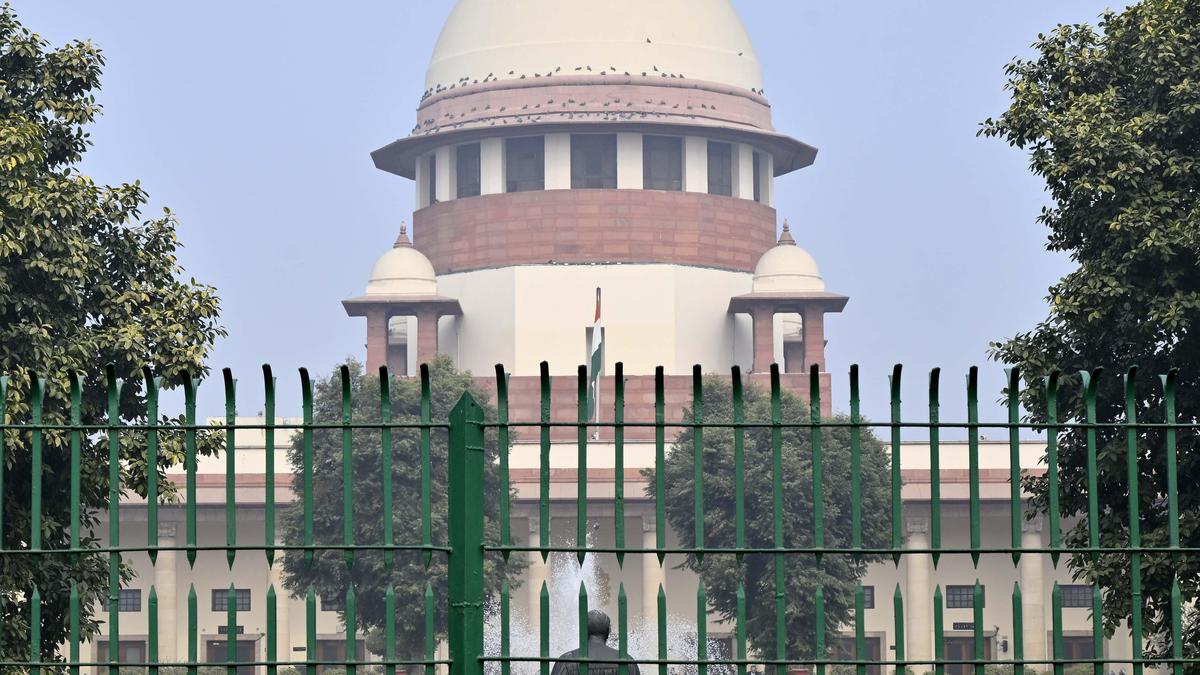
The Supreme Court said many of these convicts become untraceable. File picture
| Photo Credit: Shiv Kumar Pushpakar
A man complained of “unfair treatment” after spending 20 years out on bail in a murder case, saying the lawyer who fought to reduce his life imprisonment to a five-year prison term was appointed by the Jharkhand High Court as amicus curiae behind his back.
A Bench headed by Justice Dipankar Datta, while sending the man’s appeal for a fresh hearing before the High Court, has said, in a recent judgment, that the case reminded them of the expression “give him an inch and he will ask for a mile”.
The man in question was sentenced to life imprisonment in the murder case by a trial court in November 2002. He appealed the decision in the Jharkhand High Court. His sentence was suspended during the pendency of the bail and he was subsequently granted bail.
For 20 years, the convict did not bother to follow up on his appeal as he enjoyed bail. His appeal was listed for hearing for two decades.
Finally, in November 2024, the case came up before a Division Bench of the High Court. However, none appeared for the convict despite the fact that the case was repeatedly called for hearing.
The High Court eventually appointed an amicus curiae, a lawyer of 15 years’ professional standing, to represent him. The amicus was able to prove that the blow which the convict gave the deceased was not intentional. This led the High Court to reduce the gravity of the charges from murder to culpable homicide not amounting to murder. The punishment of life sentence was reduced to a rigorous imprisonment for five years. The convict was directed to surrender. This turn of events prompted the convict to appeal the Supreme Court against the High Court decision.
He argued that the amicus curiae was not appointed with his permission. Besides, the amicus did not argue any of the points he had made in his appeal before the High Court, which, he believed, would have secured him his release.
Justice Datta drily observed in the judgment that it was but “common knowledge” that “once a convict obtains an order from the appellate court suspending the sentence of imprisonment and is, consequently, released on bail, more often than not, he neglects and/or fails to cooperate with the court and impedes an expeditious decision on his appeal by staying away from the proceedings with a view to ensure that his liberty is not curtailed, if the appeal were to fail”.
The apex court said many of these convicts become untraceable. “These convicts, enjoying the concession of bail and misusing it, need to be dealt with firm and strong hands by the courts,” Justice Datta said.
However, the apex court found that the convict in the present case was indeed not informed about the appointment of the amicus curiae by the High Court.
Justice Datta said the Jharkhand High Court was under no obligation to inform the convict and there was nothing wrong in the “anxiety” of the High Court to hear a long-pending appeal expeditiously.
“Appellant was enjoying the concession of bail for two decades without being in any manner concerned about the fate of his appeal… Appellant, while enlarged on bail, has himself to blame for not keeping track of his appeal and by not persuading the High Court to decide the appeal at an early date,” the Supreme Court noted.
Nevertheless, Justice Datta observed that it would have been desirable if the convict had been alerted about the amicus’s appointment.
“Henceforth, whenever an appellate court considers it desirable to appoint an amicus to represent a convict whose counsel is absent, such court may also consider the desirability of issuing a notice from the registry to the address of the convict,” the Supreme Court directed.
This intimation would help the convict contact the amicus curiae about the case. If the convict, on the other hand, refuses to accept notice, it could be stuck on the outer wall of his place of address. If neither the convict nor his counsel turn up for the hearing, the High Court could proceed to hear the appeal, content that it had acted fairly.
Published – March 19, 2026 01:51 pm IST