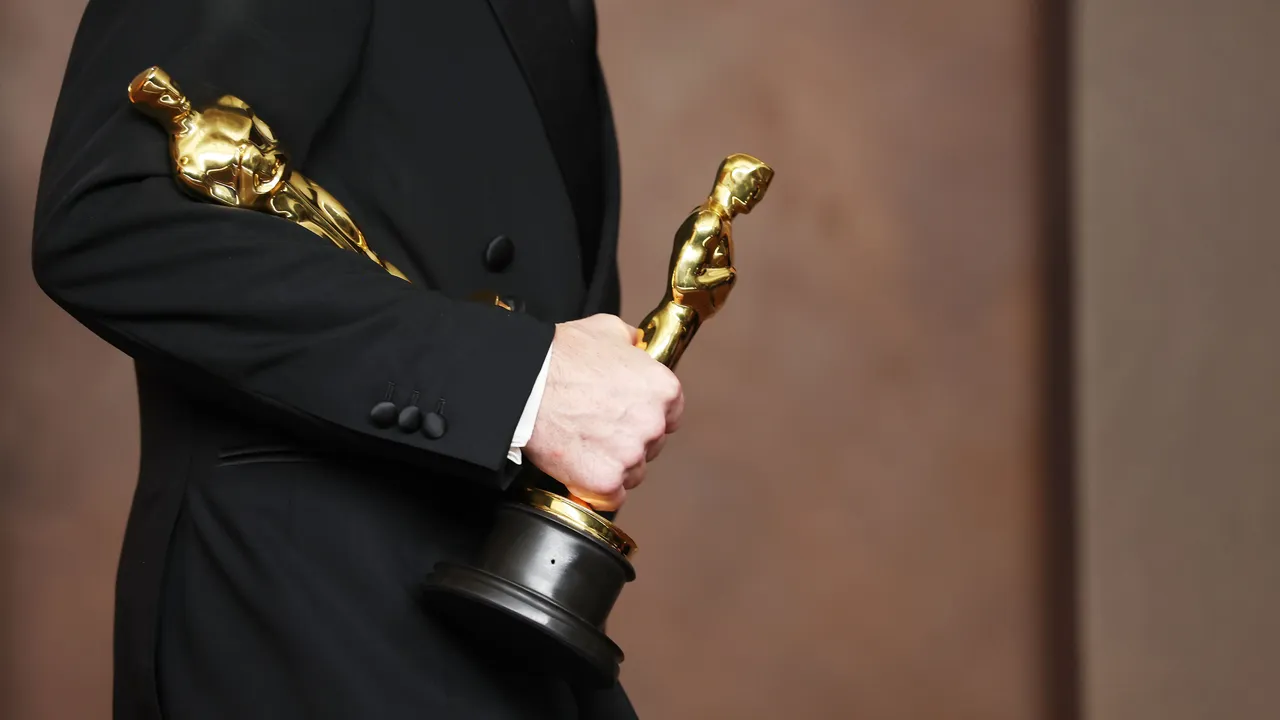
These were stirring, unimpeachable sentiments; imagine the furor that might have erupted, by contrast, if Sean Penn, who famously disdains awards ceremonies, had shown up to collect his prize for Best Supporting Actor , for “One Battle After Another.” When he won Best Actor in 2004, for “Mystic River,” he kicked off his speech with a jab about the nonexistence of weapons of mass destruction in Iraq. You suspect that he might have had a thing or two to say about the real-life applications of his “One Battle” character, a white-supremacist Army colonel who oversees an ICE-like crackdown on immigrants.
Even so, the night was not an entirely apolitical affair. Javier Bardem, presenting Best International Feature Film with Priyanka Chopra Jonas, started his remarks with a forceful “No to war, and free Palestine.” O’Brien threw in a jab about the failure to hold pedophiles accountable in the wake of the Jeffrey Epstein files. Predictably, the most topically urgent speeches could be found in the nonfiction-film categories. Gloria Cazares spoke movingly about her daughter, a victim of the 2022 school shooting in Uvalde, Texas, as she accepted the award for Best Documentary Short with Joshua Seftel and Conall Jones, the filmmakers of “All the Empty Rooms,” which takes viewers into the bedrooms of children lost to gun violence across America. David Borenstein accepted the Best Documentary Feature Oscar for “Mr. Nobody Against Putin,” which he described as a film “about how you lose your country.” Clearly not speaking only about Vladimir Putin’s Russia, he added, “You lose it through countless small little acts of complicity.”
Jimmy Kimmel, who presented both nonfiction awards, mocked “Melania,” Brett Ratner’s widely panned documentary about Melania Trump, and slammed the ascent of Bari Weiss in David Ellison’s media empire, Paramount Skydance. “As you know, there are some countries whose leaders don’t support free speech,” Kimmel said. “I’m not at liberty to say which. Let’s just leave it at North Korea and CBS.” It was a sharp dig, though I do wish that Kimmel, in invoking authoritarian regimes, had thought to mention Iran—or that someone in the writer’s room had thought to shout out the Iranian director Jafar Panahi, perhaps the greatest and certainly the bravest of this year’s nominated filmmakers. Panahi’s film “It Was Just an Accident,” a nominee for Best International Feature and Best Original Screenplay, is partly drawn from his own experiences as a prisoner in the Islamic Republic. Like the superb Brazilian film “The Secret Agent,” from the director and screenwriter Kleber Mendonça Filho, Panahi’s film is a political thriller of searing moral urgency. The fact that neither film won anything is a reminder of the Academy’s cultural myopia: for all its efforts to diversify and internationalize its voting membership, the organization seems largely oblivious to the finest, most vital work being done by filmmakers outside America.
Ultimately, it wasn’t the brutalities of the Trump Administration or Israel’s atrocities in Gaza that drew the most sustained protest on Sunday night but rather the encroaching threat of irrelevance for a film industry facing challenges on many fronts: declining ticket sales, the rise of A.I., soul-crushing corporate mergers. In one bit after another, O’Brien celebrated the cinema of the past, with nods to “North by Northwest” (1959) and “Casablanca” (1942), in order to lampoon where Hollywood seems to be heading. Among his targets were the appalling distortion of films to fit smartphone screens and the tendency of scripts in the Netflix era to become nonstop-exposition machines. He playfully posited a worst-case scenario for 2029, when the Oscars, a longtime fixture of broadcast television, will begin streaming exclusively on YouTube. The segments were funny, even when the laughter caught in your throat. Long before an uncommonly graceful and gimmick-free In Memoriam segment, with extended individual tributes to Rob Reiner, Catherine O’Hara, Diane Keaton, and Robert Redford, there was no mistaking the faintly elegiac cloud that hung over this year’s Oscars—the sense of a ceremony, and of an entire industry, unable to stop memorializing itself. The greatness of this year’s finest films aside, it will surely take more than fresh reserves of movie magic, let alone a snap of Aunt Gladys’s twig, for a spirit of optimism to prevail again.