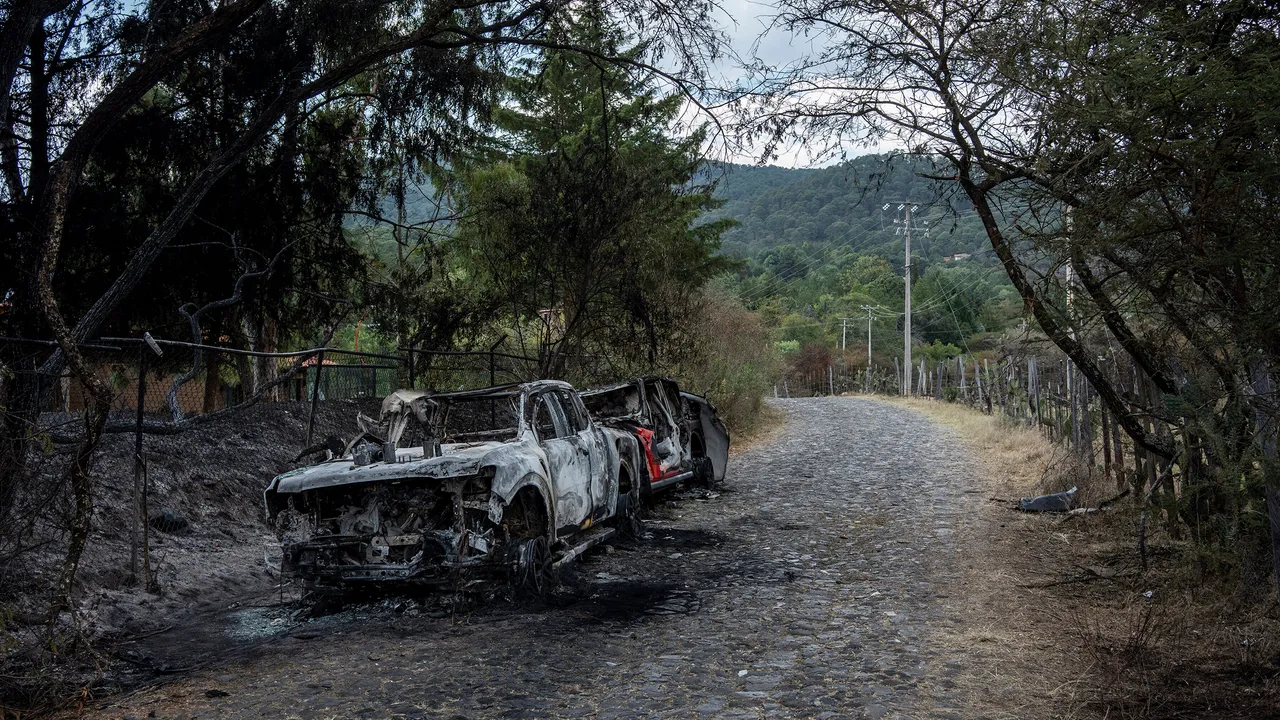
The blood and fury following Mencho’s death encapsulate the life and legacy of the crime king. Even by drug-cartel standards, Mencho was especially brutal, revelling in his bloodthirsty reputation. In 2017, a Mexican singer wrote a popular ballad titled “Soy Mencho,” which opens with the line, in Spanish, “They say I am very violent / Well, it’s true, why should I lie about it?” The C.J.N.G.’s first high-profile mass attack was in 2011, when the group left thirty-five corpses under a bridge, claiming that the victims worked for the Zetas, a rival gang. During a previous attempt to arrest Mencho, in 2015, gang members blockaded thirty-nine roads in Jalisco with burning vehicles and shot down an Army helicopter with a rocket-propelled grenade launcher. And, in the time that Mencho was the boss in Jalisco—fifteen years—government forensics teams dug up clandestine graves to find bones from more than two thousand bodies.
The modern Mexican drug war, as it is often called, began when the Mexican military first deployed troops in large numbers to dismantle the cartels, in 2006. Mencho’s contribution to this decades-long conflict was to match the military’s firepower and raise the bar of narco-paramilitary forces. During his tenure, he built up squads of highly trained and well-armed killers with names such as Los Deltas, Grupo Elite, CJNG 2000, and the Special Forces of El Mencho. He approximated military technology, using armored drones and makeshift land mines against Mexican soldiers. And he brutally conscripted gang members, using methods comparable to those of warlords who have forced children to be soldiers in West and Central Africa. The Mexican government hopes that Mencho’s death will reduce narco-violence, but the fear is that his style of war will be waged by a new generation.
When I began working in Mexico City as a foreign journalist, in 2001, I became fascinated by the cultural celebration of narcos. They were looked upon as legendary outlaws that made billions trafficking drugs to Americans, while somehow evading the Mexican Army and the U.S. Drug Enforcement Administration, or D.E.A. They even had their own genre of songs, narcocorridos, giving them a reputation somewhere between a rock star, a C.E.O., and a paramilitary general. In the decades since, the Mexican government has arrested or killed dozens of top narcos, with the most infamous, Joaquín (El Chapo) Guzmán, convicted in a major trial in New York City. Yet, until now, Mencho survived. Benjamin Lessing, a professor of political science at the University of Chicago, described the logic behind strategies of unleashing mayhem, like the C.J.N.G.’s, as “violent lobbying.” By using road blockades, assassinations, and other conspicuous acts of violence, Mencho showed the Mexican government that he could make it very costly to dismantle C.J.N.G.’s operations.
It can be difficult to document figures like Mencho. Their legends often grow larger than life, and even their real names and ages are disputed. Before his death last week, various reports had even alleged that Mencho was already dead. Mencho was born in 1966 in the municipality of Aguililla, in Michoacán, a state south of Jalisco that runs along Mexico’s Pacific Coast. I’ve visited Aguililla several times, and it’s a roughneck hill town with a long history of producing drugs such as cannabis and opium. On his birth registry, Mencho’s name is Rubén Oseguera Cervantes; he adopted Nemesio as his first name, the origin of his “Mencho” nickname, later. (Some reports claim that it was to honor a godfather; others say it was to confuse the D.E.A.) Like many Michoacános, Mencho went north as a teen-ager to seek his fortune in the United States, ending up in the Bay Area, where he got his start in heroin dealing. He was arrested in 1986, for possession of stolen items and a loaded gun, and a mug shot shows him at the age of nineteen, a pudgy youth of five feet eight in a blue hoodie with thick, curly hair.