
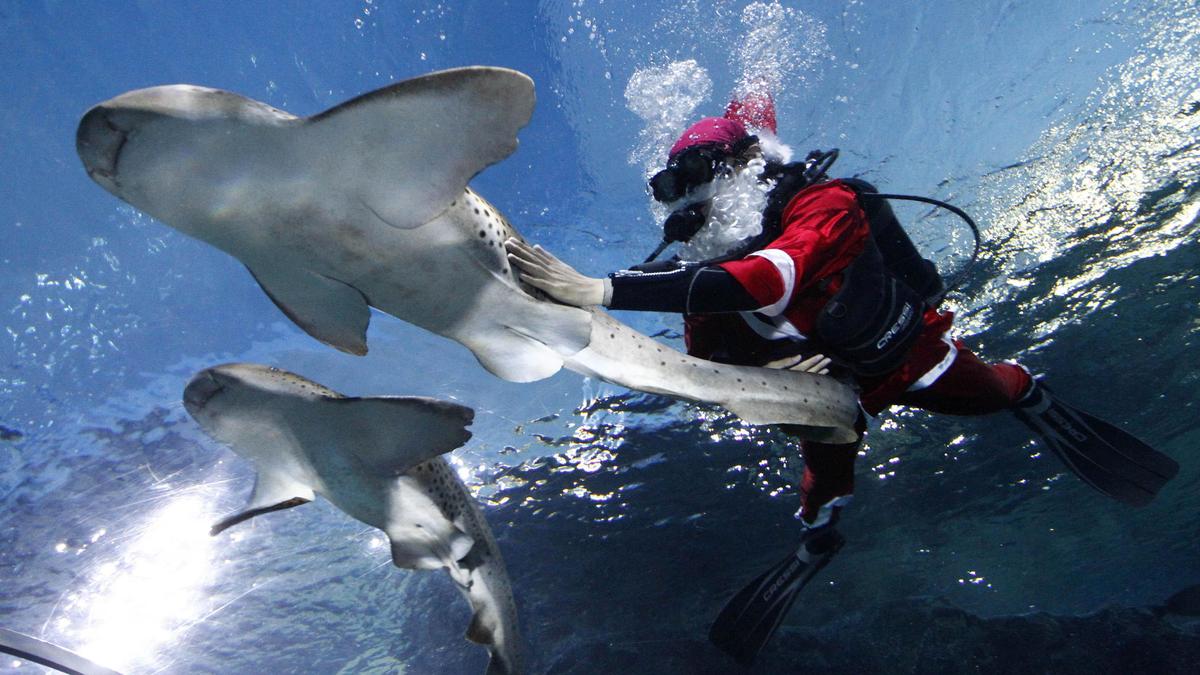
The story so far: Open up Instagram, Meta AI, TikTok, YouTube Shorts, or X on your phone and it won’t be long before you scroll to a short video clip that shows animals and humans sharing a bizarre encounter.
While an AI-generated video of a man taking an underwater selfie with a shark is easy to identify as fake, more realistic Gen AI videos can warp the way we think about wild animals and their behavioural traits, putting both us and them in danger.
Why are AI animal deepfakes on the rise?
This is thanks to a barrage of Generative AI tools that allow users to enter text prompts in everyday language and churn out hyper-realistic videos at scale that can be easily uploaded online. As platforms like Meta pivot to short-form videos in an attempt to surpass TikTok, while X rewards virality and engagement, users are incentivised to make and share more low-cost, low-effort content.
Many AI videos show unrealistic and violent scenarios that could impact the way children perceive and treat animals
| Photo Credit:
Instagram
As a result, you might have seen gorillas breaking out of zoo enclosures, crocodiles gobbling up their handlers, dying lions surrendering their cubs to humans, fishermen rescuing polar bears, and monkeys dancing with children.
These videos are generally called “AI slop” due to their low-grade entertainment value and short length. Often shared with sensationalised captions or presented as though they are real news events, viewers inevitably waste their time trying to figure out if the content is real or AI generated.
Also read: The real price of “free” social media
Violence is also a major pull factor in AI animal videos: a giraffe is decapitated by an overhead bridge, a gorilla smashes a tiger with a boulder, a hippo excretes in the face of another animal with the power of a missile, a crazed shark mauls a swimmer, and a whale swims after a desperate Arctic fox.
Such videos come with or without melodramatic storylines. These are reshared, repeated, and re-adapted by others hoping to go viral.
What harms can AI animal videos cause?
AI-generated animal videos rack up millions of views on platforms like X and YouTube, because they are seen by viewers across age groups and with varying levels of media education and digital literacy. In essence, AI animal videos can change our relationships with animals.
For example, a video of a little girl feeding puppies or a boy dancing with a monkey on Meta AI might seem like harmless, heartwarming slop, but they downplay the dangers of parents letting their children approach unvetted animals without expert supervision, and especially in a country struggling to tackle rabies.
Research in this area is ongoing, but a September 2025 report titled ‘Threats to conservation from artificial-intelligence-generated wildlife images and videos’ [Conservation Biology, 40, e70138], explores how AI images and videos of animals might undermine conservation efforts by spreading misinformation. According to the report, AI animal videos can make social media users believe that endangered/vulnerable creatures are actually easy to find around them. Exposure to inaccurate AI animal videos could also confuse children on social media, and set back efforts to identify diverse types of animals or tell apart native species.
Other possible outcomes outlined in the report could directly harm animals. These include overtourism due to AI-generated animal sightings, spreading the false idea that animals have human behavioural traits such as affection for children (known as anthropomorphism), or making exotic pets look attractive in spite of laws prohibiting wildlife trafficking.
AI animal videos are sometimes used to falsely portray rescue and rehabilitation attempts
| Photo Credit:
X
“Some AI videos depict interspecific interactions that are implausible, for example, affiliative behaviors between animals of different species, including between predators and preys, and between parasites and hosts. Some videos depict friendships between humans and wild animals, which can be dangerous if, in an encounter with an animal, a human fails to recognize it as a potential threat,” noted the paper’s authors.
How do conservation groups feel about AI?
The responsible application of Generative AI technology definitely helps out experts in the conservation sector, according to Dipankar Ghose, Senior Director-Biodiversity Conservation, at World Wildlife Fund-India.
The organisation is using AI to identify images of large mammals caught by camera traps and segregate hundreds of them by their species, in a matter of minutes. If done manually, this process would have taken days. AI is also used for bioacoustics and creating data-driven content.
However, Ghose was strongly against AI videos of animals made for entertainment.
More realistic AI videos may cause parents to believe that their children can safely interact with wild animals
| Photo Credit:
Meta AI
“It is a dangerous trend in which AI is used to create hyper-realistic clips of tigers picking up people from their beds or leopards drinking water from a kid’s water bottle, all completely fake!” he explained.
“It is a nightmare for conservationists and wildlife and forest managers, particularly the officers and field staff of state forest departments and administration, as public perception can be manipulated by these fake videos, which may result in retaliatory violence against wild animals.”
How can you identify AI animal videos?
Apart from the realism of the content, there are several signs social media users can look for before sharing an animal video
If an animal video is shot in the vertical format and depicts a complete “feel-good” storyline in exactly 10, 15, 20, 30, or 60 seconds, this is a strong sign that it might be generated with AI for social media clout.
Look for watermarks in the corners of the video frame that the original uploader might have forgotten to remove before posting.
Consider the source of the video. Genuine, high-quality animal videos are more likely to be posted by established photographers, wildlife videographers, researchers, pet owners, zoos, and animal aid organisations, rather than “meme” pages or anonymous social media users that compile many poor-quality videos.
As AI-generated videos improve in quality, make sure to verify unknown individuals or organisations who ask for funds/donations and post dramatic videos to “prove” they are rescuing animals.
Make an effort to show children the work of sincere animal lovers and wildlife researchers whose quieter, ethical, and much needed real-life coverage of wildlife was created with more care than any AI-generated animal video. Child-friendly nature documentaries are a good place to start.
Published – March 07, 2026 12:14 pm IST