
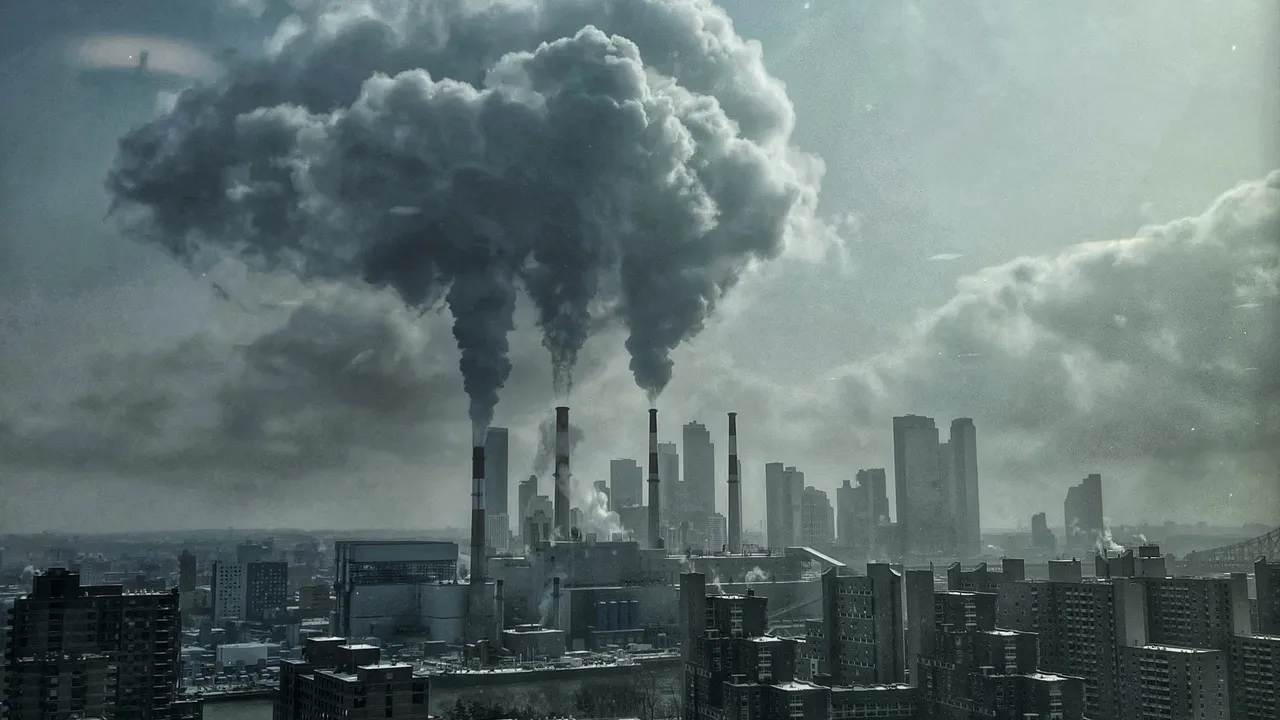
It fell to Doug Burgum, once the governor of North Dakota and now the Secretary of the Interior, to offer something resembling a scientific explanation for the Trump Administration’s decision to rescind the Environmental Protection Agency’s “endangerment finding,” which states that greenhouse gases such as carbon dioxide pose a risk to the planet’s health. “CO2 was never a pollutant,” Burgum said. “When we breathe, we emit CO2. Plants need CO2 to survive and grow. They thrive with more CO2.”
Considering that, in recent weeks, Burgum has also appeared in a cartoon with a lump of coal known as Coalie (“Mine, Baby, Mine!”) on social media, such reasoning is perhaps the best that one can hope for. It’s roughly the equivalent of explaining to a drowning person that you’re not going to throw him a life preserver because water is a building block of life. Carbon dioxide is, in fact, among the most dangerous substances at work on the Earth; as it collects in the atmosphere from the burning of fossil fuels, it is rapidly raising the Earth’s temperature, melting its poles, and setting off endless rounds of flood and fire. The latest warning came this past week, from a global team of scientists who noted, in a journal paper, that “we may be approaching a perilous threshold, with rapidly dwindling opportunities to prevent dangerous and unmanageable climate outcomes.” Indeed, recent weeks have produced predictions that a new El Niño is in the offing for later this year and, with it, the near certainty of new and dire temperature records.
Given all that, the decision to terminate the E.P.A.’s finding—which the agency issued in 2009, two years after the Supreme Court ruled, in Massachusetts v. E.P.A., that greenhouse gases are pollutants under the Clean Air Act—has to rank as one of the signal moments in America’s descent into idiocracy. Literally every major scientific organization in the world, not to mention every other U.S. President since 1988, and even all the largest oil companies, have acknowledged the dangers of greenhouse gases. The decision is of a piece with the Trump Administration’s withdrawal from the Paris Agreement and its efforts to disconnect satellites and monitoring stations—including, in December, the National Center for Atmospheric Research, in Boulder—that the world has relied on to track changes in the planet’s chemistry and temperature.
The repeal of the finding will face significant legal challenges, but the climate-skeptic industry is convinced that it has won a final battle. “We are pretty close to total victory,” Myron Ebell, a veteran of the movement, who fought climate and conservation initiatives for decades and served in the first Trump Administration, told the Times. Marc Morano, who worked for Rush Limbaugh and played a key role in the Swift Boat attacks on John Kerry before he switched to attacking climate-change policy, appears in an E.P.A. news release stating that the Administration’s actions “will make America much safer from any future climate wreckage inflicted by potential presidents like Gavin Newsom or AOC.”
A Times piece on the E.P.A.’s decision ran under a headline ratifying a sense that the Rubicon is now in the rearview mirror of a gas-guzzling S.U.V.: “Trump Administration Erases the Government’s Power to Fight Climate Change.” The fear is understandable—the finding has been the linchpin of federal regulations on everything from cars to coal-fired power stations. But it’s not, in fact, game over for future climate action, and understanding why allows for a more nuanced picture of where the climate fight actually stands now.
It was in 1988 that the public debate about climate change began, after the NASA scientist James Hansen testified before Congress and warned of the coming crisis. But, for the next thirty-five years or so, the fact that fossil fuel was relatively cheap and clean energy was relatively expensive constrained the debate. For the most part, environmentalists’ strategies involved somewhat complicated ways to bypass that economic reality. If they couldn’t persuade elected officials to raise the price of fossil fuels through taxes, they could, for instance—and quite legitimately—argue for treating by-products of fossil fuels as dangerous pollutants and begin to limit their use on that basis. The finding, though entirely correct, was also always a work-around, a way of avoiding having to directly confront the overwhelming power of the fossil-fuel industry in our political and economic life.
Then, earlier this decade, it became cheaper to produce energy from the sun and the wind than from coal and gas and oil. Around the world, the surge in clean power is now moving faster than any energy transition in history. Over the course of twenty-one months, greenhouse-gas emissions in China have plateaued and even dropped; perhaps even more significant, coal use has declined recently in India, as solar fields expand, creating a real possibility that it may be the first large nation to pass through rapid economic development without relying mostly on fossil fuel. And new reports indicate that Africa is now the fastest-growing solar market in the world, with solar capacity up fifty-four per cent over the course of the past year.
The Trump Administration can, of course, hinder the development of clean tech in the U.S.—it has shut down under-construction windfarms, restricted the installation of panels on federal lands, and removed already built and paid-for E.V. chargers from federal buildings. That it has done this to appease the fossil-fuel industry, which provided enormous financial support to Republicans in the 2024 elections, is too obvious to be worth denying. But that effort speaks, at least in part, to the industry’s nervousness. It’s even in trouble in Texas, which last year led the U.S. in clean-energy and battery installation, and where, Google announced just this past week, two new data centers it is building will be fuelled by solar power.
So if a President Newsom (in his current role, as governor of California, Newsom just signed a new agreement on climate coöperation with the British government) or a President Ocasio-Cortez were to take office someday, with a goal to rejoin the international climate fight or just to restore the U.S. as a serious manufacturing competitor to China, their first priority would not be a new endangerment finding from the E.P.A. That was the right move back in the day. Now job No. 1 would be getting back to building clean energy.