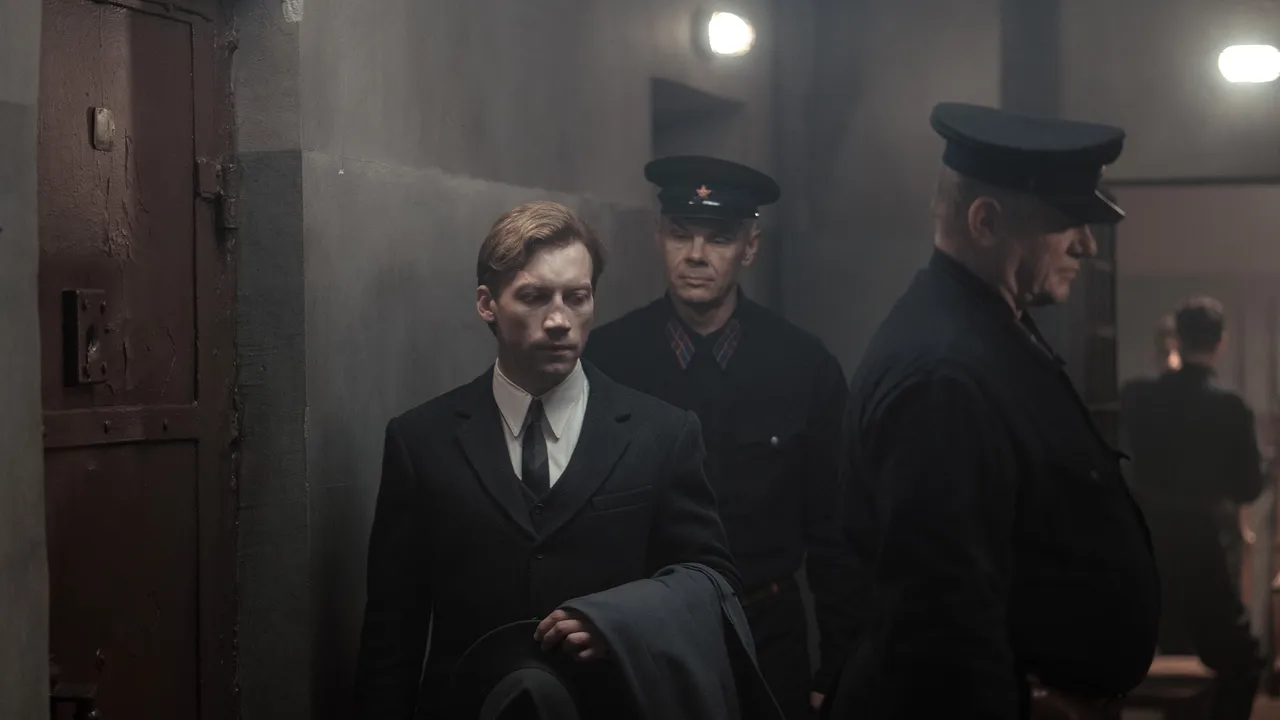
By the time Kornev is finally ushered into the cell of Stepniak (a mesmerizing Aleksandr Filippenko), there’s no sense of triumph or even anticipation about what he will discover. Stepniak’s account is terrifying, though not terribly surprising: he is one of many Old Bolsheviks who have been strategically targeted by Stalin’s regime, and his “vital information” is written, in part, in the wounds and scars covering his battered body. Stepniak was also once a lawman himself—he’s the other prosecutor of the film’s title—and Kornev, who regards him as something of a mentor, is determined to live up to their shared ideals. Loznitsa neither sentimentalizes nor mocks this impulse; for him, the human will to resist, to cling fast to integrity and courage in the face of a mounting totalitarian horror, is something as real, as undeniable, and therefore worth acknowledging, as the horror itself.
Loznitsa, who has lived in Berlin since 2001, has been making films for more than two decades, most of them nonfiction. These include “The Invasion” (2024), a portrait of everyday Ukrainian life during wartime, though he has previously revisited the Stalin era in archival documentaries, such as “The Trial” (2019) and “State Funeral” (2021). The director’s easy traverse between past and present, and between fiction and nonfiction, has accumulated its own meaning over time: fascism persists now as it did then, and its horrors are inexhaustible in any medium. So it is with “Two Prosecutors,” which is Loznitsa’s first fictional narrative in some time, though it is informed by real-life experience. The story is drawn from a novella by the Soviet physicist Georgy Demidov, who spent fourteen years in the Gulag as a political prisoner; he wrote it in 1969, but it wasn’t published until 2009, long after his death.
Not having read Demidov’s story, I can’t assess Loznitsa’s adaptation on the basis of narrative fidelity, although there is one purely cinematic coup—a structural doubling—that undoubtedly belongs to him and the astoundingly versatile Filippenko. That doubling underscores the film’s title and its structure, which is ingeniously bifurcated: the movie runs just under two hours, and the second hour, which follows Kornev as he seeks to report his findings to the prosecutor general’s office in Moscow, holds up a brilliantly warped mirror to the first. The Moscow offices are, of course, nicer than the Bryansk prison cells, with wood panelling in lieu of ashen concrete, but even here Kornev is subject to the same evasions and veiled threats, the same pointless waiting games, the same hush of conspiracy that, he realizes too late, has already eyed him as its next target. Loznitsa’s methods are grim and exacting, but the effect is never monotonous; there are shivers of Hitchcockian suspense, plus a whispery cackle of satire that veers toward the Kafkaesque. Whether Kornev is navigating the bowels of a prison or a labyrinth of bureaucratic absurdity, the rooms and anterooms he must pass through are like successive circles of Hell. Once he reaches the core, his sense of entrapment, and ours, is total.
Like “Two Prosecutors,” “Palestine ’36,” the fourth feature from the Palestinian director and screenwriter Annemarie Jacir, unfolds at a politically and existentially precarious moment in the nineteen-thirties. The similarities end there. Jacir’s film, which was short-listed (but not nominated) for the Oscar for Best International Feature, has no use for art-film solemnity. Conceived as a robust classical entertainment, it is blunt and sprawling where Loznitsa’s picture is precise and concentrated, and it pointedly frames resistance as a collective rather than a solo enterprise. The title sets the scene: the story begins in British-controlled Palestine, in 1936, and then tracks, on multiple narrative fronts, the three-year Arab revolt against the mounting injustices of mandatory rule. Chief among these is a British partition plan, well under way, to establish an Israeli state in Palestine; Jewish refugees, fleeing persecution in Europe, are already arriving en masse and building settlements in the countryside. As tension erupts between Jewish settlers and Palestinian rebels, the British police and Army enforce an indiscriminate crackdown on Arab villagers, confiscating their land, enforcing curfews, limiting travel, and beating and arresting any who resist. The Nakba of 1948 is still about a decade away, but its catastrophic legacy has already begun.