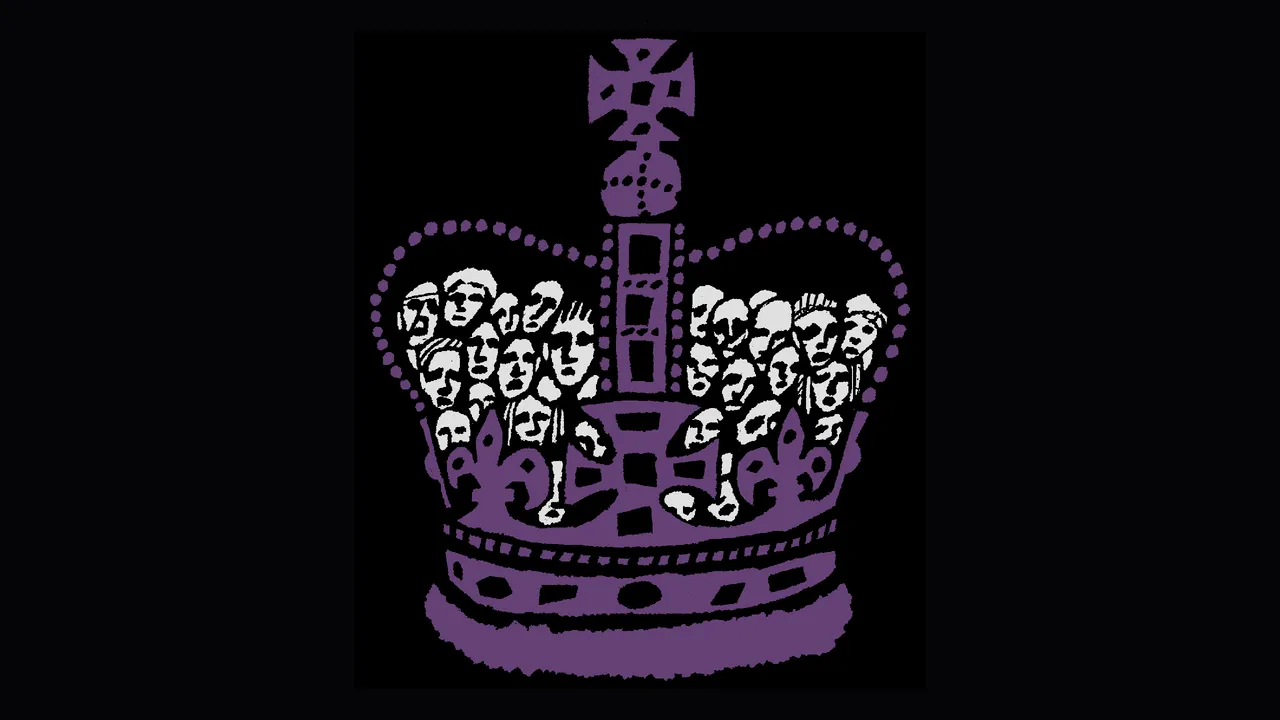
While the country’s princes and princesses had little to say about enslaved people, they loved having them around. Newman’s book is dotted with paintings that show royal bodies juxtaposed with owned, Black ones: nameless grooms and female attendants acquired to ornament, and accentuate, the existing nature of things. “My greatness is from on high,” reads the swirling banner above the top hat of Queen Anne of Denmark, James I’s wife, in a portrait from 1617. Five hunting dogs, a horse, and a liveried Black youth adorn the scene. Later in the century, Nell Gwyn, Charles II’s most famous lover, was portrayed stuffing sausages, her breasts partially exposed, with a Black servant, in a silver collar, waiting at her shoulder. “Gwyn, a commoner and royal mistress, is of higher status than her anonymous enslaved attendant,” Newman writes. “Yet both figures represent commodified bodies available for royal consumption.”
I read Newman’s book last week, while the Crown was contending with the legacy of another people-trafficking operation, this one conducted by Jeffrey Epstein. Again, the royal protagonist was a former Duke of York. Like his predecessor, Prince Andrew (as he used to be) was a brave young serviceman. Aged twenty-two, he flew helicopters during the Falklands War. One of his tasks was to act as a decoy for Argentinian missiles fired at his mother’s Navy. When he left the military, Andrew turned his attention to foreign trade. Between 2001 and 2011, he was the U.K.’s special representative for international trade and investment, travelling the world in search of profit and adventure, with a team of equerries and a six-foot ironing board. The Daily Telegraph nicknamed him “Airmiles Andy.” Of the Queen’s four children, Andrew was considered the direct and entrepreneurial one. In 2014, he set up Pitch@Palace, a chance for startups to network and present their ideas in a royal setting.
He was not dull, but he was cut off. Andrew met Epstein in the late nineties, through Ghislaine Maxwell, the youngest daughter of Robert Maxwell, a former press baron. Epstein and Maxwell promptly became guests at Balmoral, Sandringham, and Windsor Castle. “Have you found me some new inappropriate friends?” someone describing themselves as “The Invisible Man” e-mailed Maxwell, from the “Balmoral Summer Camp for the Royal Family,” in the summer of 2001. On trips across the Atlantic, Andrew stayed at Epstein’s houses in Palm Beach, New York, and on Little St. James, Epstein’s island in the Caribbean. Two women, including Virginia Giuffre, who died by suicide last year, accused the former prince of having sex with them when they were minors, on the island and at Maxwell’s mews house, in London.
During this period, Andrew was making inappropriate friends all over the place. He ensnared himself in relationships with the son of Muammar Qaddafi, the Libyan dictator, and with Tarek Kaituni, a gun smuggler. He reportedly went goose-hunting with Nursultan Nazarbayev, the authoritarian former President of Kazakhstan, whose family later purchased a mansion from him, in Berkshire. But Epstein and Maxwell appear to have occupied a privileged role. According to the latest release of the Epstein files, Andrew would forward confidential briefings about British investment opportunities overseas to the financier within minutes of receiving them. He described Epstein and Maxwell as “my US family.” Sarah Ferguson, Andrew’s ex-wife and the former Duchess of York, called Epstein the brother she had always wished for. “When are you going to employ me,” she wrote to him, in September, 2010, a year after he was released from prison for soliciting sex from a child.
Andrew has stayed silent about his relationship with Epstein and his victims, with one calamitous exception. In November, 2019, he gave an interview to the BBC, during which he denied any sexual misconduct and insisted that he broke off the friendship in 2010, after Epstein’s conviction. The former Duke did not regret the relationship, however, because he learned a lot about the world. “You have to remember that I was transitioning out of the Navy at the time,” he said. “The Navy—it’s a pretty isolated business.” He never wondered what all the people in Epstein’s houses were doing. “I live in an institution at Buckingham Palace which has members of staff walking around all the time,” he said. “I don’t wish to appear grand, but there were a lot of people who were walking around Jeffrey Epstein’s house. As far as I was aware, they were staff.”