
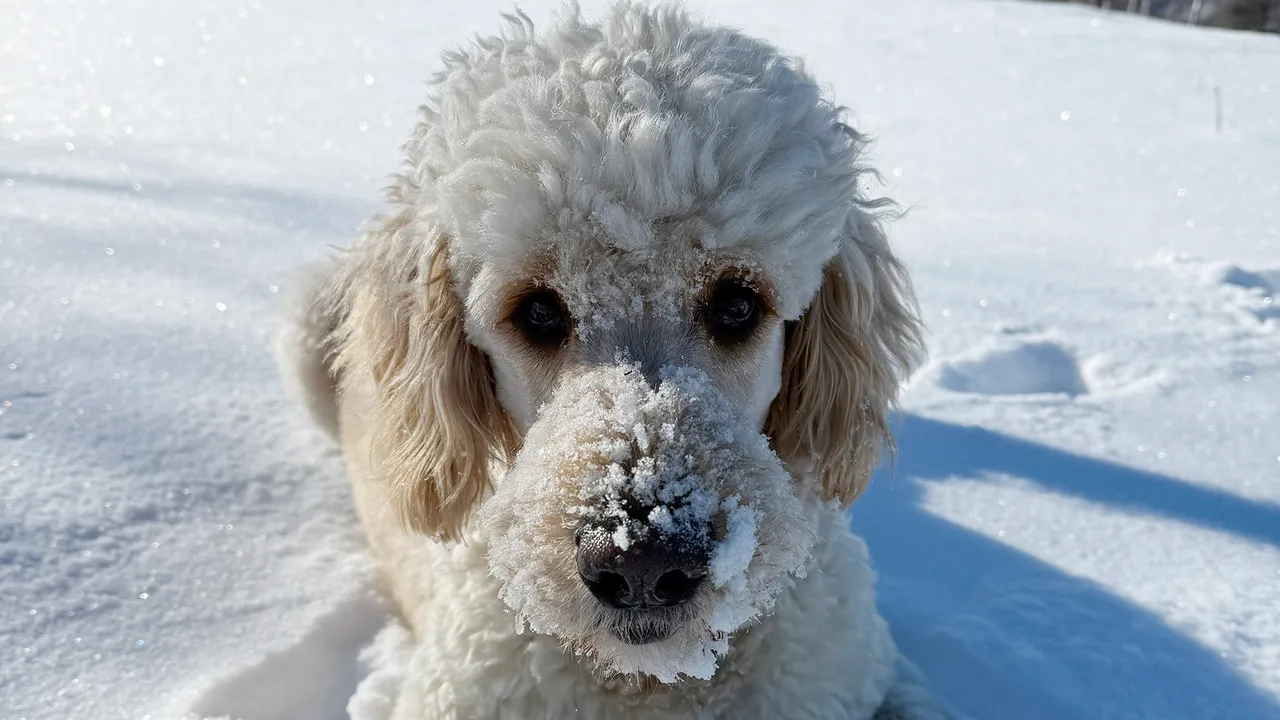
Depending on whom you ask, the doodle is either the cutest little bundle of curls you’ve ever seen or an absolute menace to dog society. Perhaps no modern dog breed is more polarizing: doodles are everywhere, in all their iterations, bouncing around and pissing off both the purebred community and the rescue folks.
In this week’s issue, John Seabrook, a staff writer and doodle owner, explores how these crossbreeds got to be so popular. I caught up with Seabrook over the phone while he was out walking his beloved goldendoodle, Herman. We discussed what he learned during his foray into dog-breed history—and what he might say to a doodle-hater.
The conversation that follows has been edited and condensed.
Why doodles? How did we get here?
It started in Australia. In 1989, a guide-dog breeder named Wally Conron bred a standard poodle with a Labrador to try and create a guide dog for people who were allergic to dog fur. He named it the Labradoodle.
Doodles were marketed as a super dog that combined the temperament of a poodle, which is very intelligent, though sometimes a bit nervy, with a golden retriever or a Labrador, which are seen to be sweeter and more affectionate and calmer than poodles.
While the popularity of doodles was growing, the people who care about dogs were increasingly concerned with the health issues facing purebred dogs caused by inbreeding. The doodle phenomenon grew as an alternative option. It’s not a purebred dog, and it’s not a mutt or a rescue. There’s a theory that these dogs are healthier—that they have less inbreeding—because they have that cross in them.
They’re very good-looking dogs. They look great on social media. So that’s another factor, too.
You’re a doodle owner. I’m curious how you felt while reporting this piece.
Well, I sort of have the wrong dog. The purebred world isn’t very fond of doodles for various reasons. So saying you have a doodle to a poodle person or a golden-retriever person is not the best conversation starter. Then, there are the rescue people and the foster people, who feel that it really is better to rescue dogs and not buy them.
So, really, you’re left with the doodle people. And the doodle people love each other because it’s like, Thank goodness we can now speak freely.
You spent a lot of time thinking about the higher-level questions around dog breeding. What did you learn about the way we talk about breeds or conceptualize them culturally?
The notion of breed really derives from the nineteenth century, from this Victorian-era idea of pure-blooded dogs that are all descended from the same foundational pair of dogs. Many of those dogs were bred by these aristocratic, landowning British people, who had their own kennels and were looking for superior hunting dogs. But the notions that underlie pure blood and breed are rooted in racism and eugenics—ideas that, when applied to humans, led to Nazism, basically. But, in the dog world, they survive. Culturally, it’s very strange, really, that these ideas are so discredited in the human world but still govern the dog world.
Do you have a message to the doodle-haters?
Please try to see that it’s not a zero-sum game. Of all the problems facing purebred dogs, doodles aren’t even in the top five. And yet, the amount of negative attention focussed on them is, I think, beyond what’s called for or useful.
What do you think Herman would think about you reporting this piece?
Right now, he’s very keen on a squirrel, so he’s not thinking about my piece. But maybe he’s hopeful to diffuse some of the anti-doodlism that’s out there in the world.
Read or listen to the story »
Editor’s Pick
Lisa Kudrow’s Alter Egos
Twenty-two years after the end of her star-making turn as Phoebe Buffay on “Friends,” Lisa Kudrow returns to “The Comeback,” her on-again, off-again cult HBO series. What does she still want to say about Hollywood? Michael Schulman reports from L.A. »
More Top Stories
Our Culture Picks
-
A book: In “The Life You Want,” the psychoanalyst Adam Phillips wages a playful war on the strictures of traditional talk therapy.
-
A movie: Justin Chang thinks more witches should’ve won Oscars, including Helen Mirren for her role in the 1981 fantasy “Excalibur.”
-
An album: Music by the Strokes, Amanda Petrusich writes, “makes everything feel less high-stakes.” Their album “The New Abnormal” might be just what we need right now.
Daily Cartoon
Puzzles & Games
P.S. More of a cat person? (Not that “Cat Person.”) Read about the German town that imposes a cat lockdown when certain birds are breeding.
Ian Crouch contributed to today’s edition.