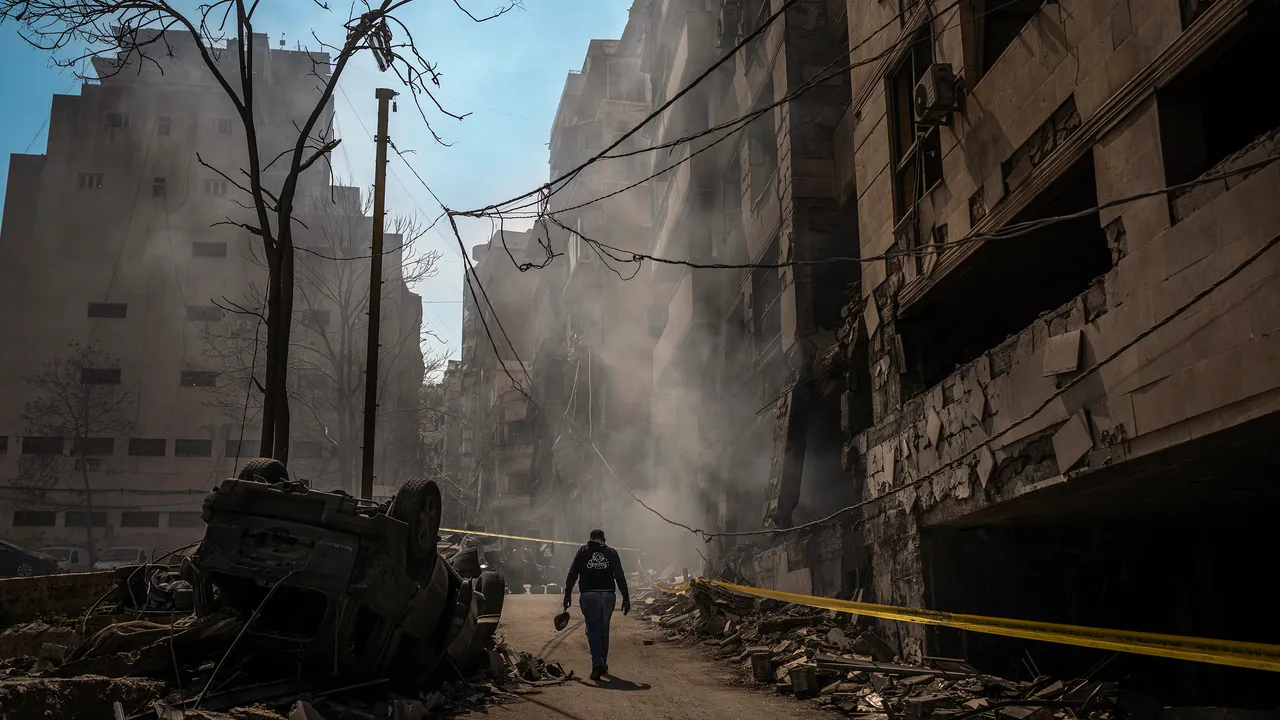
Soon after the United States and Israel attacked Iran, Hezbollah—a paramilitary group and a political party that wields tremendous power in Lebanon, and is an Iranian proxy—struck back, firing missiles at Israel. Israel retaliated with strikes and a “limited” ground invasion of southern Lebanon. Even though the Iranian front of the war has received significantly more attention in the global press, the reality on the ground in Lebanon is staggering: the Israeli attacks have already killed more than a thousand people, and displaced upward of a million, in a country of some five million. The displacement orders affected more than fourteen per cent of the country. And many Lebanese are concerned that Israel intends to eventually redraw the border between the two countries.
To better understand this part of the widening Middle East conflict, I recently spoke by phone with Maha Yahya, the director of the Carnegie Endowment’s Middle East Center, who lives in Lebanon and was in Beirut when we talked. During our conversation, which has been edited for length and clarity, we discussed the roots of Lebanon’s long political crisis, how Israel’s war in Gaza changed Lebanese society, and what Israel really hopes to achieve with its bombing campaign in Lebanon.
Can you describe the political situation in Lebanon leading up to the October 7th attacks? Because the period after that is when Israel has been especially aggressive in Lebanon, at least in recent years.
God, it feels like a lifetime ago, honestly. I think the situation prior to October 7th was pretty much status quo, both internally, within the country, but also in the country’s relationship with Israel. The last war between Israel and Lebanon was in 2006. The cessation of hostilities, or ceasefire, that was put in place at the end of that conflict was holding. There was very little interaction along the border. In 2022, an agreement was struck between Lebanon and Israel to finalize the delineation of our maritime borders. And, as for the land borders, some of the disputed points had been resolved.
Internally, in Lebanon, there was a power struggle between the various political parties. Hezbollah still had quite a bit of political power. They were the central political power, in many ways. And then you had the Lebanese government forces on the other side, who were basically the heads of various militias during the Lebanese civil war who had simply moved from the street into government at the end of hostilities, in 1989. There had been growing resentment of that political class within Lebanon, especially after a series of protest movements in 2019, when the country seemed to be facing economic collapse. And the protests were about how grossly the country was being mismanaged, but also that a majority of Lebanese people, across all sectarian groups, were fed up.
So that movement against Lebanon’s political status quo had quite a bit of momentum, but it was derailed. One of the reasons why it was derailed was something that took a lot of us by surprise but shouldn’t have, which was how fast Hezbollah came to the fore to defend the system. It derailed the protest movement within weeks. I remember those protests as such a moment of hope. People were energized like I’ve never seen before.
Did Hezbollah dislike the protest movement because the fractured nature of Lebanese politics gave them a way of wielding de-facto power?
It was that—the extent to which they were invested in the system as is. The division of power between six political leaders from different sectarian backgrounds gave them outsized political power. Of course, the arms also gave them power within that system. So, on the one hand, part of Hezbollah’s discourse is a commitment to anti-corruption, et cetera. None of this has ever happened, and at the same time they were very invested in making sure that the demonstrations quickly diminished. And then COVID came, and then the catastrophic Beirut port explosion that derailed the process as well.
So how would you describe the period from October 7th until early March of this year? What changed?
In the immediate aftermath of October 7th, Hezbollah made the decision to support Gaza by waging a low-intensity conflict on Israel’s northern borders. That opened the door for Israel. And I think this is where Hezbollah completely misread the situation. I don’t think many of us, frankly, understood the extent to which that created a shock within the system in Israel and within a society that already was veering to the right. So we saw an escalation. Israel was hitting deeper into Lebanon. And there were assassinations. And the response from Hezbollah was, We will respond at the time of our own choosing. They thought that, by maintaining a measured response to what Israel was doing, they could stave off a broader attack. But that did not work. And we saw that it did not work in September, 2024, when Hassan Nasrallah was assassinated, and there were these pager attacks on Hezbollah officials. This was interesting logistically, but it was also a terror operation. When you have pagers going off in public markets, in supermarkets, in pediatric offices, with children holding these pagers, the danger to civilians is quite significant.
You also have other countries, led by the United States, pressuring the central government of Lebanon to disarm Hezbollah. Did that not happen because of a lack of will on the part of the central government, or because it did not have the power to do so?
In terms of the relationship between Hezbollah and the central government, it was a very, very tenuous one, particularly after Nasrallah made the decision to join the fray and attack Israel, and then immediately afterward we had the war, which was followed by a cessation of hostilities, during which Hezbollah asked the speaker of parliament and the central government to basically negotiate with Israel on their behalf. And we ended up with a cessation of hostilities that was not to Hezbollah’s advantage. And, by then, Hezbollah really had been significantly weakened.
What we do know is that Iran’s Islamic Revolutionary Guard Corps (I.R.G.C.), by then, had gone from being macromanagers to something else. They had been involved at the macro level in managing Hezbollah. There was an I.R.G.C. member on the seven-member Shura Council of Hezbollah. After Nasrallah was killed, and the war had started, I.R.G.C. members were on the ground and helping lead the battles, if you like. And over the past year, they’ve been helping reformulate and reorganize the military arm of Hezbollah.