Malli (name changed), an agricultural labourer from Yadgir, is unsure about her age. “I must be in the late 20s… may be 26,” she says coyly.
A mother of four, her eldest son is 10 years old. The middle children – five and three – go to the nearby anganwadi. The youngest, who is in his fifth month now, occasionally coos as she speaks. She is not familiar with terms such as under-nutrition, stunting or wasting, but she recollects that her third son started experiencing health issues soon after birth.
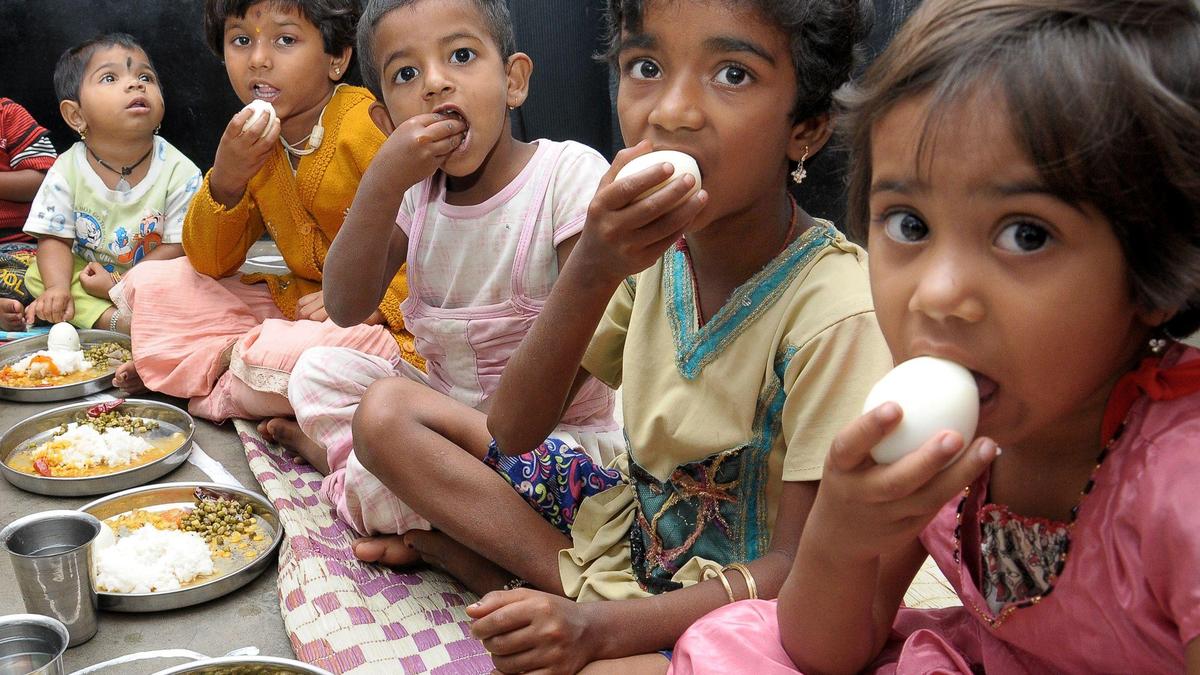
Going by Malli’s estimation, she probably was a teenager when she conceived first; and, possibly, a child bride when she got married. A household of seven, Malli’s family gets supplements, including eggs and pulses from the Anganwadi centre, facilitated by Central guidelines and State schemes to battle child malnutrition.
Activists of Jagruti Mahila Okkoota weigh children to assess malnutrition, in Belagavi district of Karnataka.
| Photo Credit:
File photo
In north Karnataka districts, child malnutrition – specifically undernutrition – has long remained a persistent and entrenched problem. More than a function of food scarcity, it is an outcome of overlapping issues – some of them inter-generational and some structural.
A vortex of deprivation
From a spate of hunger and malnutrition-related child deaths in Raichur that shook the State’s conscience in 2011 and 2012, things do seem to have improved in north Karnataka districts 15 years down the line.
As per NFHS-5 figures published in 2019-21, child stunting in the State stood at 35.4%. The latest figures from the State Government show that the stunting numbers have dropped to 31% as of January 2026.
However, climatic, socio-economic, and behavioural vulnerabilities come together to make it an ordeal for the region to escape the vortex of chronic deprivation.
While several government initiatives have been introduced to tackle the challenge, lacunae in administration and inconsistent political attention have slowed down the implementation momentum in the north Karnataka districts.
Information tabled in the legislature in Feburary 2026 shows the highest percentage of severely stunted children in Vijayapura, Yadgiri, Raichur, Kalaburagi, Koppal, Bidar, Ballari and Vijayanagara districts, ranging between 20% and 25%.
Tough terrain
The Kalyana Karnataka region – formerly known as Hyderabad-Karnataka – was under the rule of the Nizam of Hyderabad until 1948. In 2012, Article 371-J was inserted into the Constitution, granting special status to districts in the region with the aim of addressing the historical regional imbalances in the belt.
Given the semi-arid landscape that experiences erratic rainfall, the diet habits in these districts were shaped by climatic and livelihood stresses and chronic poverty.
“Much of the region falls within drought-prone, rain-fed agro-climatic zones where recurrent dry spells have adversely affected agricultural productivity, household income stability, and access to diverse diets,” says Khyati Tiwari, Nutrition Specialist, UNICEF.
Not a lot more than roti and dal made it to the plate. This lack of dietary diversity limited protein and micronutrient intake.
Activists of Jagruti Mahila Okkoota train women in making laddus and chikki to counter malnutrition among children in Belagavi district of Karnataka.
| Photo Credit:
File photo
Socio-economic disparities
Socio-economic disparities add another layer to the problem. The Kalyana Karnataka districts have consistently performed low in key human development indicators, such as female literacy, sanitation coverage, and maternal nutritional status.
“Poor maternal health and nutrition contribute significantly to adverse birth outcomes, particularly low birth weight, which increases vulnerability to early childhood wasting, and subsequently stunting,” notes Ms. Tiwari.
High levels of anaemia among women and children have remained a critical concern. According to NFHS-5 data, anaemia prevalence among pregnant women exceeds 85-90% in Raichur and Koppal districts. This results in inter-generational transmission of under-nutrition.
Vidya Patil, a grassroots activist associated with Rajya Mahila Okkuta, has been working with women across several districts in Kalyana Karnataka. According to her, endogamy, child marriage, and short-interval pregnancies are common in the region, leaving the mother and infant nutritionally vulnerable.
Behavioural elements and social vulnerabilities
Gaps also persist in child feeding practices. Delayed initiation of breastfeeding, inadequate complementary feeding after six months of age, and insufficient dietary diversity during early childhood compound the problem.
Widespread migration further complicates the issue. While government programmes have been introduced to track and monitor the health status of people, and provide them with nutritional supplements, seasonal migration from these districts to Bengaluru, Hyderabad, Pune, and other cities in search of jobs disrupts continuity of service delivery, and monitoring. Alcoholism within families is yet another villain.
Government intervention
To tackle the problem, from time to time, consecutive governments have attempted several initiatives. The ongoing ones include supply of supplementary nutritional food for children aged six months to six years, scheduled vaccination programmes for pregnant women and children under six years of age, health check-up for children enrolled in anganwadi centres, and Chiguru programme, which focuses on strengthening early childhood care and nutrition for children under six years by improving growth monitoring, caregiver counselling, and early identification of growth faltering through anganwadi platforms.
Officials have also been organising monthly nutrition camps to identify anaemic and undernourished women, where mothers are counselled on the importance of a balanced diet.
The government has collaborated with NGOs and civil society partners, such as UNICEF, and Sri Sathya Sai Annapoorna Trust, on specific initiatives anchored in ICDS.
A lower equilibrium
According to Ms. Tiwary, the expansion and scale-up of initiatives, such as Mathru Poorna, improved access to nutritious meals for pregnant and lactating women, increased regular attendance at anganwadi centres, and created sustained platforms for counselling on maternal nutrition, breastfeeding and childcare practices during the first 1,000 days.
“Similarly, strengthened growth monitoring and early identification under Chiguru enabled improved detection and follow-up of children at risk of malnutrition,” she adds.
Nalini Atul, Secretary of the Kalyana Karnataka Region Development Board, feels that egg distribution has particularly improved the overall nutrition statistics in the area.
“The scheme was started in Kalyana Karnataka before it was rolled out in the entire State. I believe it has helped with protein supplementation in children. When we are looking at this area, where poverty and migration are on a higher side, it is coming from a very low-level equilibrium. One egg may or may not make much of a difference in other part of Karnataka where you are at a different level of equilibrium. But the same will have a higher outcome in an area like this,” he says.
Staff serving food to children at an anganwadi.
| Photo Credit:
Photo for representation only
Measurable gains
Comparison between NFHS-4 (2015–16) and NFHS-5 (2019–21), as well as district-level trends indicate moderate improvements in child nutrition outcomes across Kalyana Karnataka districts.
Official data from the Integrated Child Development Services (ICDS) and the Poshan monitoring system indicate a decline in SAM (Severe Acute Malnutrition) and MAM (Moderate Acute Malnutrition) cases in Kalaburagi, Bidar and Yadgiri districts over the past two to three years.
In Kalaburagi district, SAM cases stood at 7,276 in 2023-24. The figure reportedly dropped sharply to 707 in 2024–25, and further to 553 in 2025-26.
MAM cases showed a mixed trend. The district recorded 10,304 MAM cases in 2023-24, which increased to 11,401 in 2024-25 before declining to 7,760 cases in 2025-26.
In Bidar district, official data shows that SAM cases decreased from 763 in 2024-25 to 118 in 2025-26. MAM cases also declined from 5,650 to 5,108 in the corresponding period.
In Yadgir, 608 out of the 1,04,246 children screened were found to be malnourished, with severe acute malnutrition (SAM) accounting for 0.48%, as of January 2025. Following intensified interventions, including improved egg supply and awareness campaigns, the number of malnourished children reportedly declined to 380.
‘Stats don’t always reflect ground realities’
Activists and field workers in the region, nevertheless, feel that progress has been slow. Alleging that officials are under pressure to show improved results, they say that statistical improvements don’t always reflect ground realities.
A social activist, speaking on condition of anonymity, cited a recent instance in Aland taluk of Kalaburagi district where dietary supplements were allegedly not supplied to several anganwadi centres in November and December 2025. Claiming that there have been several such instances, she also alleges instances of anganwadi workers and anganwadi association leaders swindling dietary supplements in large quantities.
The shift from the hot-cooked meal model under Mathru Poorna to Take-Home Rations (THR) has proved less effective. While Mathru Poorna functioned not only as a nutrition intervention, but also as a social platform, which enabled gathering of pregnant and lactating women, and thereby collective learning, exchange of information and peer support, THR disabled this community aspect.
Moreover, the ration meant to nourish the pregnant or lactating mother started getting split between family members.
Cultural barriers
Hafeez Ulha, State committee member of Bharath Gyan Vigyan Samithi, also points to cultural beliefs that hinder progress.
“Iron tablets distributed to pregnant women to combat anaemia are often not consumed. Many women believe that iron tablets will lead to excessive growth of the baby and complications during delivery, possibly requiring a Caesarean section,” Mr. Ulha says.
Veena Rao, a former bureaucrat currently heading the Auro Society for Public Nutrition, was brought back by the State Government in 2010 to shape the Karnataka Nutrition Mission. Despite promising results, the mission did not expand and was eventually subsumed within broader national and state nutrition programmes.
According to Ms. Rao, many women are not given additional food during pregnancy. “The reasoning is that it will keep the baby small, and facilitate an easy childbirth.”
While the baby needs to be fed complimentary food after six months of birth and the government’s answer to this is the supplements supplied through anganwadi centres (AWCs), in reality, it doesn’t work that way, she points out.
“Women resume work soon after pregnancy due to financial pressures, and the supplements are not always collected. A baseline survey we carried out in 2023 in Yadgir showed 20% of infants not getting any complementary food alongside breast milk until they were nearly two years of age,” says Ms. Rao, who has come across instances where diets consist of nothing but rice mixed with instant noodle masala.
She points to the market vacuum where baby food is not available at affordable rates for the poor.
Sub-standard supplement
Complaints about the low quality of supplementary nutrition, especially the health mix supplied to anganwadis, also surface.
“We collect the eggs and ration regularly from the anganwadi, but have stopped taking the nutritious powder mix. The quality is not good. We even complained to the anganwadi worker, but she seems to be helpless, and says that’s what they are receiving,” says Malli from Yadgir.
Several field workers report cases like that of Malli, where people either refuse to accept the powder, or mix it with fodder to feed cattle.
Implementation challenges
Ramanna N. Ganekal, leader of Kalyana Karnataka Vimochana Vedike in Deodurg taluk of Raichur district, says that while the national attention led to temporary improvements, sustained monitoring has weakened over time. Workload of anganawadi workers is another critical constraint.
Gopal Dabade, doctor and public health activist, feels that administration often takes on a feudal colour in many places.
“Elected MLAs and MPs become feudal landlords. I have witnessed panchayat meetings taking place in the house of the panchayat chairman in Bagalkot and Vijayapura districts,” he says.
Mr. Ganekal also points to practical barriers in accessing Nutrition Rehabilitation Centres (NRCs). Mothers of severely malnourished children are advised to stay for 15 days at the NRC at Raichur Institute of Medical Sciences, where they receive nutritional support and a compensation of ₹2,500.
“But many women cannot leave behind other children, or elderly family members. Even if compensation is provided, they hesitate to get admitted. As a result, children miss critical treatment,” he says.
Convergent efforts
Given the multi-sectoral nature of the problem, experts suggest that solving it requires sustained convergence across nutrition, health, water and sanitation, social protection, livelihoods, and women’s empowerment interventions, with intensified focus on the first 1,000 days of life and high-burden geographies.
Adequate financial allocation to the region, timely fund disbursement and effective utilisation are key. There have also been appeals for setting up a Centre for Human Development in northern Karnataka.
Pointing to the absence of region-specific interventions for northern Karnataka districts, Ms. Rao asks, “The stunting in children in Mysuru is 27% while the figure for Raichur is 39% as per NFHS-5. Do both the regions demand the same kind of interventions?”
Officials, however, insist that progress is happening, albeit slowly.
“There is increased focus from the State Government to solve nutritional issues, including anaemia among girls (15-19 years). Further, the State is investing money into the region through KKRDB and putting money in the hands of the poor. It has certainly helped to improve the quality of food,” says Mr. Atul.
He argues that traditional issues – administrative, social, political, economic and inter-generational – cannot be solved in a day, or in a year.
“Even five years is a very small time frame when it comes to improving education, nutrition and health indicators. It takes persistent and consistent effort, and quality staff. It’s not that the region has not done well, but it’s also that it has to pull a lot of weight and yet is expected to move at a fast pace.”
(With inputs from Kumar Buradikatti, Ravikumar Naraboli and Praveen B. Para)